India’s fuel story is moving again, and this time, car buyers have a real reason to pause before making a decision. After E20 rollout became the national focus, reports now suggest that the government has started early discussions on a possible E25 petrol shift—and that has triggered serious concern across the auto industry around testing, emissions, and long-term vehicle compatibility.
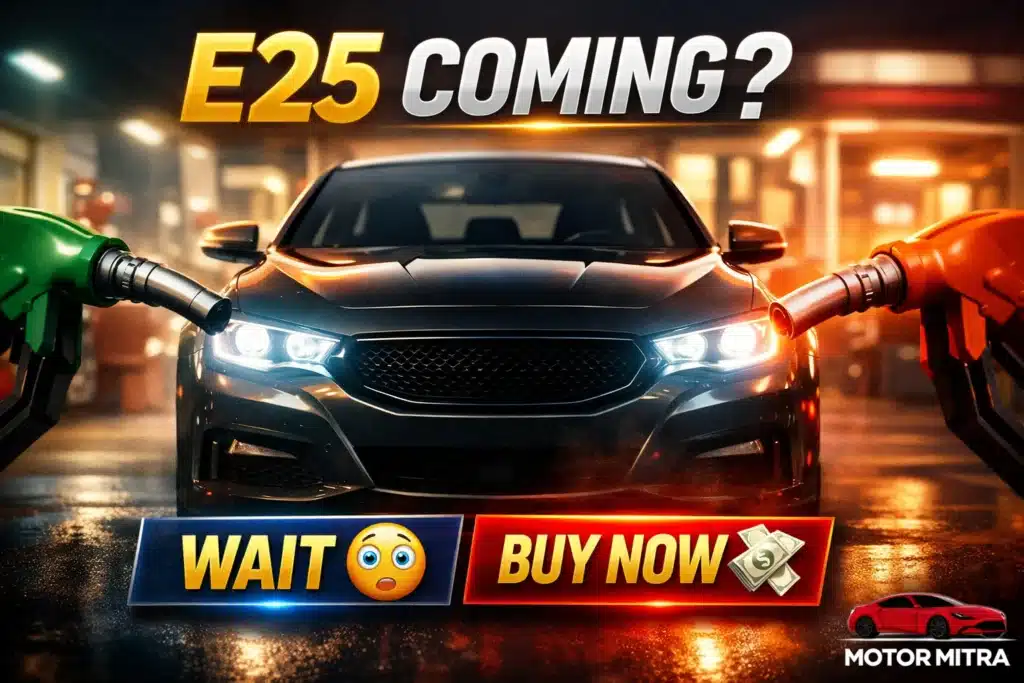
The big question is simple, but the impact could be serious: should you wait to buy a car because of E25? For most buyers, the answer is still no—but if you are planning to keep your car for many years, ignoring this shift could be a mistake. Because this is not just about fuel anymore, it is about mileage, warranty behaviour, and long-term ownership experience.
And this is exactly where most buyers get confused.
Why This Matters
- A fuel change like this can directly affect mileage and long-term ownership cost
- Cars you buy today are expected to last years, but fuel standards may change faster
- Making the right decision now can save you from future compatibility issues

Also Read:- 35 KMPL Swift Coming? Maruti’s Hidden Hybrid Tech Could Cut Your Fuel Cost Big Time!
What’s Happening
India has already moved into the E20 phase, and E20 petrol is now being rolled out more widely as part of the country’s ethanol-blending push. Now, according to recent reports, the Centre has begun early-stage talks with automakers on whether India should move further to E25, which would mean petrol blended with 25% ethanol.
The reason behind this shift is clear and strategic: India wants to reduce dependence on imported crude oil and move toward domestically produced ethanol. At a policy level, this makes strong sense. But for the automotive ecosystem, it opens up a new layer of complexity that cannot be ignored. Because once the fuel changes, everything connected to the engine is forced to adapt.
Why Automakers Are Cautious
The industry’s concern is not just about a slight drop in mileage. Reports indicate that automakers are more worried about certification timelines, emission testing, and potential liability issues if fuel standards evolve after a vehicle has already been engineered and approved for E20.
In simple terms, a car that is perfectly compliant today may behave differently tomorrow if the fuel composition itself changes.
And this is where things start getting serious.
It is not that modern cars cannot handle ethanol blends at all. They can. But the industry wants proper validation, extended testing cycles, and a clearly defined transition roadmap before any new mandate is pushed forward. Without that clarity, the risk shifts from policy to your car—and eventually to you.
What It Means For Buyers
If you are planning to buy a car in 2026, the most important point to understand is that E20 is already the current direction, and most newer cars are being designed around it. Reports also suggest that vehicles manufactured from around 2023 to 2025 onward are already engineered with E20 compatibility in mind, which means the immediate risk for new buyers remains limited. But here’s the part most buyers don’t see coming.
Older vehicles may experience a noticeable drop in mileage and could see faster wear on certain rubber or plastic components when exposed to higher ethanol blends over time. So if you are driving an older car and planning to keep it longer, the impact of future fuel changes may be more visible than expected.

This is not an immediate problem—but it is not something to ignore either.
Should You Wait To Buy?
But the biggest mistake is not choosing the wrong car—it’s choosing at the wrong time.
For most buyers, waiting purely because of E25 may sound smart, but it is not always practical. The biggest reason is that E25 is still at a discussion stage, and there is no confirmed timeline suggesting an immediate shift across the market. If you need a car right now, choosing a modern E20-compliant vehicle remains a safe and logical decision.
But if you are someone who keeps a car for 8 to 10 years and wants maximum future-proofing, this is where patience can become a strategic advantage. Because the real decision is not about today—it is about how your car performs years later.
The smarter approach is simple: choose a vehicle that clearly supports E20, verify the manufacturer’s fuel recommendations, and avoid making rushed decisions based on early policy noise.
Also Read:- 2026 Scooter Tsunami: 20+ Launches Set to Crush Fuel Bills & Electrify Streets
E25 is an important signal of where India’s fuel policy could be heading next, but it is not a reason for most buyers to stop their plans today. The smarter move is to focus on what is confirmed, not what is still evolving.
Buy a car that is already aligned with current fuel standards, stay informed, and keep an eye on how this transition develops. Because in a fuel shift like this, the mistake is not buying early—the mistake is buying blind.
Also Read:-
Toyota Mirai Begins Hydrogen Fuel-Cell Testing in India 2025| Clean Mobility Push
Maruti Suzuki Fronx Flex-Fuel Debuts | India Launch 2026
Top 5 Best Mileage Bikes in India 2025: Fuel Efficient Kings