By MotorMitra Editorial Published: April 24, 2026
How Maruti Suzuki Shattered All Records with 23.47 Lakh Units in FY26
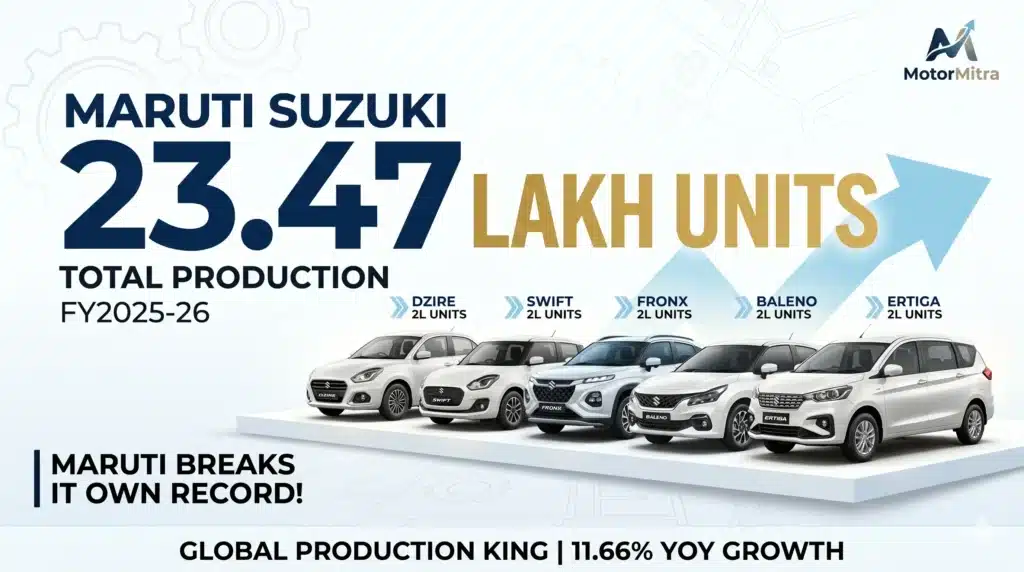
The Indian automotive landscape has witnessed several milestones over the decades, but few are as seismic as the one just announced by Maruti Suzuki India Limited (MSIL). As the curtains draw on Financial Year 2025-26, the nation’s largest carmaker has not just beaten the competition—it has obliterated its own previous records. With a monumental production figure of 23.47 lakh units, Maruti Suzuki has firmly established India as the undisputed epicenter of the global small and mid-size car industry.
For the team at MotorMitra, this isn’t just a number; it is a narrative of industrial prowess, supply chain resilience, and an unwavering pulse on the heartbeat of the Indian middle class.
Also Read: Kia Syros MY26 Update: Prices Cut, 3 New Trims Added, Styling Tweaked
A Global Benchmark: Surpassing the Parent Company
What makes the figure of 23.47 lakh units truly staggering is its global context. In the world of manufacturing, very few individual companies produce at this scale within a single country. With this achievement, Maruti Suzuki has officially topped the charts across every manufacturing facility under the Suzuki Motor Corporation (SMC) umbrella globally.
For the first time, the Indian subsidiary isn’t just a significant part of the Japanese giant; it is the leading engine driving the brand’s global success. This surge signifies that the “Make in India” initiative has moved beyond a slogan to become a high-output reality that sets international standards for efficiency and volume.
The ‘Big Five’: The Engines of Growth
While many manufacturers struggle to find even one “blockbuster” model, Maruti Suzuki’s FY26 success was built on the shoulders of five distinct giants. In an unprecedented feat, five different models individually crossed the 2-lakh unit production mark this year.


- The All-New Dzire: Continuing its reign as the king of the sedan segment, the Dzire proved that the three-box silhouette still holds immense aspirational value in India.
- The Swift: The hatchback that refused to grow old. Despite being in the market for decades across generations, the Swift remains the go-to choice for the youth.
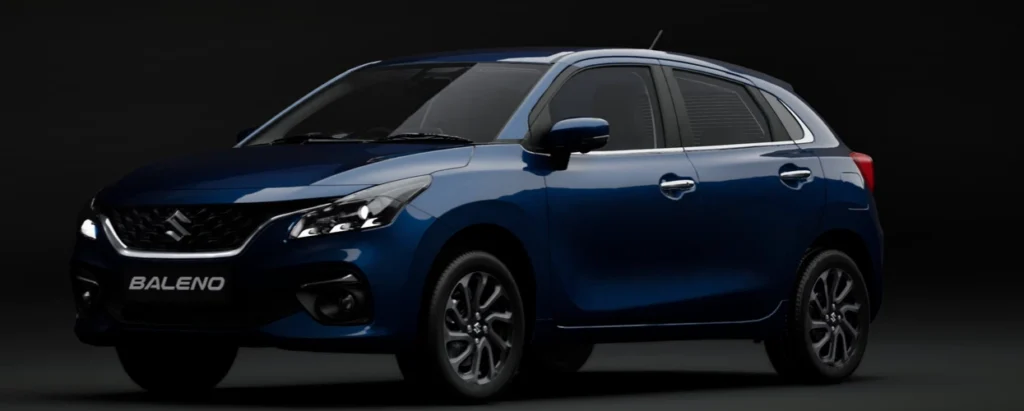
- The Baleno: Dominating the premium hatchback space, the Baleno’s sophisticated tech and Nexa appeal kept the assembly lines humming 24/7.
- The Fronx: Perhaps the biggest surprise of the last two years, this SUV-styled crossover has captured the imagination of the urban buyer, bridging the gap between a hatch and a full-blown SUV.
- The Ertiga: As Indian families look for value-driven mobility, the Ertiga has become the backbone of the MPV segment, serving both personal and commercial fleets with equal ease.
The diversity of this “Big Five”—ranging from a sedan and a premium hatch to an MPV and a compact SUV—highlights Maruti’s “no-gap” strategy. By ensuring they have a winner in every sub-segment under Rs. 15 lakh, they have insulated themselves against shifts in consumer taste.
Analyzing the 11.66% Leap
The growth trajectory over the last four years reveals a fascinating trend. In FY23, production stood at 19.22 lakh units. This rose to 19.84 lakh in FY24 and breached the 2-million mark in FY25 with 21.02 lakh units. However, the jump to 23.47 lakh units in FY26 represents an 11.66% year-on-year growth.
This is the steepest growth curve seen in the post-pandemic era. It suggests that while the industry faced “fatigue” in some segments, Maruti Suzuki tapped into a new vein of demand. Analysts attribute this to the company’s aggressive refreshment of its portfolio and its rapid expansion into the CNG and Hybrid spaces, which have become the preferred choice for fuel-conscious Indians.
Infrastructure: Building the Future 40 Lakh Units
You cannot produce 2.3 million cars without a world-class manufacturing backbone. Currently, MSIL operates four massive hubs: Gurugram, Manesar, and Kharkhoda in Haryana, and the Hansalpur facility in Gujarat. Together, these plants have a combined installed capacity of roughly 24 lakh units.
With production hitting 23.47 lakh, the company is essentially operating at 97% capacity utilization—a dream figure for any industrialist. To ensure this momentum doesn’t hit a ceiling, Maruti Suzuki recently locked in land for a fifth facility at Khoraj Industrial Estate in Sanand, Gujarat. Once this new plant goes live, it will add another 10 lakh units to the annual capacity, bringing the total vision to a staggering 40 lakh (4 million) units per year.
The Policy Tailwind: GST 2.0 and Beyond
In his official statement, Hisashi Takeuchi, MD & CEO of Maruti Suzuki India Limited, highlighted that this was not a solo effort. He credited the current government’s policy environment, specifically citing the rollout of GST 2.0, as a catalyst that strengthened market confidence.
The simplified tax structures and improved logistics under the new policy framework allowed Maruti to streamline its massive vendor base of over 400+ suppliers, ensuring that parts reached the assembly line just-in-time, every time.
For the average car buyer, Maruti’s record-breaking production is good news. High production volume typically leads to:
- Reduced Waiting Periods: Even for high-demand models like the Fronx and Dzire.
- Better Serviceability: More cars on the road mean a more robust network of spare parts and service centers.
- Technological Trickle-down: As Maruti scales, the cost of high-end features like ADAS, 360-degree cameras, and Hybrid drivetrains becomes more affordable for the mass market.
Maruti Suzuki has proven that while the “EV revolution” is on the horizon, the present belongs to an efficient mix of internal combustion, CNG, and Hybrid technology. As they eye the 4-million mark, one thing is certain: the Indian road will continue to be dominated by the ‘S’ badge for a long time to come.
Stay tuned to MotorMitra for more exclusive deep dives into the world of Indian automotive excellence!