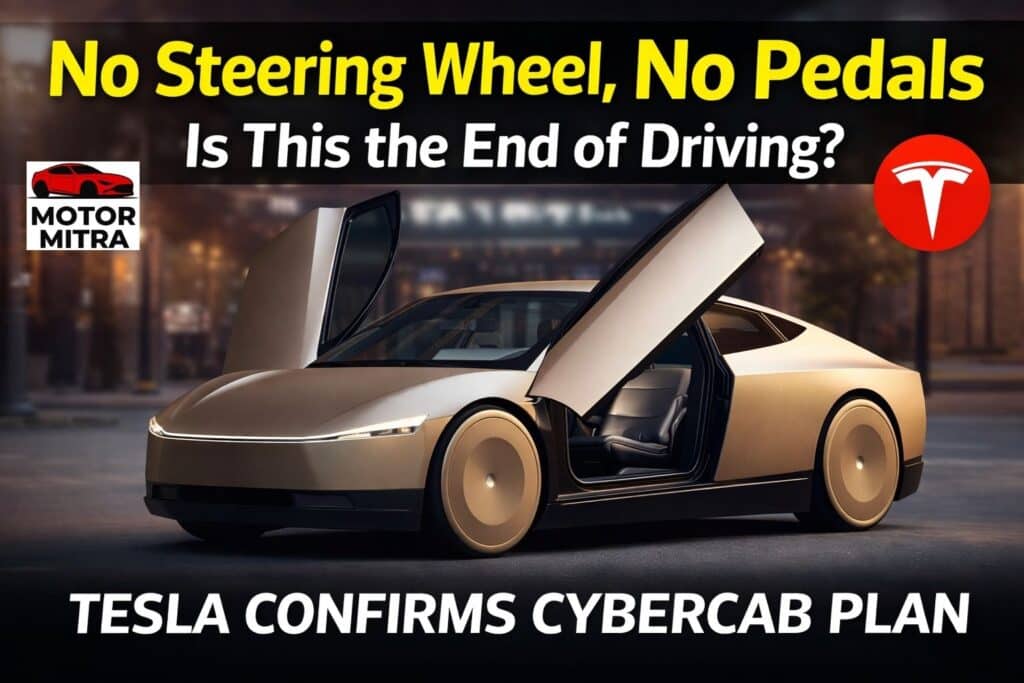
Tesla has taken a decisive step toward a fully autonomous future after CEO Elon Musk confirmed that production of the company’s dedicated robotaxi, known as the Cybercab, will begin in the second quarter of 2026. The announcement signals one of the most radical shifts yet in the global automotive industry, as the Cybercab is designed to operate without a steering wheel, pedals, or any traditional driver controls.
Unlike existing Tesla models that still allow human intervention, the Cybercab is being developed exclusively for autonomous operation. According to Musk, this will be the first Tesla vehicle built specifically for unsupervised self-driving, rather than adapting autonomy to a conventional car platform. The vehicle is intended to serve as the backbone of Tesla’s long-promised robotaxi vision.
Production of the Cybercab is expected to take place at Tesla’s Giga Texas facility, where the company plans to scale manufacturing for large-volume output. By centralising production at one of its most advanced plants, Tesla aims to optimise costs and streamline deployment as it prepares for what could be a global rollout of autonomous ride-hailing vehicles in the coming years.
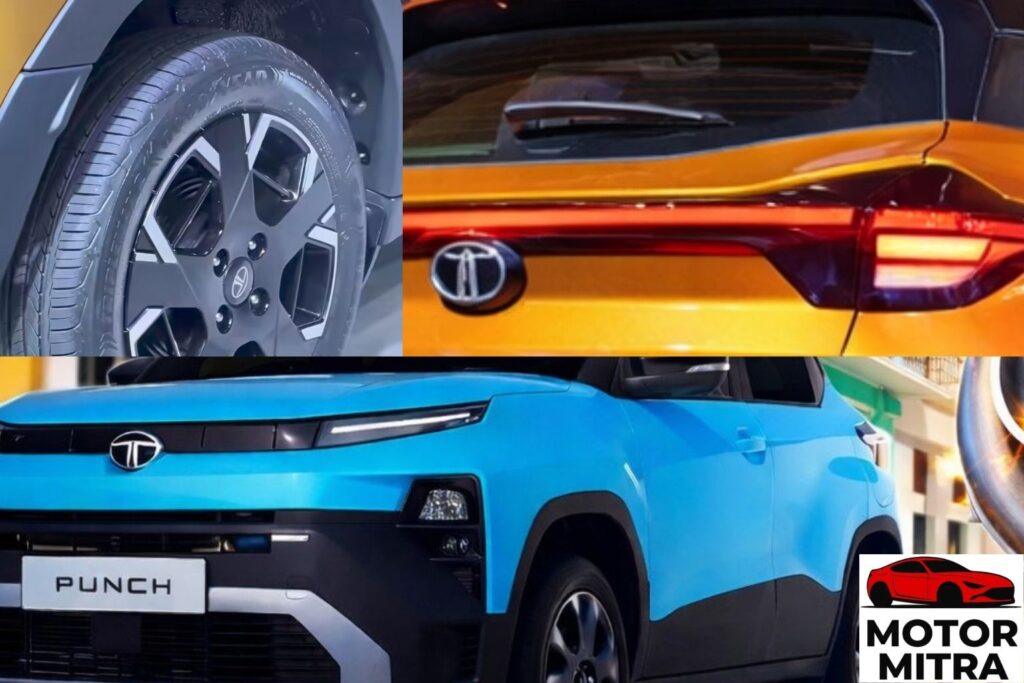
Also Read – First in Its Class? Tata Punch Brings AMT Convenience to CNG SUVs—A Small Change with Big Impact
The Cybercab’s design philosophy represents a fundamental break from a century of automotive norms. With no steering wheel or pedals, passengers will have no ability to manually control the vehicle. Instead, the car will rely entirely on Tesla’s artificial intelligence software, camera-based perception systems, and neural networks trained on vast amounts of real-world driving data. Tesla continues to back its vision-only approach, rejecting lidar-based systems used by some rivals, and argues that this strategy better mirrors how humans perceive and navigate roads.
Elon Musk has consistently maintained that human drivers are responsible for the overwhelming majority of road accidents. By removing the driver altogether, Tesla believes the Cybercab could eventually deliver safer, more predictable transportation. The company also expects continuous over-the-air software updates to improve performance and safety over time, allowing the vehicle to learn and adapt long after it leaves the factory.

Also Read – Which Kia Cars Sold the Most in December 2025? Sonet, Seltos and Carens Break Down
However, while the production timeline is now clearer, large-scale deployment remains uncertain. Regulatory approval and safety validation will play a decisive role in determining how quickly the Cybercab can be introduced on public roads. Autonomous vehicles without manual controls raise complex legal questions around liability, insurance, and compliance with traffic laws, many of which were written with human drivers in mind. Musk has acknowledged that regulatory processes could slow the pace of real-world adoption, even if the technology itself is ready.
The Cybercab is central to Tesla’s broader robotaxi ambitions. The company envisions a future in which fleets of autonomous vehicles operate around the clock, offering ride-hailing services at lower costs than human-driven taxis. In the longer term, Tesla has suggested that owners could allow their vehicles to join such a network when not in personal use, generating passive income. The Cybercab, built for high utilisation and minimal human involvement, is designed specifically for this model.

Also Read – A Historic Surge in Gold and Silver Prices: Reshaping Investment Dynamics in 2026
For markets such as India, the Cybercab remains a distant prospect for now. Autonomous vehicle regulations, infrastructure readiness, and public acceptance are still evolving. Nevertheless, Tesla’s confirmation of a production timeline sends a strong signal about the direction in which global mobility is heading. Technologies that appear experimental today often become mainstream faster than expected once regulatory frameworks catch up.
As Tesla moves closer to putting a fully driverless vehicle into production, the Cybercab stands as one of the most ambitious automotive projects of the decade. Whether it ultimately reshapes urban transport or faces prolonged regulatory delays, its arrival marks a turning point in the conversation around autonomy. The question is no longer whether cars can drive themselves, but how soon societies will be ready to let them do so.
For more such updates and latest news on cars and bikes stay connected to motormitra.in
Thank you ..