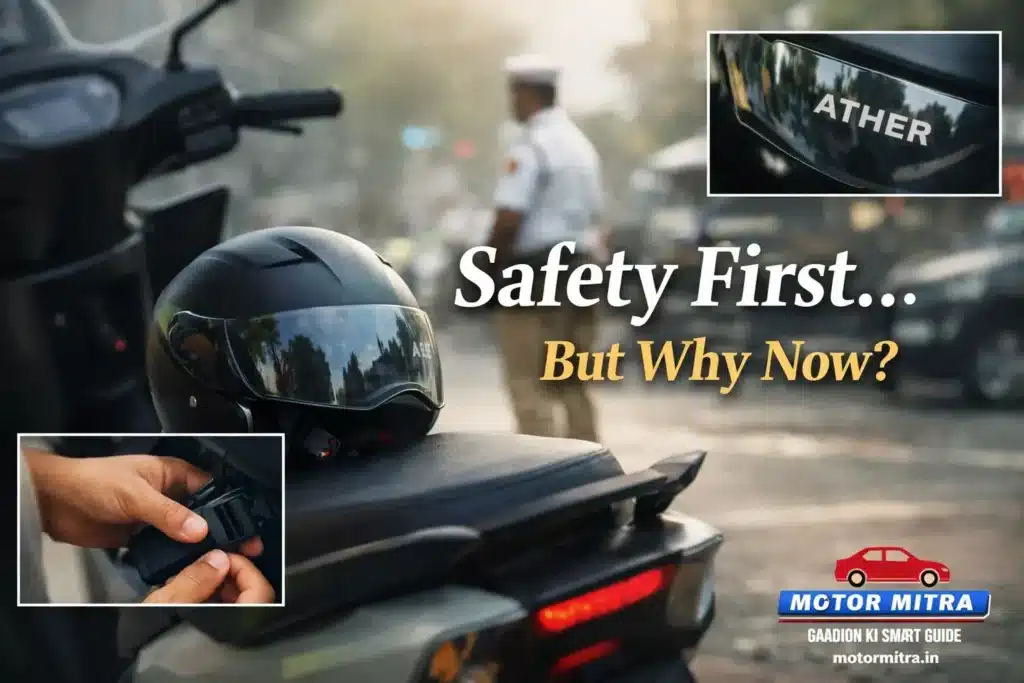
This isn’t just another brand activity or CSR headline. Ather Energy stepping into child helmet safety—alongside city traffic authorities—signals a much deeper shift in how EV companies want to be seen in India. At a time when road safety violations involving children are increasingly under scrutiny, Ather’s move positions the brand beyond products and into public responsibility.
What looks like a simple helmet distribution drive is, in reality, a well-timed message—to parents, policymakers, and the broader mobility ecosystem.
Why This Isn’t a Typical CSR Move
CSR campaigns usually sit quietly on brand blogs and annual reports. This one didn’t. It was public, partnered with authorities, and focused on a subject that triggers strong parental emotion.
By associating itself with child rider safety, Ather stepped into a space that:
- Is socially sensitive
- Has regulatory relevance
- Directly affects urban families
That combination makes this initiative far more strategic than it appears on the surface.
Also Read:- Ather 450 Apex: 3 Reasons It Makes Sense— And 2 Big Reasons It Might Not
The Importance of the Bengaluru Police Partnership
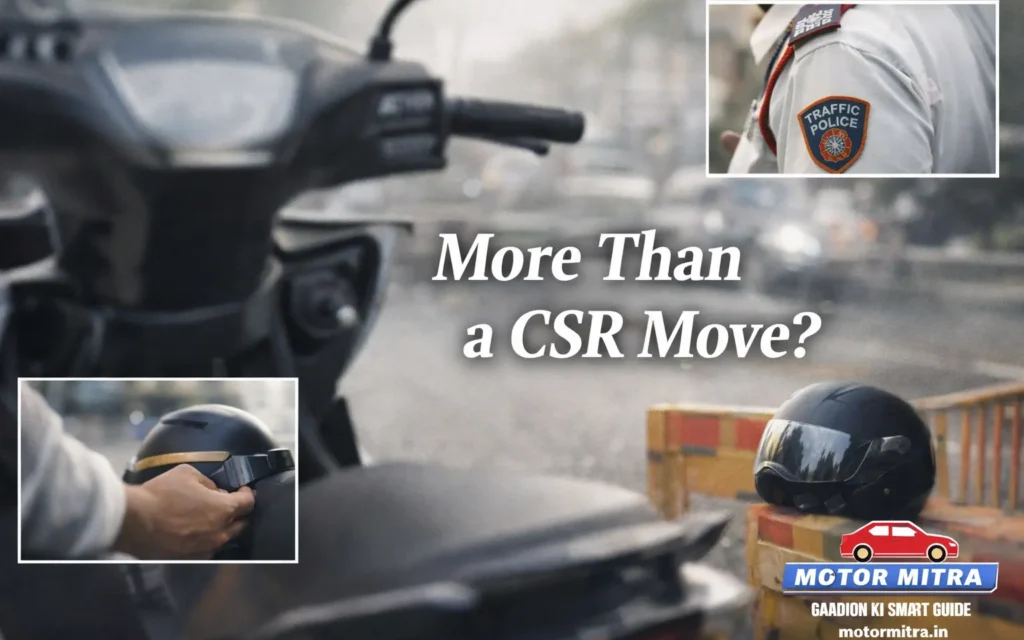
The involvement of Bengaluru Traffic Police changes the tone completely. This is no longer a brand speaking about safety—it’s a brand acting with enforcement authorities.
Such partnerships do three things simultaneously:
- Add legitimacy to the message
- Push behavioural change, not just awareness
- Signal alignment with future enforcement trends
For a fast-growing EV brand, being seen on the same side as traffic authorities is a long-term credibility play.
Why Child Helmet Safety, Specifically?
India’s helmet compliance conversation usually revolves around adult riders. Child helmet usage remains inconsistent, loosely enforced, and often ignored.
That’s precisely why this focus matters.
Targeting child safety:
- Appeals directly to parents’ responsibility
- Avoids political or policy controversy
- Creates moral pressure rather than legal pressure
From a brand perspective, it’s one of the strongest emotional touchpoints possible—especially in urban EV markets.
Also Read:- Ather Electric Scooters Set to Get Costlier From January 1, 2026
The EV Angle Most People Are Missing
This initiative isn’t just about safety—it’s also about normalising EVs as everyday family vehicles.
Electric scooters are often positioned as:
- Tech-forward
- Youth-oriented
- Performance-focused
By anchoring its message in child safety, Ather subtly shifts perception toward:
- Family trust
- Responsibility
- Maturity as a mobility brand
That repositioning matters as EV adoption moves beyond early adopters to mainstream households.
Why Timing Makes This Move More Powerful
This push comes at a moment when:
- Cities are tightening helmet enforcement
- Public discourse on road safety is rising
- EV brands are competing for legitimacy, not just sales
By acting early, Ather places itself ahead of the curve, rather than reacting to regulation later.
This is how brands quietly future-proof themselves—by aligning with where regulation and public sentiment are likely headed, not where they already are.
Also Read:- EV Scooter War Explodes! Yamaha, Ather & Bajaj Prepare Game-Changing Launches In 2026
What This Signals to Other EV Brands
Ather’s move raises the bar.
If EV companies want to be taken seriously as long-term mobility players, product launches alone won’t be enough. Safety, responsibility, and public participation will increasingly define brand strength.
Other EV brands now face a quiet question:
- Do they stay product-centric?
- Or do they also step into civic responsibility spaces?
In that sense, this initiative could influence industry behaviour, not just consumer perception.
Is This About Image—or Impact?
Sceptics may call this a branding exercise, and that criticism isn’t entirely unfair. But impact and image are not mutually exclusive.
If:
- Children wear helmets more consistently
- Parents become more safety-conscious
- Authorities get stronger public support
Then the outcome matters, regardless of brand motivation.
And for Ather, impact-driven branding may turn out to be the most effective kind.
The Bigger Picture Taking Shape
This helmet safety push hints at how EV brands may evolve in India—less as hardware sellers, more as mobility stakeholders.
As electric two-wheelers become mainstream, expectations will change. Brands won’t just be judged on range or charging speed, but on how responsibly they integrate into public life.
That may be the real story unfolding here.
Official information about Ather’s initiatives and brand philosophy is available via Ather Energy’s website (https://www.atherenergy.com). Broader road safety regulations and enforcement context can be tracked through the Ministry of Road Transport and Highways (https://morth.nic.in).
What looks like a simple safety drive today may well be remembered as a moment when EV branding in India quietly changed direction. And that’s why Ather’s child helmet push is, indeed, bigger than it looks.
For more such updates and latest news on cars and bikes stay connected to motormitra.in
Thank you ..
auto.motormitra
Latest Auto News and Trends
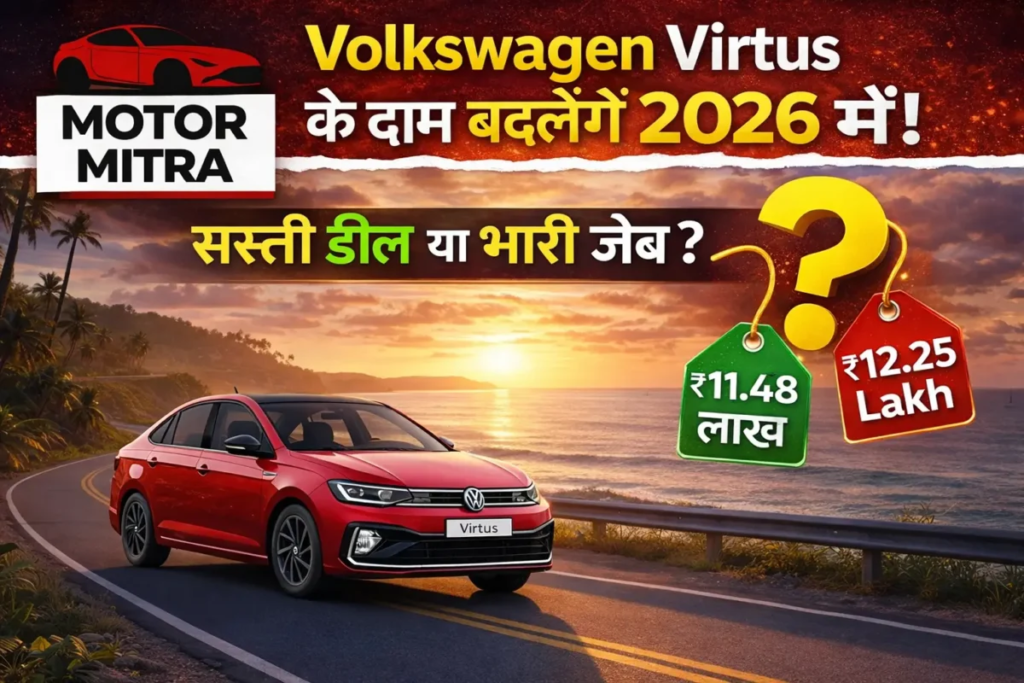
Also Read:- 2026 में Volkswagen Virtus खरीदना हुआ आसान या मुश्किल? जानें नई कीमतें और वेरिएंट्स में हुए बड़े बदलाव!
ऐसी ही और ताज़ा खबरों और अपडेट्स के लिए जुड़े रहें Auto.MotorMitra के साथ।
धन्यवाद!
Times Mitra
Latest bytes of news.

Also Read:- Gold and Silver Prices Crash in India| November 2025 Update
For more such updates and latest news on cars and bikes stay connected to times.motormitra.in
Thank you ..