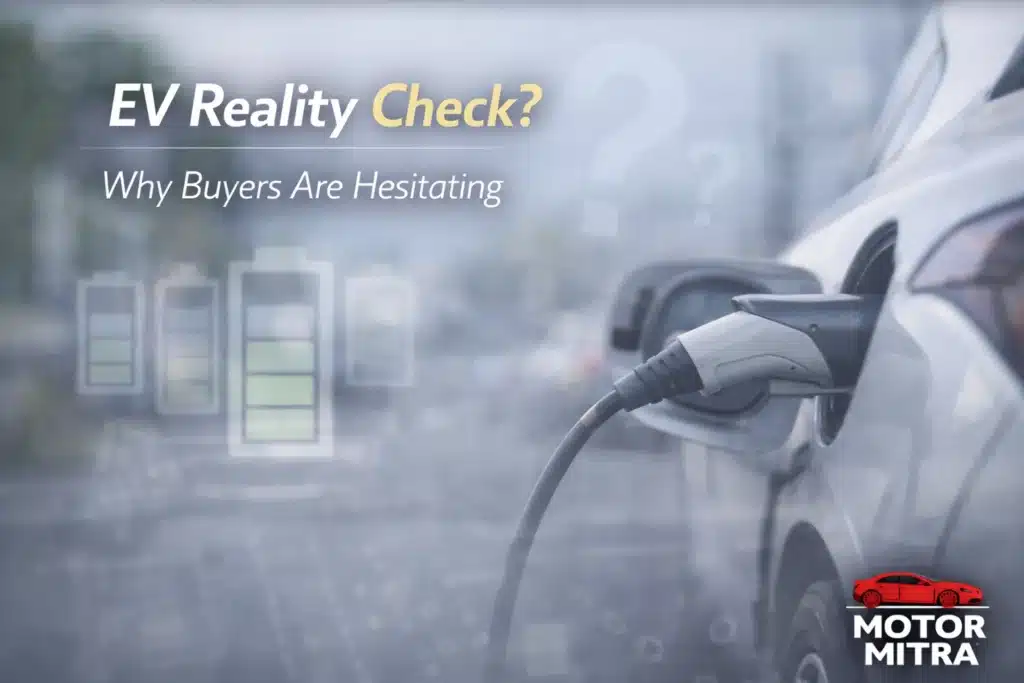
Not long ago, India’s electric vehicle story felt unstoppable. New launches, government incentives, startup buzz, and global narratives combined to create a sense of inevitability. EVs were no longer a question of if, but when. Yet, beneath the surface, something has started to shift. Buyers aren’t rejecting EVs outright — but many are quietly stepping back, reassessing the decision rather than rushing in.
This isn’t a collapse. It’s a pause. And that pause says a lot.
Why This Matters
- EV adoption depends as much on buyer confidence as on policy push
- Quiet hesitation can slow momentum faster than loud opposition
- Automakers are watching buyer behaviour more closely than headlines
The Gap Between Interest and Commitment
Interest in EVs remains high. Awareness is widespread, test drives are happening, and curiosity hasn’t faded. But interest isn’t translating into the same level of purchase urgency it once did.
For many buyers, the excitement phase is over. What’s left is practical evaluation — and that’s where doubts are surfacing. Charging access, real-world range, long-term battery health, and resale value are no longer abstract concerns. They are being actively questioned.
When buyers start asking tougher questions, decisions slow down.
Also Read:- EVs or Hybrids? Indian Car Buyers Are Making a Clear Choice
Charging Reality Is Still Uneven
Infrastructure remains the single biggest friction point. While charging networks have improved in major cities, reliability and coverage are still inconsistent. Apartment dwellers, frequent highway users, and buyers outside metro areas remain unsure if EV ownership will fit their routines.
This uncertainty doesn’t always stop a purchase — but it often delays it. Buyers who might have switched earlier are now waiting, watching how the ecosystem evolves.
The Cost Equation Isn’t Clear Enough
EVs promise lower running costs, but the upfront price gap continues to influence decisions. Incentives help, but many buyers still struggle to justify the premium, especially when resale value remains uncertain.
For a market that plans ownership in five-to-eight-year cycles, clarity on long-term value is critical. Without it, hesitation grows. Buyers don’t want to feel like early adopters carrying hidden risks.
Hybrids and Efficient ICE Are Filling the Comfort Gap
As EV momentum slows, hybrids and efficient petrol cars are quietly benefiting. They offer better fuel efficiency, familiar ownership patterns, and none of the infrastructure anxiety.
This doesn’t mean buyers are abandoning electrification. It means they are choosing incremental change over radical change. Hybrids feel like a safer bridge, especially for families and first-time upgraders.
Also Read:- Can Methanol Hybrids Outshine EVs? Inside the Tech Auto Giants Are Quietly Betting On
Automakers Are Adjusting, Not Retreating
Interestingly, manufacturers seem to recognise this shift. While EV plans remain intact, timelines are being recalibrated. More hybrid options are appearing, and EV launches are becoming more targeted rather than mass-focused.
This isn’t a step back from EVs — it’s a strategic pause to align products with buyer readiness.
Trust Takes Longer Than Technology
Technology can move fast. Trust does not. For many Indian buyers, a car is the second-largest purchase after a home. Reliability, predictability, and peace of mind matter more than innovation alone.
EVs are still building that trust. Every satisfied owner helps, but every unresolved concern slows broader acceptance.
Also Read:- Tata Bets Big On SUVs In 2026: Three EVs And One ICE Launch Planned
The Silence Is the Signal
What makes this phase notable is its quietness. There’s no loud backlash against EVs. No rejection. Just delayed decisions, longer research cycles, and cautious optimism.
In consumer behaviour, silence often signals uncertainty — and uncertainty is where momentum softens.
This Isn’t the End of the EV Story
It’s important to be clear: EV adoption in India isn’t failing. It’s stabilising. Early hype has given way to realism, and that transition is natural in any technology cycle.
As charging infrastructure improves, costs fall, and resale markets mature, confidence will return. But it will return gradually, not explosively.
The Bigger Picture
India’s EV journey is moving from promise to proof. Buyers now want evidence — not projections. They want to see how EVs perform not just in headlines, but in everyday life.
Until that proof feels widespread, hesitation will remain.
Bottom line:
Something does feel off in India’s EV story — not because EVs lack potential, but because buyers are taking a step back to reassess. This pause isn’t a rejection; it’s a reality check. And how the industry responds to this moment may shape the next phase of India’s transition more than any incentive or announcement.
For more such updates and latest news on cars and bikes stay connected to motormitra.in
Thank you ..
auto.motormitra
Latest Auto News and Trends

Also Read:- Hyundai Creta ने रचा इतिहास: 2025 में 2 लाख+ बिक्री के साथ बना अजेय SUV किंग!
ऐसी ही और ताज़ा खबरों और अपडेट्स के लिए जुड़े रहें Auto.MotorMitra के साथ।
धन्यवाद!
Times Mitra
Latest bytes of news.

Also Read:- Samsung CES 2026- Next-Gen AI Innovation to Break Cover
For more such updates and latest news on cars and bikes stay connected to times.motormitra.in
Thank you ..