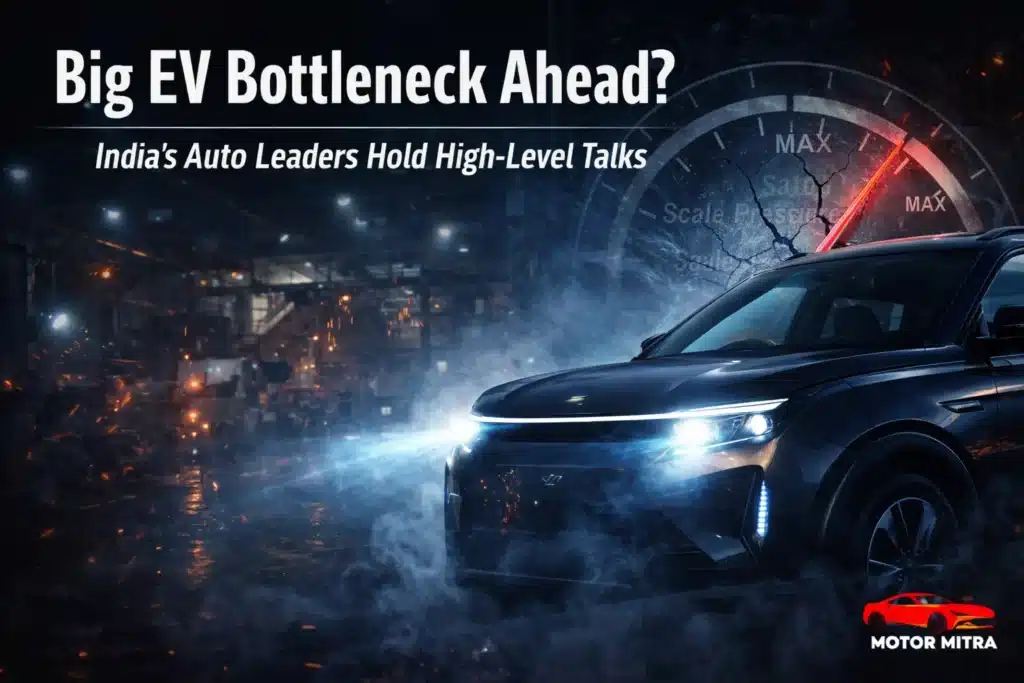
India’s EV momentum could soon face its first serious stress test. As demand rises across passenger cars, buses and commercial fleets, the ecosystem’s ability to scale without friction is now under scrutiny.
Industry leaders have convened high-level talks not to slow growth — but to prevent emerging bottlenecks from disrupting the next phase of expansion.
Why This Matters
- Rapid Electric Vehicle adoption is testing production capacity and supply chains.
- Charging infrastructure expansion must match vehicle growth.
- Industry-government coordination may determine how smoothly India scales.
This is not a slowdown narrative — it is a scale-management challenge.
Is Electric Vehicle Growth Outrunning Infrastructure Readiness?
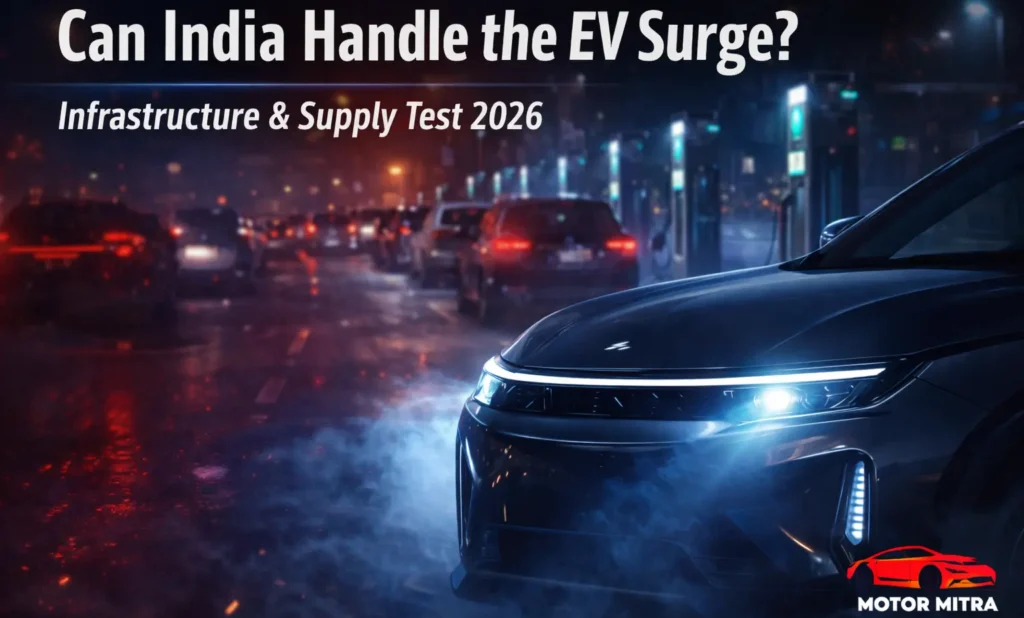
India has witnessed steady growth in electric vehicle adoption, particularly in urban centers and public transport electrification. However, scaling production and charging infrastructure in parallel remains complex.
Electric Vehicle manufacturing requires:
- Battery supply consistency
- Semiconductor reliability
- Vendor ecosystem coordination
- Skilled workforce expansion
Any gap in these layers can delay deliveries or inflate operational costs.
With major OEMs racing to expand Electric Vehicle portfolios, any delay in infrastructure alignment could quickly translate into competitive imbalance across the sector.
Also Read:- Mahindra EV Owners No Longer Need Service Centers — Big Relief in Delhi NCR?
What Are the Key Bottleneck Risks?
- Battery Supply Chain Sensitivity
Global battery raw material dependencies remain volatile. If input costs fluctuate, EV pricing flexibility narrows. - Charging Infrastructure Alignment
Urban charging density must expand proportionately with vehicle sales to maintain buyer confidence. - Policy & Incentive Continuity
Stability in subsidies and regulatory frameworks ensures long-term investment confidence. - Component Localization
Higher localization can reduce dependency but requires capital and time.
If even one link weakens, delivery timelines, fleet economics and consumer confidence could feel the strain.
Why Industry Leaders Are Stepping In Now
The Electric Vehicle conversation has shifted from “adoption encouragement” to “mass scaling execution.” That transition demands coordination between:
- OEMs
- Battery manufacturers
- Charging network providers
- Government agencies
High-level talks signal urgency without panic. The goal is to prevent friction before it becomes visible at the consumer level.
When production, infrastructure and policy operate in harmony, adoption accelerates sustainably. If coordination falters, growth curves can flatten.
Could Commercial Electric Vehicles Face the Highest Pressure?
Commercial fleets and electric buses scale differently from passenger Electric Vehicles. Large fleet deployments demand charging depots, predictable uptime and service network depth.
If deployment outpaces backend readiness, operators may hesitate in future tenders.
This makes early-stage scale alignment crucial.
Passenger Electric Vehicle growth depends on confidence. Commercial EV growth depends on reliability economics.
Also Read:- Mahindra Expands SUV & EV Production — Will 2026 Buyers Finally Get Faster Deliveries?
Is This a Temporary Hurdle — Or Structural Risk?
India’s Electric Vehicle market remains in expansion mode. The current conversations appear precautionary rather than reactive.
However, history shows that fast-growing sectors often encounter scale friction. The difference between sustained growth and plateau lies in execution quality.
If industry collaboration resolves supply chain tightness and infrastructure coordination gaps, the Electric Vehicle growth curve may remain upward.
If scaling mismatches intensify, momentum could moderate temporarily.
Quick Snapshot
| Factor | Current Situation |
|---|---|
| Electric Vehicle Adoption | Growing steadily |
| Production Capacity | Expanding, but pressure rising |
| Charging Network | Scaling gradually |
| Policy Support | Active but evolving |
Will the EV Momentum Hold in 2026?
If India’s auto leaders translate dialogue into coordinated action, the Electric Vehicle ecosystem could strengthen at precisely the right time.
If execution lags behind ambition, bottlenecks may emerge quietly before surfacing in delivery timelines or infrastructure strain.
If coordination translates into faster localization, infrastructure density and supply stability, India’s EV growth curve could strengthen further in 2026. If alignment falters, friction may surface quietly before becoming visible in delivery delays or infrastructure gaps. The difference between acceleration and bottleneck will be decided by execution speed.
Stay tuned to Motor Mitra as further policy clarity and official industry updates unfold.
For more such updates and latest news on cars and bikes stay connected to motormitra.in
Thank you ..
auto.motormitra
Latest Auto News and Trends

Also Read:- जनवरी 2026 Honda Discounts: City, Amaze और Elevate पर ₹1.76 लाख तक की भारी छूट
ऐसी ही और ताज़ा खबरों और अपडेट्स के लिए जुड़े रहें Auto.MotorMitra के साथ।
धन्यवाद!
Times Mitra
Latest bytes of news.

Also Read:- Samsung CES 2026- Next-Gen AI Innovation to Break Cover
For more such updates and latest news on cars and bikes stay connected to times.motormitra.in
Thank you ..