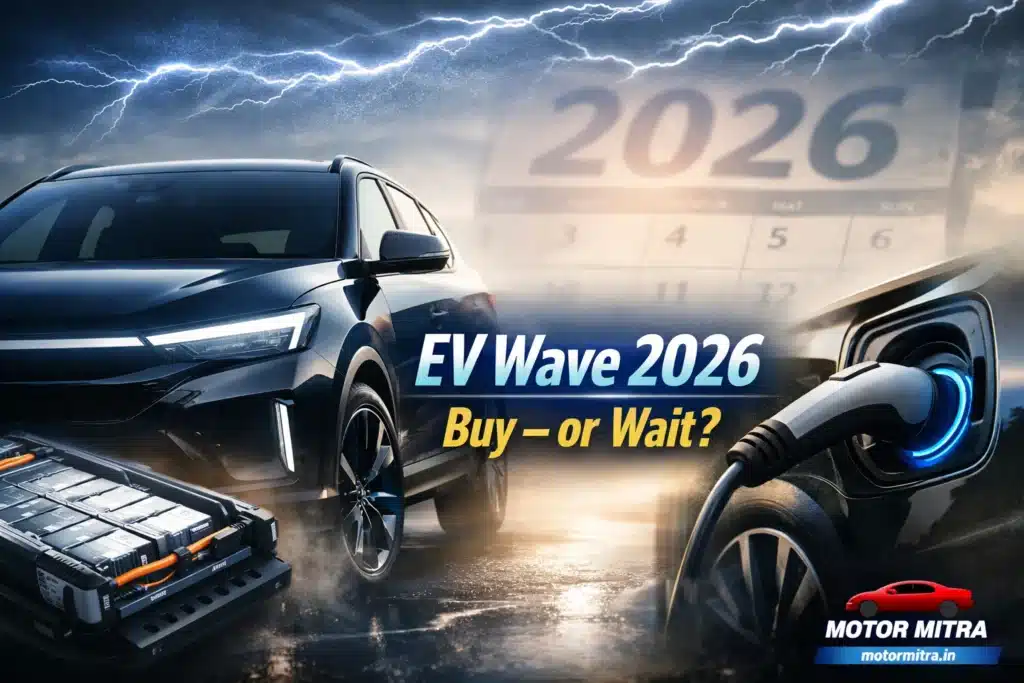
India’s electric car market is approaching a decisive phase. With a long list of upcoming EV cars lined up for 2026, buyers planning a purchase in the next few months are facing a serious dilemma — secure a deal now, or wait for what could be a major technology reset.
This is no longer just about incremental updates. It is about next-generation platforms, larger battery packs, stronger competition, and potentially recalibrated pricing.
The timing question is real.
Why This Matters
- Multiple upcoming EV cars in 2026 may reshape pricing expectations
- Dedicated EV platforms could deliver better range and efficiency
- Waiting might mean improved technology — but possibly higher cost
When a segment enters scale mode, yesterday’s benchmark can quickly become outdated.
Is 2026 the Start of a True EV Upgrade Cycle?
Several manufacturers are preparing models built on born-electric platforms instead of adapted combustion bases. This shift matters more than many realise.
The shift to dedicated Upcoming EV Cars architecture is not cosmetic — it directly impacts ownership experience.
- Better battery packaging
- Higher claimed range
- Faster charging compatibility
- Improved cabin space
Buyers entering the market just before such platform transitions sometimes feel left behind once newer models arrive.
At the same time, outgoing batches often carry dealer-level benefits.
The decision becomes strategic.
Also Read:- 5 Upcoming Cars Set for February Launch — EVs, SUVs and a Premium Twist
Which Upcoming EV Cars Could Shift the Market?
The 2026 lineup spans mass-market compact EVs to premium three-row SUVs. This range overlap could intensify competition across price bands.
Below is a snapshot of key upcoming EV cars expected in 2026:
| Car Name | Expected Price (₹ ex-showroom) | Key Expected Highlights |
|---|---|---|
| Tata Harrier EV | 30–35 lakh | Large SUV stance, long range focus |
| Tata Sierra EV | 26–32 lakh | Lifestyle design revival, spacious cabin |
| Mahindra XUV.e8 | 28–36 lakh | Dedicated EV platform, possible AWD |
| Mahindra BE.05 | 25–33 lakh | Coupe-inspired SUV, high tech interior |
| Maruti eVX | 20–28 lakh | Mass-market mid-size electric SUV |
| Hyundai Ioniq 7 | 45–55 lakh | Premium 3-row EV SUV, advanced features |
| Kia EV9 | 50–60 lakh | Large SUV, strong highway range |
| MG Cyberster | 60–75 lakh | Performance-focused electric roadster |
| Toyota Urban Cruiser EV | 18–25 lakh | Practical urban SUV EV positioning |
| Tata Punch EV Update | 10–12 lakh | Compact city EV efficiency |
| Renault Kwid EV | 7–9 lakh | Entry-level EV hatchback |
| Nissan EV SUV (expected) | 22–30 lakh | Mid-tier SUV EV segment entry |
(Prices indicative; official announcements pending.)
The breadth of this pipeline signals intent. When multiple upcoming EV cars target similar brackets, competitive pressure typically increases.
And competition often translates to feature upgrades.
Could Prices Rise Instead of Falling?
Many buyers assume waiting automatically guarantees lower prices.
That assumption may not always hold.
If new launches introduce larger battery packs and better hardware, entry-level prices could inch upward. Compliance shifts, localisation strategies and battery sourcing dynamics may also influence cost.
So waiting for “better” may sometimes mean paying more.
The financial equation could shift quickly depending on how aggressively brands position introductory pricing.
Also Read:- Upcoming Car Launches in Feb 2026: Maruti, Tata, MG, Toyota & Nissan Ready to Strike
Is Range Anxiety Finally Being Addressed?
Range remains one of the biggest purchase triggers.
Several upcoming EV cars are expected to cross the 450–500 km claimed range mark in certain variants. Faster charging compatibility is also expanding.
For buyers who frequently travel long distances, this evolution could be meaningful.
However, for primarily urban users, current EV offerings already meet daily usage needs comfortably.
Sometimes, waiting for the next big jump may not change real-world experience significantly.
What About Waiting Periods?
New model launches tend to create demand spikes. Allocation pressure often follows.
Buying now could mean:
- Shorter delivery timelines
- Known ownership reviews
- Possible stock clearance benefits
Waiting may mean:
- Latest hardware
- Higher early demand
- Initial waiting periods
In high-growth segments, early adoption cycles move quickly.
Is 2026 the EV Inflection Year?
The scale of upcoming EV cars suggests that manufacturers see confidence in demand expansion.
If charging infrastructure expands simultaneously and battery performance improves meaningfully, 2026 may become a stabilising year for EV adoption.
But inflection points also mean rapid model refresh cycles.
Technology evolution may accelerate.
For buyers who prioritise always having the latest generation, waiting might feel justified. For those prioritising practicality and predictable ownership, locking a proven current model may reduce uncertainty.
The 2026 pipeline undeniably looks aggressive.
But regret does not only come from buying early.
It can also come from postponing decisions too long in a fast-moving market.
With upcoming EV cars reshaping the segment, the smarter decision may depend less on headlines — and more on how urgently you need a car, how you use it, and how much you value being first versus being practical.
In the electric era, timing may matter as much as technology.
For more such updates and latest news on cars and bikes stay connected to motormitra.in
Thank you ..
auto.motormitra
Latest Auto News and Trends
Also Read:- दिसंबर 2025 में भारत की सबसे ज्यादा बिकने वाली स्कूटर्स: Activa टॉप पर, 125cc सेगमेंट तेज़ी से आगे
ऐसी ही और ताज़ा खबरों और अपडेट्स के लिए जुड़े रहें Auto.MotorMitra के साथ।
धन्यवाद!
Times Mitra
Latest bytes of news.

Also Read:- Indian Navy Set for Historic Expansion: 19 Warships to Join the Fleet in 2026
For more such updates and latest news on cars and bikes stay connected to times.motormitra.in
Thank you ..