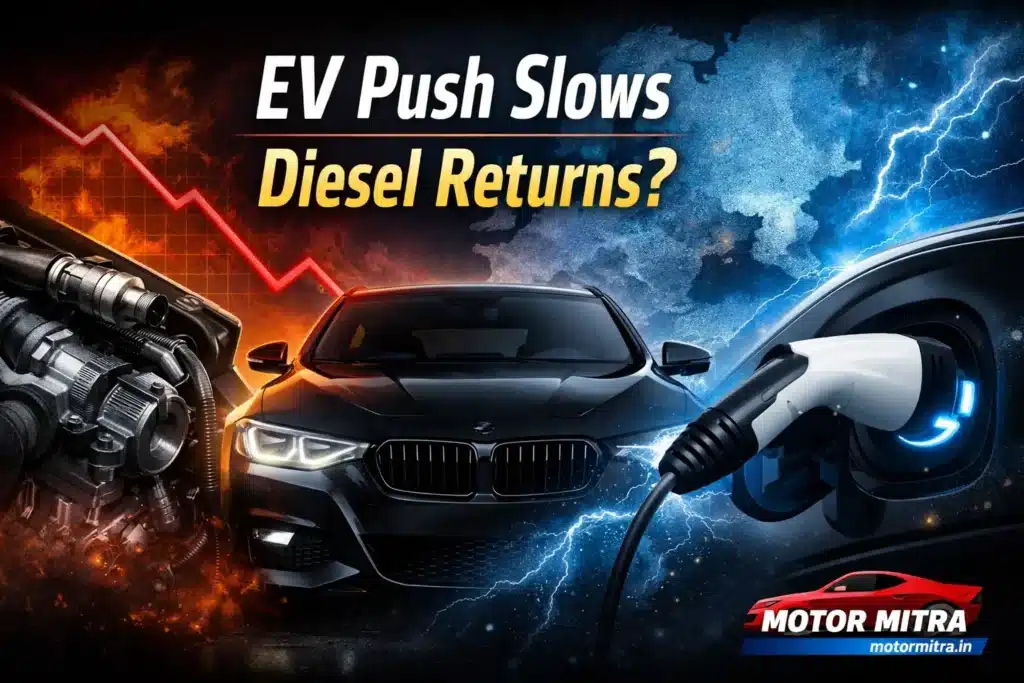
Europe’s electric transition has just hit its first visible wobble. After years of aggressive EV Push expansion plans, the revival of diesel cars in Europe signals that momentum is no longer automatic.
EV Push isn’t reversing — but confidence around its pace is clearly being tested.
And that’s where diesel Cars quietly re-enters the conversation.
Why This Matters
- Europe has been one of the strongest EV Push policy regions
- Automakers heavily invested in phasing out combustion engines
- Diesel Cars revival suggests demand recalibration
When manufacturers adjust product strategy, it’s rarely cosmetic. It reflects real demand pressure.
Is Europe Rebalancing Its Electric Ambition?
For the past few years, EV adoption in Europe was accelerating on the back of regulatory deadlines, subsidy support, and tightening emissions norms. Automakers outlined ambitious timelines to reduce or eliminate internal combustion options.
But recent signals suggest buyers may be hesitating.
High EV pricing, subsidy cuts in some markets, and cost-of-living pressures appear to be slowing purchase momentum. While EV sales haven’t collapsed, growth rates have moderated.
In that environment, diesel cars in Europe are no longer a legacy footnote — they are being reconsidered.
Also Read:- Upcoming EV Cars 2026 — Buy Now or Regret Later?
Why Would Diesel Return Now?
Diesel engines, once criticised heavily after emissions controversies, never fully disappeared from Europe’s automotive landscape. They remained attractive for:
- Long-distance efficiency
- Strong torque delivery
- Better highway fuel economy
For fleet buyers and high-mileage drivers, diesel still offers practical advantages.
If EV affordability gaps widen or charging infrastructure concerns persist, the case for diesel doesn’t vanish overnight.
Instead, it regains breathing room.
Is This an EV Failure — or a Market Adjustment?
This isn’t collapse — but it is the first serious sign of recalibration.
Electrification is still progressing. Infrastructure continues to expand. New electric models are entering the market.
However, rapid adoption phases are often followed by recalibration periods. Early adopters move first. The next wave of buyers tends to be more price-sensitive and more cautious.
When that second wave hesitates, manufacturers respond strategically.
Reintroducing or strengthening diesel cars in Europe may be less about abandoning EVs — and more about hedging against demand volatility.
Are Automakers Playing It Safe?
Product strategy decisions are rarely ideological. They are economic.
If:
- EV demand softens
- Subsidies shrink
- Financing becomes expensive
Manufacturers need alternatives that maintain showroom traffic.
Diesel, particularly in efficient modern configurations, offers that alternative in certain segments.
It’s not a retreat — it’s a strategic buffer against uncertain EV demand.
Also Read:- EV Sales Dip in January 2026 — Is the Electric Boom Losing Steam?
Could This Influence Other Regions?
Europe often acts as a bellwether for regulatory direction and drivetrain trends.
If diesel cars in Europe gain renewed traction, other regions may also slow aggressive phase-out timelines. Markets with weaker charging infrastructure or stronger fuel economy priorities could interpret this as validation for a more gradual transition.
That doesn’t mean EV momentum disappears.
It means transition paths may become less linear.
What Should Buyers Read Into This?
For consumers, the signal is nuanced.
If you were expecting diesel to vanish immediately, this development suggests otherwise. Certain segments — especially larger vehicles and long-range commuters — may retain combustion options longer than previously assumed.
On the EV side, pricing strategies and feature positioning could become more competitive as manufacturers defend market share.
Choice may temporarily expand rather than shrink.
Is This a Turning Point — or Just a Pause?
The bigger question isn’t whether electrification stops. It won’t.
The question is whether transition timelines get stretched.
EV policy ambition remains strong across Europe. But policy and consumer readiness don’t always move at identical speeds.
When that gap widens, market correction follows.
Diesel’s return doesn’t erase Europe’s electric ambition — but it does complicate the narrative.
If EV demand continues to fluctuate, manufacturers may lean harder on combustion options than expected.
And in a market driven by momentum, even small hesitation can reshape strategy faster than policy ever could.
For more such updates and latest news on cars and bikes stay connected to motormitra.in
Thank you ..
auto.motormitra
Latest Auto News and Trends

Also Read:- महिंद्रा थार रॉक्स 2025 – ₹12.25 लाख से शुरू | फीचर्स, माइलेज, वेरिएंट्स
ऐसी ही और ताज़ा खबरों और अपडेट्स के लिए जुड़े रहें Auto.MotorMitra के साथ।
धन्यवाद!
Times Mitra
Latest bytes of news.

Also Read:- A Historic Surge in Gold and Silver Prices: Reshaping Investment Dynamics in 2026
For more such updates and latest news on cars and bikes stay connected to times.motormitra.in
Thank you ..