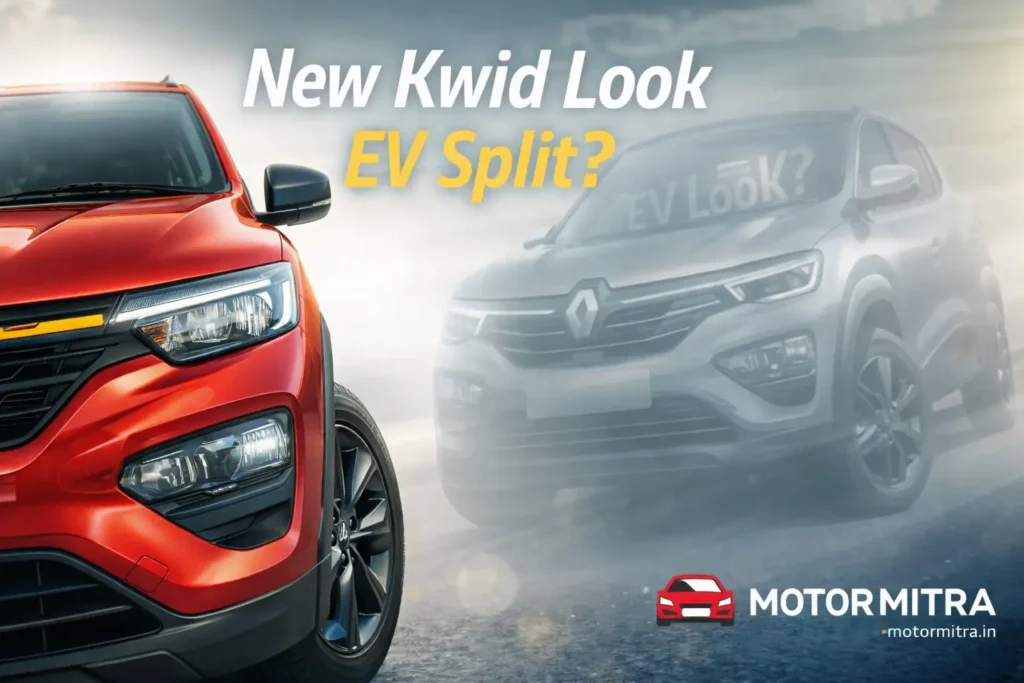
Renault’s entry-level strategy just took an unexpected turn. As automakers push entry cars toward EV-inspired identities, the 2026 Renault Kwid has surfaced with a noticeably different direction.
In a segment where electrification cues are becoming standard, this divergence feels deliberate.
And deliberate moves usually signal strategy — not styling experiments.
Why This Matters
- Entry-level cars are increasingly shifting toward EV design language
- Renault already has an electric Renault Kwid strategy in play
- A different facelift direction suggests strategic positioning
When a brand runs two visual identities for the same nameplate, it’s rarely accidental.
Why Does the 2026 Renault Kwid Look Different From the EV?
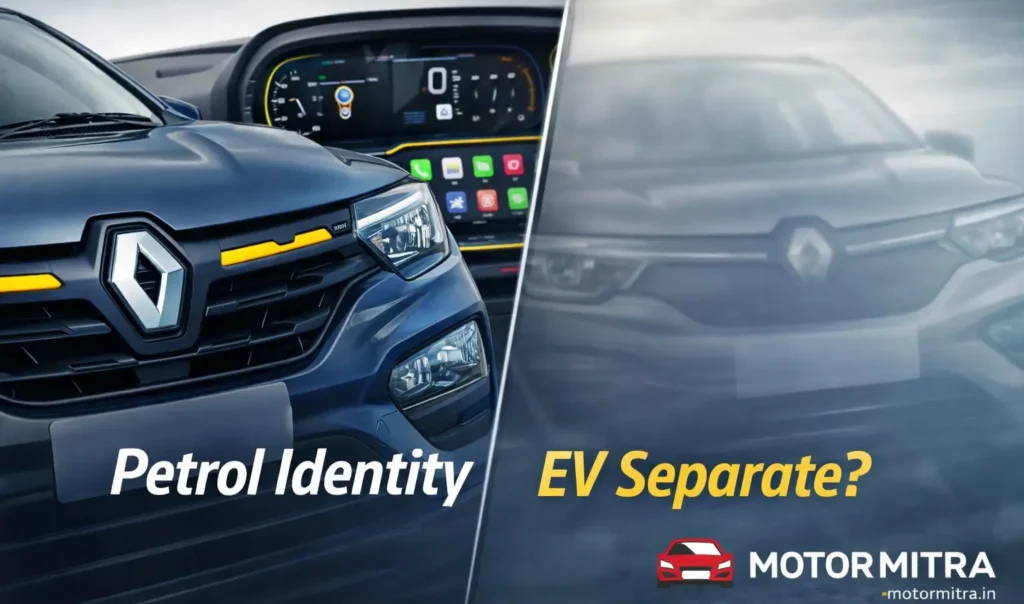
Spy images indicate noticeable styling divergence. The facelifted 2026 Renault Kwid appears to retain a more conventional grille structure and updated lighting treatment, rather than adopting the closed-off EV-style fascia seen on the electric variant.
This isn’t cosmetic — it’s positioning.
Rather than blending the petrol and EV identities into one unified look, Renault may be deliberately separating them. That approach allows each version to target distinct buyer expectations.
EV buyers often expect futuristic cues. Traditional hatchback buyers may still prefer familiar design language.
Blurring those lines doesn’t always help sales.
Also Read:- New Renault Duster vs Creta, Seltos, Kushaq & Taigun — Who’s Under Real Pressure?
Is Renault Protecting the Entry-Level Segment?
The Renault Kwid remains one of Renault’s most price-sensitive offerings. Entry-level hatchback buyers prioritise affordability, running costs, and familiarity.
If the 2026 Renault Kwid had shifted too aggressively toward EV-inspired styling, it could risk alienating its core audience.
Maintaining a recognisable combustion-friendly identity may therefore be strategic, not conservative.
In markets where EV adoption is still developing, combustion variants remain volume drivers.
What Does This Say About Renault’s EV Strategy?
Renault has not backed away from EV ambitions. The brand continues expanding electric portfolios globally. However, electrification timelines differ across regions.
Separating the design language of the 2026 Renault Kwid from its EV sibling could serve multiple goals:
- Protect EV positioning as a distinct premium-forward option
- Avoid confusion between petrol and electric variants
- Maintain cost-effective styling architecture
In a competitive entry-level segment, clarity matters.
Is This a Design Detour — or Market Reality?
The more interesting question is whether this divergence reflects temporary caution or long-term segmentation.
Automakers often experiment with EV-inspired aesthetics across their lineup. But not all customers embrace abrupt design shifts.
If Renault observed resistance to overly futuristic cues in certain markets, this facelift could be a recalibration.
And recalibration in entry segments often means protecting volume, not chasing headlines.
It means adjustment.
Could This Influence Pricing Strategy?
Design direction often ties into perceived positioning. EV-inspired styling can subtly elevate a car’s visual presence — but it can also create expectation gaps around features and pricing.
By keeping the 2026 Renault Kwid visually grounded, Renault may be preserving its affordability narrative.
Meanwhile, the EV variant can occupy a differentiated space without internal competition.
Clear segmentation avoids overlap — and overlap erodes margins.
Also Read:- What Is Renault’s Mini Duster? The Sub-4m SUV Set to Challenge Brezza and Nexon
What Should Buyers Watch Next?
Spy shots reveal only surface details. The deeper story lies in:
- Feature upgrades
- Powertrain confirmation
- Safety additions
- Final pricing
If Renault successfully balances updated styling with competitive pricing, the facelifted Kwid could strengthen its role as a volume stabiliser.
But if the gap between combustion and EV variants widens too sharply, buyers may perceive inconsistency.
And perception drives entry-level purchase decisions more than brand messaging ever could.
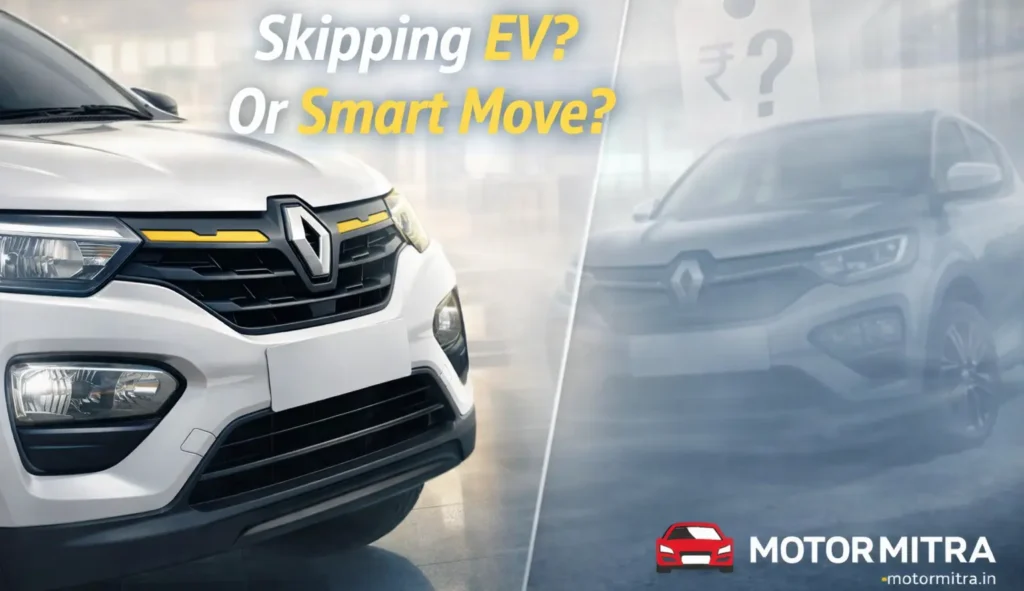
Is Renault Skipping the EV Path — or Just Taking Two Roads?
The headline may suggest a departure, but the strategy likely isn’t binary.
Renault appears to be running parallel tracks:
One electric-forward.
One combustion-optimised.
The 2026 Renault Kwid facelift reinforces that dual approach.
Electrification remains the long-term direction. But the pace of adoption isn’t uniform across segments or markets.
In entry-level hatchbacks, volume still matters more than symbolism.
Renault may not be skipping the EV path — but it is clearly refusing to blend both identities too quickly.
In the entry-level space, volume matters more than symbolism.
If electrification adoption lags in key markets, combustion-led facelifts like this may remain central longer than expected.
And in small cars, strategy isn’t about following trends — it’s about surviving them.
And in a market where affordability, regulation, and consumer readiness don’t always align, sometimes two roads are safer than forcing one.
For more such updates and latest news on cars and bikes stay connected to motormitra.in
Thank you ..
auto.motormitra
Latest Auto News and Trends
Also Read:- Tata Punch को मिलने वाला है नया अपडेट, जानिए क्या बदलने वाला है देश की सबसे पॉपुलर माइक्रो-SUV में
ऐसी ही और ताज़ा खबरों और अपडेट्स के लिए जुड़े रहें Auto.MotorMitra के साथ।
धन्यवाद!
Times Mitra
Latest bytes of news.
For more such updates and latest news on cars and bikes stay connected to times.motormitra.in
Thank you ..