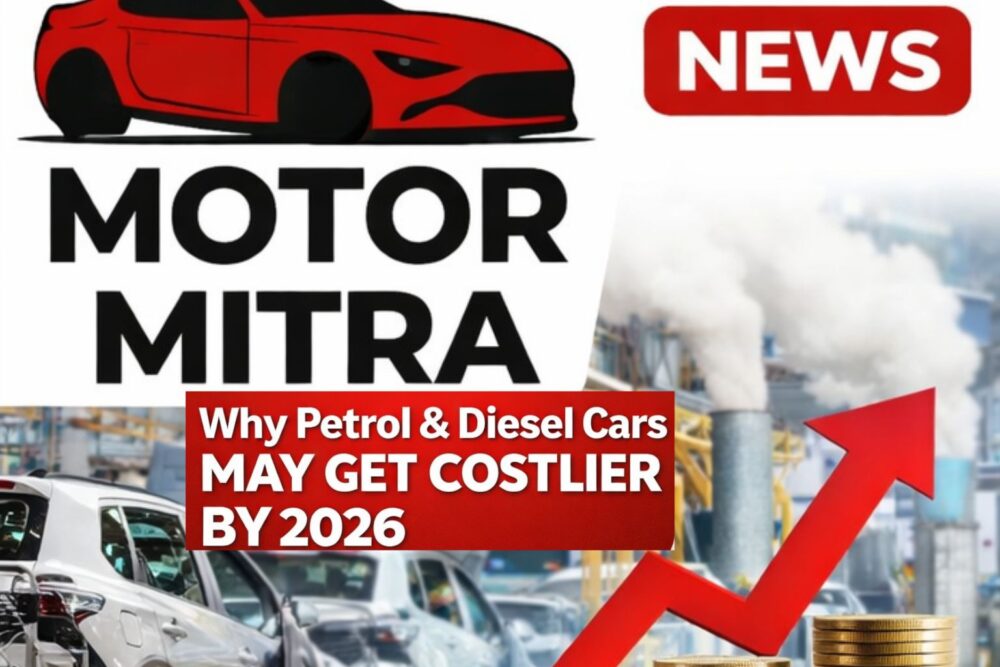
Planning to buy a petrol or diesel car in India?
You might want to pause — because prices are likely to go up again soon. With stricter emission norms, rising costs, and policy uncertainty, car buyers could soon face a much higher entry price — especially in the SUV segment. Petrol diesel cars price increase in India is becoming a serious concern for buyers…
For buyers planning to purchase a new car in the next 12 to 18 months, this shift could prove decisive. What currently looks like a manageable upgrade may soon become a substantially costlier commitment, especially in popular SUV segments that dominate Indian sales charts.
Why This Matters
- Petrol and diesel cars could become 3–5% more expensive
- Budget buyers may face higher entry prices
- Decision confusion: buy now or wait

Why Car Prices Are Quietly Rising Again
The economics of car manufacturing in India have changed dramatically. Automakers today are dealing with elevated prices of steel, aluminium, and other critical raw materials that form the backbone of vehicle production. At the same time, semiconductor chips—now essential even in entry-level cars—remain costlier and more complex than they were before the pandemic.
Industry estimates suggest that these input factors alone justify a 2–5 percent increase in ex-showroom prices across segments. While manufacturers have tried to stagger price hikes to avoid demand shocks, margins have steadily thinned. As a result, further increases now seem less a matter of “if” and more of “when”. For buyers, this isn’t just inflation — it’s a shift that could change purchase timing completely
Emission Norms and the Diesel Dilemma
Beyond raw materials, regulatory compliance has emerged as a major cost driver. The introduction of BS6 Phase 2 norms has significantly increased the complexity of internal combustion engines. Vehicles now require advanced sensors, real-driving emission monitoring systems, and more sophisticated engine calibration to meet compliance targets.
Diesel engines, in particular, have become expensive to engineer and certify. This explains why diesel variants today often command a ₹1–3 lakh premium over their petrol counterparts. What was once a fuel-choice decision driven largely by running costs is now a much heavier financial calculation at the time of purchase itself. Here’s where things get interesting…
How This Affects You as a Buyer
- Entry-level cars may soon cross key price brackets
- Diesel variants could become significantly costlier
- Monthly EMIs are likely to increase

2026 and the Policy Overhang
Historically, April has been a sensitive month for the Indian auto industry. Policy changes, tax adjustments, and regulatory updates are frequently rolled out at the start of the financial year, and these often trigger price revisions. With 2026 approaching, industry insiders are cautious but clear: another round of correction cannot be ruled out.
Past trends indicate that such shifts have led to price increases ranging from ₹20,000 to as much as ₹1 lakh per vehicle. Given the current cost environment, a similar or even sharper impact would not be surprising. Buyers waiting too long may find themselves paying significantly more for the same car, with little or no added value in terms of features. And this is where the real impact begins…
SUVs Likely to Feel the Heat First
The impact of these developments is expected to be most visible in the SUV space, which continues to drive volumes and profitability for manufacturers. Diesel-powered SUVs, in particular, are likely to bear the brunt.
Models such as the Hyundai Creta diesel, which already start above the ₹12 lakh mark, could see 3–5 percent price hikes in the near future. High demand, combined with increasingly complex diesel technology, makes such increases difficult to avoid.
Larger and heavier SUVs face even steeper pressure. The Tata Harrier, positioned as a diesel-only offering, operates in a price band where incremental costs add up quickly. Industry estimates suggest that price hikes of ₹1 lakh or more over the medium term are a realistic possibility.
Even compact SUVs are not immune. The Tata Nexon diesel, long considered one of the most value-driven options in its class, may still see increases in the ₹30,000–50,000 range despite its high sales volumes.

Also Read- Mahindra EV Owners No Longer Need Service Centers — Big Relief in Delhi NCR?
Fuel Prices and the Changing Ownership Equation
Fuel prices continue to influence buying behaviour, but the equation is evolving. In most metro cities, petrol now sells in the range of ₹95–105 per litre, while diesel hovers between ₹87–92 per litre. The gap, once wide enough to clearly justify diesel ownership, has narrowed to just ₹8–12 per litre.
This shrinking difference changes the economics of ownership, especially for urban buyers. Diesel still makes sense for those with high monthly running or frequent highway usage, but for city-focused drivers, petrol is increasingly emerging as the more balanced and future-proof choice. Lower upfront cost, quieter operation, and fewer long-term regulatory concerns are tipping the scales.
Should You Buy Now or Wait?
Buy now if:
- You want to avoid upcoming price hikes
- You already have a purchase plan
Wait if:
- You are considering EV or hybrid options
- Budget is flexible and not urgent
A Narrow Window for Buyers
For consumers, timing may be the single most important factor in the coming months. Vehicles manufactured in 2025 are still attracting discounts, exchange bonuses, and dealer-level negotiations. This flexibility tends to disappear quickly once a new financial year begins or once manufacturers announce fresh price revisions.
Waiting indefinitely for clarity on future hikes carries its own risk. Historically, price increases are announced suddenly, leaving buyers with little room to react. Those who lock in bookings earlier often end up saving significantly, even if delivery happens a few months later.
Looking Beyond Petrol and Diesel
As internal combustion engine cars grow more expensive, alternatives are becoming harder to ignore. Electric vehicles, especially compact urban EVs, are increasingly competitive in the ₹10–12 lakh range when subsidies and low running costs are factored in. For buyers with predictable daily usage and access to home charging, EVs offer insulation from both fuel price volatility and future emission-related restrictions.
CNG and strong hybrid options also present a middle ground, particularly for high-mileage users who want lower running costs without fully transitioning to electric mobility.
The Bigger Picture
The Indian car market is at a crossroads. Petrol and diesel vehicles are not disappearing overnight, but they are steadily becoming more expensive to own and operate. What buyers are witnessing is not a temporary spike, but a structural shift driven by regulation, technology, and global supply dynamics.
The reality is simple — petrol and diesel cars in India are only getting more expensive. If you’re already planning to buy, delaying your decision could mean paying significantly more for the same car in the coming months.
For more such updates and latest news on cars and bikes stay connected to motormitra.in
Thank you ..