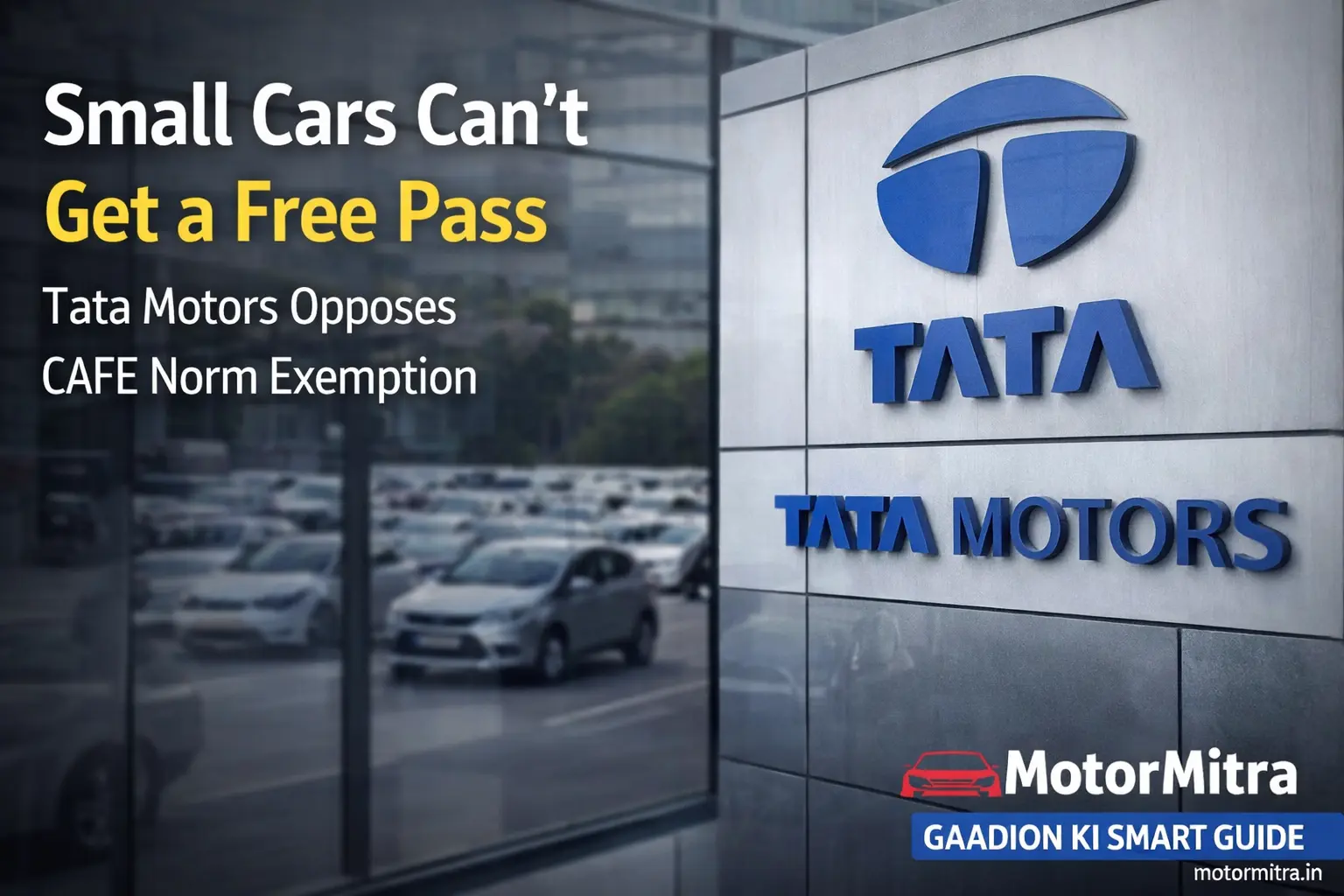
Tata Motors has taken a clear and firm stand against the proposal to exempt small cars from India’s Corporate Average Fuel Efficiency (CAFE) norms, stating that such a move could slow down India’s transition to cleaner and more efficient vehicles.
Thank you for reading this post, don't forget to subscribe!The statement comes at a time when the Indian government and industry stakeholders are debating ways to revive the small car segment, which has seen declining sales in recent years due to rising costs and stricter regulations. times.motormitra.in
What Are CAFE Norms?
CAFE norms are regulations that require car manufacturers to maintain an average fuel efficiency across their entire fleet. Auto.MotorMitra The goal is to reduce carbon emissions, improve fuel economy, and push manufacturers toward cleaner technologies, including electric vehicles and hybrids.

Also Read:- Tata Punch vs Citroën C3: Which One Should You Buy in 2026? The Ultimate Small Car Face-Off
India is currently following CAFE Phase 2 norms, and discussions are underway for future phases that will further tighten emission and efficiency standards. motormitra.in
You can read more about the policy framework on the official government portal:
👉 Official Source: https://heavyindustries.gov.in
What Is the Proposal About?
Some industry voices have suggested that small cars—especially entry-level hatchbacks—should be exempted from CAFE norms. motormitra.in The argument is that:
- Small cars already have lower emissions
- Additional compliance costs make them expensive
- Stricter norms are hurting affordability
However, Tata Motors believes this approach is short-sighted. times.motormitra.in
Tata Motors’ Key Argument
Tata Motors has reportedly stated that exempting small cars would dilute the very purpose of CAFE norms. Auto.MotorMitra According to the company, every vehicle category must contribute to emission reduction if India wants to meet its long-term climate and sustainability goals. motormitra.in
Tata Motors’ position highlights three main concerns:
- It may discourage innovation in affordable, efficient vehicles
- It could slow EV adoption, especially in the mass market
- It risks creating uneven regulatory pressure across segments
The company believes that relaxing norms for one category could lead to similar demands from other segments in the future. motormitra.in
Impact on Electric Vehicle Push
Tata Motors is currently India’s largest electric car manufacturer, with models like the Tiago EV, Tigor EV, Nexon EV, and Punch EV. times.motormitra.in The company argues that uniform CAFE norms encourage manufacturers to balance their fleets using EVs and cleaner technologies.
If small cars are exempted:
- OEMs may delay electrification plans
- Investment in affordable EVs could slow down
- Overall fleet efficiency targets may suffer
This would go against India’s broader push toward electrification and reduced dependence on fossil fuels. motormitra.in
More details on India’s EV roadmap are available here:
👉 Official Source: https://www.niti.gov.in
Affordability vs Sustainability Debate
Supporters of exemption argue that small cars are crucial for first-time buyers and that rising regulatory costs are pushing customers toward used cars or two-wheelers. times.motormitra.in
Tata Motors, however, believes the solution lies elsewhere:
- Smarter taxation policies
- Incentives for clean technologies
- Localised battery and component production
- Government support for affordable EVs
Rather than diluting regulations, Tata Motors suggests addressing cost pressures directly. Auto.MotorMitra
Tata’s Broader Industry View
Tata Motors’ stance also reflects its long-term business strategy. motormitra.in The company has invested heavily in:
- EV platforms
- Battery technology
- Local manufacturing
- Sustainable mobility solutions
From Tata’s perspective, weakening CAFE norms could penalise companies that have already invested in cleaner technologies, while benefiting those who delay compliance. motormitra.in
Comparison Table
| Aspect | Exempt Small Cars | Uniform CAFE Norms |
|---|---|---|
| Emission Control | Limited | Strong times.motormitra.in |
| EV Adoption | Slower Auto.MotorMitra | Faster |
| Innovation Push | Reduced | Encouraged |
| Long-Term Sustainability | Weak | Strong motormitra.in |

Also Read:- India Goes Crazy for Tata Sierra– 70,000 Bookings in a Single Day
What This Means for Buyers
For consumers, this debate may not lead to immediate changes, but it will shape future car offerings. times.motormitra.in If CAFE norms remain uniform:
- More fuel-efficient petrol cars
- Increased hybrid and EV options
- Better long-term running costs
Tata Motors believes that this approach ultimately benefits buyers, even if initial prices are slightly higher.
Tata Motors opposing the exemption of small cars from CAFE norms underlines a larger policy debate—whether India should prioritise short-term affordability or long-term sustainability. Auto.MotorMitra
While small cars play a vital role in the market, Tata Motors argues that every segment must contribute to emission reduction. With India aiming for cleaner mobility and higher EV adoption, the company believes diluting regulations now could prove costly in the future. motormitra.in
The final decision will rest with policymakers, but Tata Motors’ stance adds significant weight to the argument for uniform, technology-neutral emission norms.
For more such updates and latest news on cars and bikes stay connected to motormitra.in
Thank you ..
auto.motormitra
Latest Auto News and Trends

Also Read:- Yamaha FZ-RAVE 2025 Launched in India – नई स्टाइलिश 150cc बाइक ₹1.17 लाख में
ऐसी ही और ताज़ा खबरों और अपडेट्स के लिए जुड़े रहें Auto.MotorMitra के साथ।
धन्यवाद!
Times Mitra
Latest bytes of news.

Also Read:- Android 16 Accessibility Hype? Gemini Features Fall Short for Real Users
For more such updates and latest news on cars and bikes stay connected to times.motormitra.in
Thank you ..