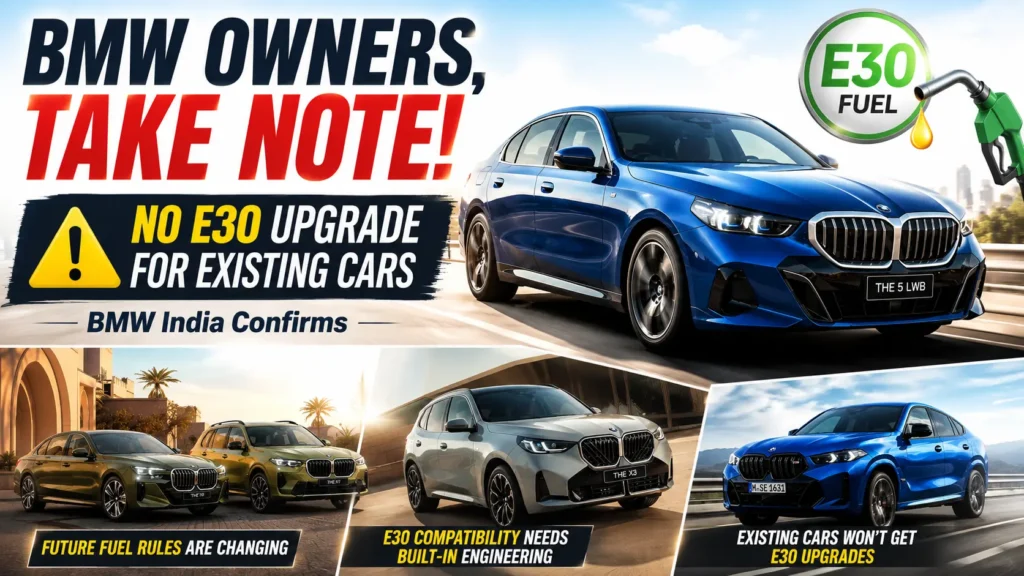
BMW owners planning to keep their cars for the long term may have just received an important reality check. As India gradually prepares for higher ethanol-blended fuels in the coming years, BMW India has confirmed that existing BMW models cannot simply be upgraded later to support BMW E30 Fuel Compatibility. While the announcement does not affect current ownership today, it highlights a challenge that could become increasingly relevant as the country’s fuel ecosystem continues to evolve.
The clarification arrives at a time when India’s automotive industry is undergoing one of its biggest transitions in decades. Alongside stricter emissions regulations, hybrid adoption and electrification, higher ethanol-blended fuels are becoming a major part of future policy planning. Many buyers assumed that future fuel compatibility could eventually be addressed through software updates or minor mechanical revisions. BMW’s latest statement suggests the reality is far more complex than that.
More importantly, the development signals a broader shift in how premium car buyers may evaluate vehicles in the future. Performance, luxury, technology and safety have traditionally dominated purchase decisions, but fuel compatibility and long-term regulatory readiness are gradually becoming part of the conversation. For luxury brands and their customers, the cars of tomorrow may need to be designed very differently from the cars being sold today.
Also Read:- Tata’s Next Altroz Surprise Spotted: Flex Fuel E85 Or A New Turbo Racer In Disguise?
BMW Owners Were Expecting An Upgrade—BMW Says That’s Not Possible
BMW India has made it clear that existing vehicles currently on Indian roads cannot be converted or upgraded later to achieve full E30 fuel compatibility. According to the company, E30 readiness requires specific engineering solutions that must be incorporated during the vehicle development process rather than added through a dealership retrofit or software update after production.
The clarification is significant because many owners naturally assumed that future compatibility could be achieved through calibration changes or hardware upgrades. BMW’s position indicates that once a vehicle has been designed, tested and certified for a specific fuel standard, converting it to reliably operate on substantially higher ethanol concentrations becomes a far more complicated undertaking.
Importantly, this does not mean current BMW models are suddenly outdated or unsuitable for Indian conditions. Existing vehicles remain fully compatible with the fuel standards for which they were originally developed and approved. The announcement simply creates a clear distinction between today’s products and future vehicles that may be engineered specifically around higher ethanol blends from the beginning.
Why E30 Compatibility Starts Long Before A Car Reaches Showrooms
One of the biggest misconceptions surrounding ethanol-blended fuels is that compatibility is primarily a software issue. In reality, E30 fuel compatibility begins years before a vehicle reaches a dealership. Engineers must evaluate how higher ethanol concentrations interact with fuel pumps, injectors, fuel lines, seals, combustion characteristics, emissions systems and numerous other components throughout the vehicle’s lifespan.
Ethanol behaves differently from conventional petrol and places unique demands on fuel-system materials and engine management systems. Manufacturers must therefore conduct extensive durability testing, performance validation and regulatory compliance assessments to ensure long-term reliability. These processes are integrated into vehicle development programs and often cannot be replicated economically after production has already begun.
This engineering reality explains why most automakers introduce major compatibility improvements through new-generation products rather than retrofitting older vehicles. BMW’s position reflects a broader industry approach and highlights the complexity involved in preparing vehicles for future fuel standards.
The Question Every BMW Buyer Is Asking Right Now
For existing BMW owners, the immediate impact is limited. India continues operating under current fuel standards, and BMW’s existing portfolio remains compliant with the fuel requirements applicable today. There is no indication that owners need to alter their driving habits, maintenance routines or ownership plans because of the company’s latest clarification.
However, the discussion becomes much more relevant for buyers who plan to keep their vehicles for many years. Long-term owners may increasingly consider future compatibility when evaluating premium vehicles, particularly as fuel regulations continue evolving. While luxury features, performance and brand appeal remain central to purchasing decisions, future readiness could gradually become another important factor.
The announcement may also influence buyers deciding whether to purchase a current-generation luxury vehicle or wait for future models designed around upcoming regulatory requirements. As fuel policies evolve, manufacturers could begin highlighting compatibility and future readiness as key selling points alongside traditional performance and technology metrics.
Also Read:- Car Owners Can Finally Stop Worrying: E20 Fuel Won’t Void Your Insurance
Who Should Be Paying Attention To BMW’s E30 Clarification?
| Buyer Type | Impact Of BMW’s E30 Clarification | Should You Be Concerned? |
|---|---|---|
| Existing BMW Owner | No E30 retrofit or upgrade expected | No immediate concern |
| New BMW Buyer | Future fuel compatibility becomes a consideration | Moderate |
| Long-Term Owner | Future regulations may influence ownership planning | Worth monitoring |
| Luxury Car Shopper | Next-generation products may offer greater future readiness | Consider future options |
| Performance Enthusiast | Current performance remains unaffected | Low concern |
| Resale-Focused Buyer | Future compatibility discussions may eventually influence market perception | Monitor developments |
The table highlights an important reality. BMW’s announcement does not create an immediate ownership problem, but it introduces a factor that premium car buyers may increasingly evaluate moving forward. As India’s fuel landscape changes, compatibility and long-term readiness could become more prominent discussion points throughout the luxury vehicle market.
BMW’s E30 Warning May Be The First Of Many
The broader significance of BMW’s statement extends well beyond a single manufacturer. India’s automotive industry is simultaneously navigating stricter emissions standards, increasing electrification, hybrid adoption and growing ethanol usage. Together, these developments are influencing how future vehicles are designed, engineered and marketed.
Luxury brands face a particularly complex challenge because customers expect advanced technology, strong performance, regulatory compliance and long-term durability in the same package. As a result, future-ready engineering decisions are becoming increasingly important during vehicle development cycles. The transition toward higher ethanol-blended fuels is simply one part of a much larger transformation taking place across the automotive sector.
BMW is unlikely to be the only manufacturer addressing these questions in the coming years. As India moves closer to higher ethanol adoption targets, more automakers may eventually clarify how future fuel standards affect both current products and next-generation vehicles.
The Real Story Is Bigger Than BMW
BMW India’s confirmation that existing cars cannot be upgraded for E30 fuel compatibility may initially sound like a technical announcement, but the implications extend much further. The bigger takeaway is not that current BMW owners face an immediate problem. Instead, it is that future fuel regulations are beginning to influence vehicle buying decisions even in the premium segment.
For existing owners, nothing changes today. Their vehicles remain fully compatible with the fuel standards they were designed to use. However, for future buyers, BMW’s statement serves as an early reminder that long-term compatibility may soon become as important as performance, technology, luxury and brand value.
For now, existing BMW owners have little reason to worry. But the message from BMW is clear: the cars of tomorrow will be designed for a very different fuel future than the cars many people are buying today.