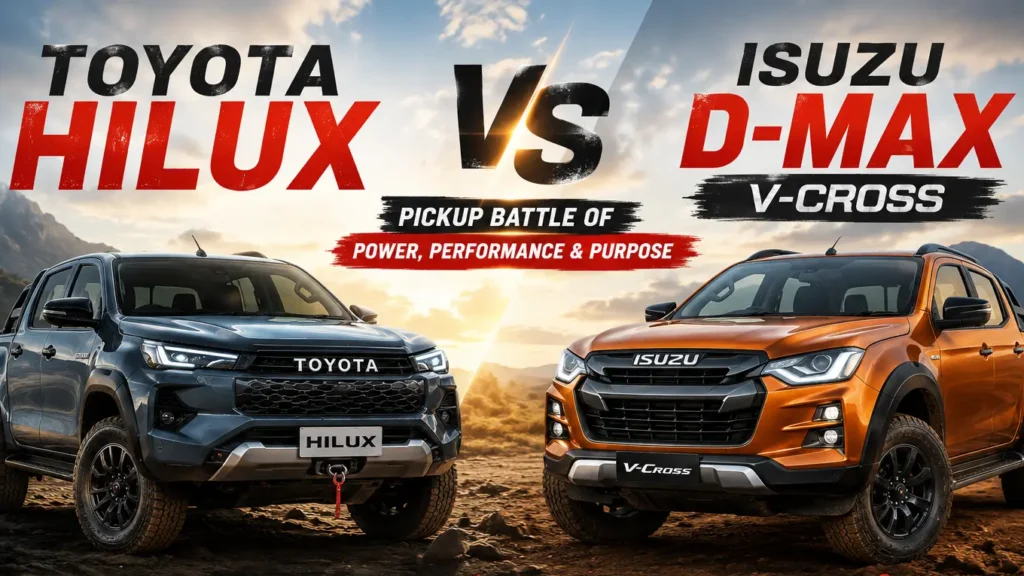
The Indian lifestyle pickup truck segment is one of the smallest yet most passionate niches in the automotive market. There are exactly two vehicles competing for the attention of buyers who want a proper double-cab pickup with genuine off-road capability, workhorse practicality, and the lifestyle statement that only a pickup truck can make – the 2026 Toyota Hilux and the Isuzu D-Max V-Cross. With Toyota having just launched the updated Hilux facelift with a new 4×2 variant and refreshed features, and Isuzu having updated the D-Max V-Cross earlier in 2026, both vehicles are at their freshest and most competitive. The question that every potential pickup buyer is asking is simple – which one deserves your money?
The answer is not as straightforward as comparing specification sheets might suggest. These two vehicles represent fundamentally different philosophies within the same segment. The Toyota Hilux is the premium, power-focused option that leverages Toyota’s global reputation for indestructibility and offers a significantly more powerful engine. The Isuzu D-Max V-Cross is the value-focused alternative that offers genuine capability at a substantially lower price point, backed by Isuzu’s own impressive heritage in the pickup truck space. Understanding the strengths and weaknesses of each requires a deep dive into every aspect of ownership.
Price and Variants
The pricing difference between these two vehicles is substantial and immediately frames the comparison. The 2026 Toyota Hilux starts at Rs 31.99 lakh for the new GX 4×2 AT variant, with the GX 4×4 AT at Rs 33.69 lakh and the top-spec VX 4×4 AT at Rs 36.69 lakh. All variants come exclusively with a six-speed automatic transmission.
The 2026 Isuzu D-Max V-Cross starts at Rs 25.50 lakh for the base 4×4 Z variant and tops out at Rs 30.28 lakh for the Z Prestige AT. Isuzu offers both manual and automatic transmission options, giving buyers more choice in how they interact with their vehicle. The base V-Cross with a manual gearbox is approximately Rs 6.5 lakh cheaper than the base Hilux automatic – a significant sum that could fund extensive modifications, accessories, or simply remain in your bank account.
For like-for-like comparison, the Hilux GX 4×4 AT at Rs 33.69 lakh versus the D-Max V-Cross Z Prestige AT at Rs 30.28 lakh represents a Rs 3.41 lakh premium for the Toyota. Whether that premium is justified depends on how much you value the Hilux’s additional power, Toyota’s brand cachet, and the specific features that differentiate the two vehicles.
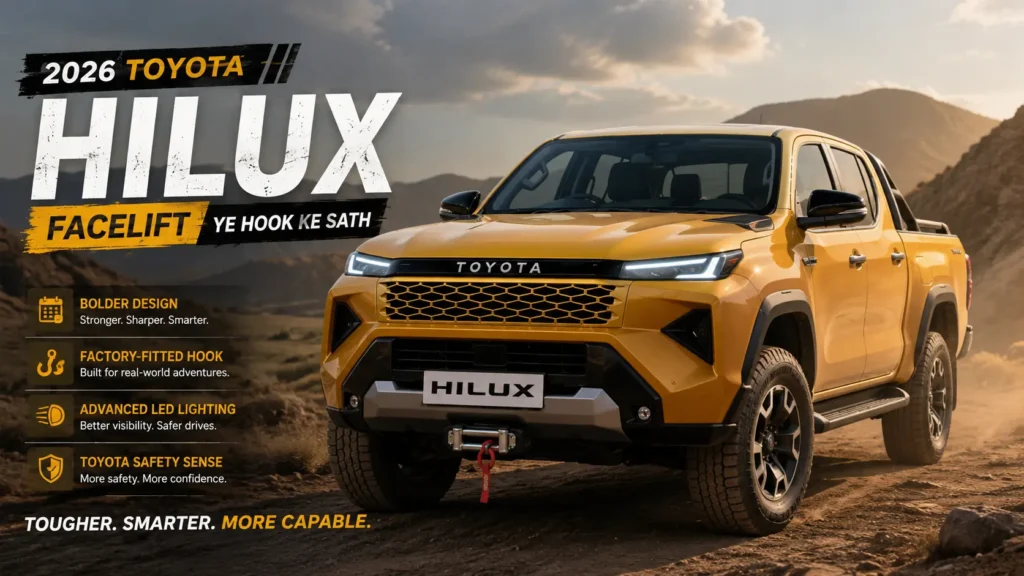
Also Read: 2026 Toyota Hilux Facelift Launched in India at Rs 31.99 Lakh – New 4×2 Variant, 204 HP
Engine and Performance – Power vs Efficiency
This is where the Toyota Hilux makes its strongest case. The 2.8-litre four-cylinder turbocharged diesel engine produces 204 HP and a massive 500 Nm of torque, paired exclusively with a six-speed automatic transmission. These figures are genuinely impressive for the segment – 500 Nm of torque means effortless towing, confident overtaking on highways, and the kind of low-end grunt that makes off-road crawling feel relaxed rather than strained. The engine is BS6 Phase 2 compliant and benefits from Toyota’s decades of diesel engineering expertise.
The Isuzu D-Max V-Cross uses a smaller 1.9-litre four-cylinder turbocharged diesel engine producing 163 HP and 360 Nm of torque. While these figures are respectable, the gap compared to the Hilux is significant – 41 HP less power and 140 Nm less torque. In real-world driving, this translates to the Hilux feeling noticeably more effortless during highway overtaking, heavy load carrying, and steep gradient climbing. The V-Cross is adequate for most situations, but the Hilux has reserves of power that the Isuzu simply cannot match.
However, the V-Cross’s smaller engine has its own advantages. The 1.9-litre unit is lighter, which contributes to better fuel efficiency. The V-Cross delivers approximately 12.4 kmpl according to ARAI certification, and real-world figures of 10 to 12 kmpl are achievable. The Hilux, with its larger and more powerful engine, typically delivers 8 to 10 kmpl in real-world conditions. Over the course of ownership, this efficiency difference translates to meaningful fuel cost savings for the V-Cross owner.
The availability of a manual transmission on the V-Cross is another advantage for buyers who prefer the engagement and control of a manual gearbox, particularly during off-road driving where precise throttle and gear control can be crucial. The Hilux’s automatic-only approach is more convenient for daily driving but removes the option for those who enjoy rowing through gears.
Features and Technology – Hilux Steps Ahead
The 2026 Hilux facelift brings significant technology upgrades that give it a clear advantage in the features department. The 12.3-inch touchscreen infotainment system is substantially larger than what the V-Cross offers, providing a more immersive experience for navigation and media. Toyota’s i-Connect connected car technology adds remote monitoring, geo-fencing, and emergency assistance capabilities that the V-Cross lacks.
The Hilux also gains a 360-degree camera system for the first time, which is invaluable for parking and manoeuvring a vehicle of this size in urban environments. LED headlamps with integrated DRLs, diamond-cut alloy wheels, a rear deck boarding step, and tailgate assist with lockable rear door round out the Hilux’s feature advantages.
The D-Max V-Cross, while not as feature-rich, offers a competent package that covers the essentials. The Z Prestige variant includes a touchscreen infotainment system with smartphone connectivity, automatic climate control, cruise control, and a reasonable set of convenience features. For buyers who prioritise capability over technology, the V-Cross provides everything necessary without the premium pricing of the Hilux.
Safety – Toyota’s Advantage
Safety is an area where the Hilux pulls ahead convincingly. The 2026 Hilux comes with seven airbags, ABS with EBD and Brake Assist, TPMS, 360-degree camera, and Toyota’s GOA body structure. This is a comprehensive safety package that provides confidence for both occupants and the driver.
The D-Max V-Cross offers six airbags, ABS with EBD, and stability control, but lacks the 360-degree camera and the additional seventh airbag that the Hilux provides. While both vehicles offer adequate safety for the segment, the Hilux’s more comprehensive package gives it an edge, particularly for buyers who prioritise occupant protection.
Off-Road Capability
Both vehicles are genuinely capable off-road machines, and this is where the pickup truck format truly shines compared to conventional SUVs. The Hilux 4×4 variants feature Multi-Terrain Select with modes for different surfaces, Downhill Assist Control, and a low-range transfer case. The combination of 500 Nm torque and electronic aids means the Hilux can tackle serious terrain with confidence and composure.
The D-Max V-Cross 4×4 offers shift-on-the-fly four-wheel drive, a rear differential lock, and hill descent control. While it lacks the Hilux’s Multi-Terrain Select system, the V-Cross’s mechanical capability is proven and reliable. The lighter weight of the V-Cross can actually be an advantage in certain off-road situations, as less mass means less momentum to control on descents and less likelihood of getting bogged in soft surfaces.
In practical off-road terms, both vehicles will handle 95 percent of the terrain that Indian adventure enthusiasts are likely to encounter. The Hilux’s additional power provides a margin of safety in extreme situations, but the V-Cross is no slouch and has proven its capability across thousands of kilometres of Indian off-road trails.
Ownership Experience – Brand vs Value
Toyota’s brand strength in India is undeniable. The company has one of the most extensive service networks among premium manufacturers, and Toyota vehicles consistently command strong resale values. The Hilux benefits from this brand halo – it will likely depreciate less than the V-Cross over a five-year ownership period, and finding a buyer when you decide to sell will be easier.
Isuzu’s network is smaller with approximately 43 dealer outlets across India, compared to Toyota’s significantly larger presence. However, Isuzu has built a loyal following among pickup truck enthusiasts, and the V-Cross community is active and supportive. Parts availability and service quality at Isuzu dealerships are generally good, though the limited network can be a concern for buyers in smaller cities.
The V-Cross’s lower purchase price means lower insurance premiums, lower loan EMIs, and more money available for modifications and accessories – which is how many pickup truck owners personalise their vehicles. The Rs 3 to Rs 6.5 lakh saved by choosing the V-Cross over the Hilux can fund a comprehensive modification package including off-road bumpers, suspension upgrades, lighting, and camping equipment.
The Verdict
Choose the Toyota Hilux if you want the most powerful engine in the segment, the latest technology features, Toyota’s brand strength and resale value, comprehensive safety, and the prestige of owning India’s most premium pickup truck. The Hilux is the better vehicle on paper and in execution, but it commands a significant premium for these advantages.
Choose the Isuzu D-Max V-Cross if you want genuine pickup truck capability at a substantially lower price, prefer the option of a manual gearbox, value fuel efficiency over outright power, and plan to invest the savings in modifications and accessories. The V-Cross is the smarter financial choice for buyers who prioritise value and capability over brand prestige and technology.
FAQ
1. Which is better – Toyota Hilux or Isuzu D-Max V-Cross?
The Hilux is better in power (204 HP vs 163 HP), features (12.3-inch screen, 360° camera), safety (7 airbags), and brand value. The V-Cross is better in price (Rs 6.5L cheaper), fuel efficiency, manual gearbox option, and value for money.
2. What is the price difference between Hilux and V-Cross?
The Hilux starts at Rs 31.99 lakh while the V-Cross starts at Rs 25.50 lakh – a difference of Rs 6.49 lakh. In comparable 4×4 automatic specs, the difference narrows to approximately Rs 3.41 lakh.
3. Which pickup has more power – Hilux or V-Cross?
The Toyota Hilux with 204 HP and 500 Nm is significantly more powerful than the Isuzu V-Cross with 163 HP and 360 Nm. The Hilux has 41 HP and 140 Nm more torque.
4. Is Isuzu D-Max V-Cross reliable?
Yes, Isuzu has a strong reputation for diesel engine reliability globally. The 1.9-litre engine is proven across multiple markets and the V-Cross has built a loyal following in India for its durability and low maintenance costs.
5. Does Toyota Hilux come in manual?
No, the 2026 Toyota Hilux is available only with a 6-speed automatic transmission. The Isuzu D-Max V-Cross offers both manual and automatic options.
For more such updates on latest cars, bikes and EVs stay connected to MotorMitra. #gaadiyonkismartguide