
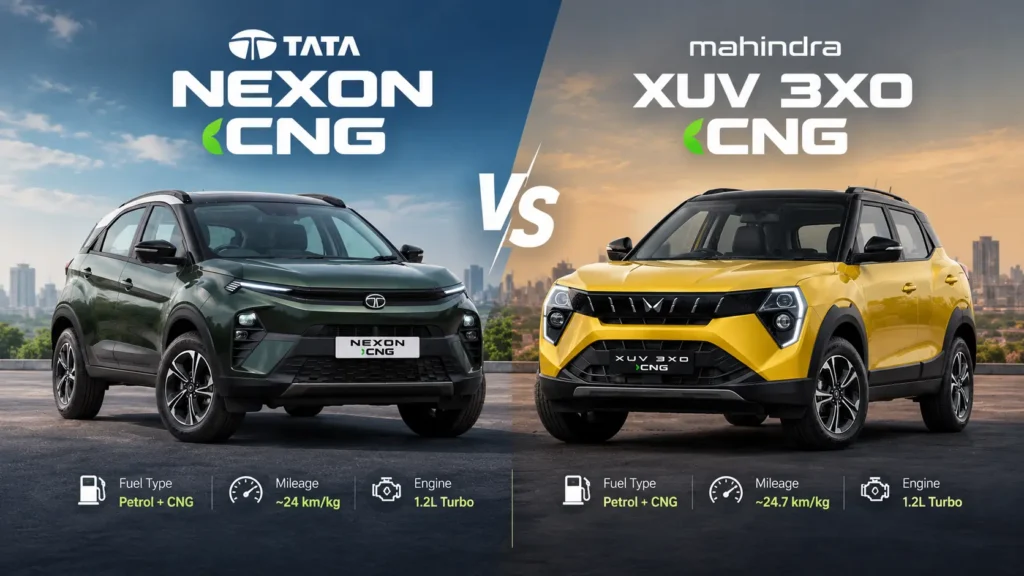
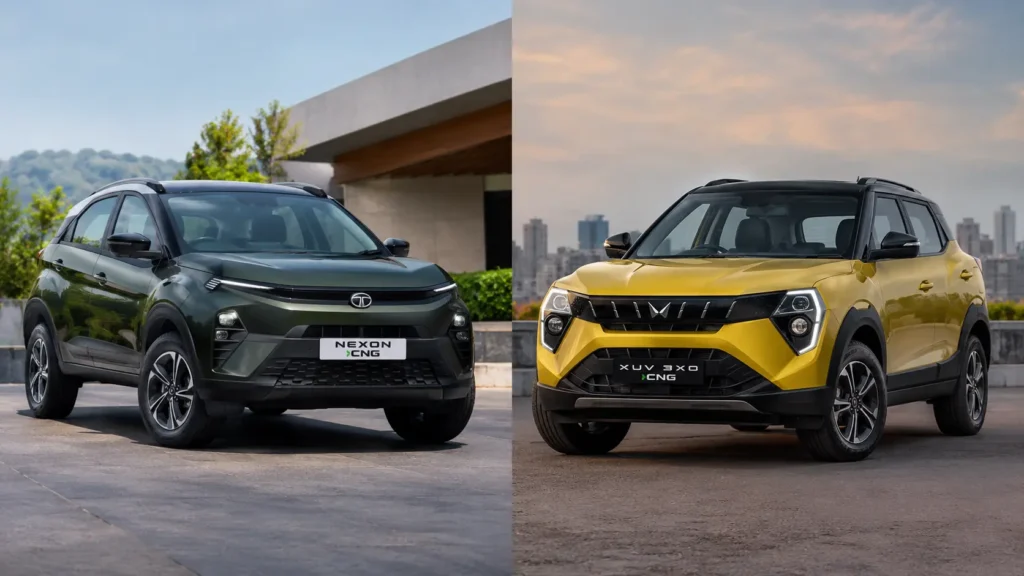
The compact SUV market in India has a new contender in the CNG segment. With the launch of the Mahindra XUV 3XO CNG, buyers who were considering the Tata Nexon iCNG now have another option to explore. Both SUVs combine turbocharged petrol engines with factory-fitted CNG technology, but they take slightly different approaches to performance, practicality and features.
Tata Nexon CNG vs Mahindra XUV 3XO CNG: Price Comparison
Price is an important starting point, especially for buyers upgrading from a hatchback or a smaller car.
The Tata Nexon iCNG has a lower entry price, making it an attractive option for budget-conscious buyers. The Mahindra XUV 3XO CNG, meanwhile, enters the market with a higher starting price but offers a stronger engine output.
| Specification | Tata Nexon iCNG | Mahindra XUV 3XO CNG |
|---|---|---|
| Starting price | ₹8.35 lakh | ₹9.99 lakh |
| Top variant price | ₹13.42 lakh | ₹12.27 lakh |
| Fuel type | Petrol/CNG | Petrol/CNG |
| Engine | 1.2-litre turbo-petrol | 1.2-litre turbo-petrol |
| Transmission | Manual and select additional options by variant | 6-speed manual |
| Claimed CNG mileage | Around 24 km/kg | 24.7 km/kg |
The Nexon has the advantage if keeping the initial purchase cost low is the priority. However, the XUV 3XO CNG becomes an interesting alternative for buyers who are willing to spend more on a more powerful CNG-powered SUV.
Also Read:https:https://motormitra.in/tata-festive-offers-oct-2026/
Engine and Performance: Which SUV Is More Powerful?
This is where the Mahindra XUV 3XO CNG has a clear advantage on paper.
The Tata Nexon iCNG uses a 1.2-litre turbocharged petrol engine. In CNG mode, it produces approximately 74 bhp and 170 Nm of torque. The twin-cylinder arrangement helps Tata make better use of the boot area than a conventional single-cylinder installation.
The Mahindra XUV 3XO CNG also gets a 1.2-litre turbocharged engine, but its output in CNG mode is higher. It produces approximately 110 bhp and 200 Nm of torque, paired with a six-speed manual gearbox.
This difference could matter to buyers who frequently travel with passengers, drive on highways or want stronger acceleration when overtaking. The XUV 3XO CNG’s higher output gives it an advantage in the specifications department.
That does not automatically mean every driver will find it better. Driving comfort, throttle response, engine refinement and performance under real-world conditions also matter.
Mileage: Tata Nexon CNG vs Mahindra XUV 3XO CNG
For most CNG buyers, fuel efficiency is one of the biggest reasons to consider this technology in the first place.
Mahindra claims a mileage of 24.7 km/kg for the XUV 3XO CNG. Tata’s Nexon iCNG has a claimed efficiency of approximately 24 km/kg, depending on the specific version and published specification.
On paper, the difference is relatively small. Actual mileage will depend on traffic, driving style, passenger load, tyre pressure, road conditions and how often the vehicle switches between petrol and CNG.
In a real-world test reported by CarWale, the Nexon CNG manual returned 11.65 km/kg in the city and 17.5 km/kg on the highway. These figures illustrate why buyers should not expect the claimed efficiency in every driving situation.
If you mainly drive in congested urban traffic, compare real-world owner experiences rather than relying only on the manufacturer’s claimed mileage. Your monthly savings will depend on both fuel consumption and local CNG prices.
Boot Space and Everyday Practicality
CNG technology has traditionally presented a challenge for SUV buyers: where do you keep the luggage when the fuel cylinders occupy part of the boot?
Both Tata and Mahindra use twin-cylinder arrangements to make their CNG models more practical. Instead of relying on one large cylinder, the setup uses two smaller cylinders positioned lower in the luggage area.
The arrangement helps improve packaging, but it does not eliminate the impact on usable luggage space.
According to published specifications, the Tata Nexon offers approximately 321 litres of boot space, while the Mahindra XUV 3XO offers around 270 litres.
This gives the Nexon an advantage for families who regularly carry shopping bags, suitcases or luggage for weekend trips. Buyers should still check the actual luggage area in person, because the shape of the boot and the space available around the cylinders can affect how easily larger items fit.
For someone who mostly drives alone or carries only a few bags, the difference may not be a major concern. For a family that travels frequently, it could be an important deciding factor.
Features and Interior: Which SUV Feels Better Equipped?
Both SUVs target buyers who want more than basic transportation. Their appeal includes modern infotainment systems, convenient cabin equipment and features that make daily driving more comfortable.
Tata Nexon iCNG
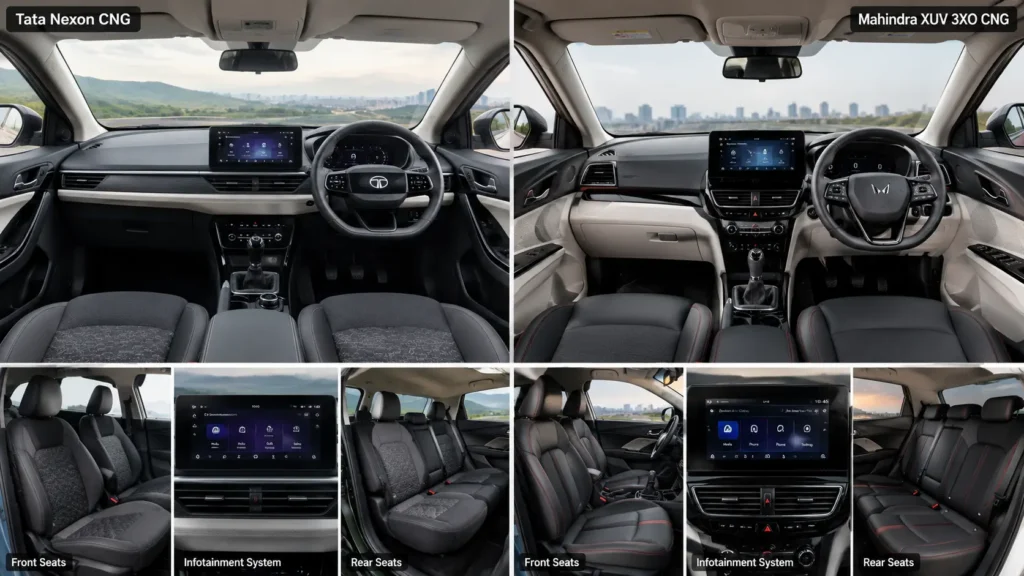
The Nexon CNG range includes features such as touchscreen infotainment, automatic climate control and a sunroof on selected variants. Higher-spec versions offer additional equipment, giving buyers more choice depending on their budget.
One advantage is the wider spread of variants, which makes it easier to choose a configuration that matches different budgets and preferences.
Mahindra XUV 3XO CNG
The XUV 3XO CNG brings a modern cabin, a touchscreen infotainment system, climate control and a sunroof on selected variants. The broader XUV 3XO range is also known for equipment such as a panoramic sunroof and a 360-degree camera, although buyers should check which features are included in each CNG trim.
There is an important distinction here: not every feature available in the petrol range is necessarily offered on every CNG variant.
The Nexon has an advantage for buyers seeking a wider selection of CNG trims, while the XUV 3XO could appeal to those who prioritise performance and a feature-rich cabin. Compare the exact variants rather than assuming that both models offer identical equipment at similar prices.
Also Read:https://motormitra.in/tesla-roadster-2026-price-specs-release-date-faqs/
Safety: What Should Buyers Check?
Safety should be considered alongside price, mileage and features when choosing a compact SUV.
Both models belong to a segment where buyers increasingly expect multiple airbags, electronic safety systems and useful driver-assistance features. However, the equipment can vary by variant.
Before booking either SUV, check the following:
- Number of airbags offered on the specific variant.
- Availability of electronic stability control and other active safety systems.
- Rear parking sensors or camera, depending on the trim.
- Seatbelt reminders and other occupant-protection equipment.
- The applicability of published crash-test ratings to the exact model and version being considered.
Do not assume that a safety rating for one variant or model year automatically applies to every version. Check the latest manufacturer specifications and the relevant crash-test documentation before making a final decision.
Which SUV Is Better for City Driving and Highway Trips?
The right choice depends on how you intend to use your car.
For city driving, the Nexon CNG’s lower starting price and larger stated boot capacity may be useful advantages. Buyers who spend most of their time commuting can focus on running costs, ease of driving and the comfort of the selected variant.
The XUV 3XO CNG’s higher engine output could appeal to drivers who regularly travel on highways or want more performance from their CNG SUV. Its claimed mileage is also marginally higher, although actual consumption will vary.
For family road trips, check rear-seat comfort, luggage capacity and the availability of convenient features in person. A test drive with your typical passengers can reveal differences that a specification sheet cannot.
Tata Nexon CNG vs Mahindra XUV 3XO CNG: Which One Should You Buy?
There is no single winner for every buyer, because the two SUVs prioritise slightly different things.
Choose the Tata Nexon iCNG if:
- You want a lower starting purchase price.
- You need more stated boot space for family luggage.
- You prefer having a wider range of CNG variants to consider.
- Your main priority is balancing everyday usability with fuel savings.
Consider the Mahindra XUV 3XO CNG if:
- You want higher power and torque figures in CNG mode.
- You value its claimed mileage advantage.
- You are comfortable with its higher entry price.
- You find a variant that offers the features you want within your budget.
Final Verdict
The Tata Nexon iCNG and Mahindra XUV 3XO CNG bring two different strengths to India’s growing CNG SUV market.
The Nexon makes a strong case for buyers who value affordability, luggage capacity and a wider choice of variants. The XUV 3XO CNG stands out for its higher engine output and slightly better claimed fuel efficiency.
Before making a decision, compare the exact variants, check the latest ex-showroom and on-road prices in your city, and take both SUVs for a test drive. Also consider local CNG availability, since convenient refuelling can make a significant difference to everyday ownership.
For buyers who want lower running costs without moving to a smaller vehicle, both SUVs deserve a place on the shortlist. The better purchase will ultimately depend on whether you value price and practicality more than additional performance.