India’s automotive landscape is shifting faster than ever. Rising fuel prices, blended petrol concerns, and growing environmental awareness have pushed buyers toward electrified powertrains. Yet, pure electric vehicles still face challenges around charging infrastructure and range anxiety. That is exactly where hybrid technology steps in as the practical middle ground — offering the familiarity of petrol with the efficiency of electric power.
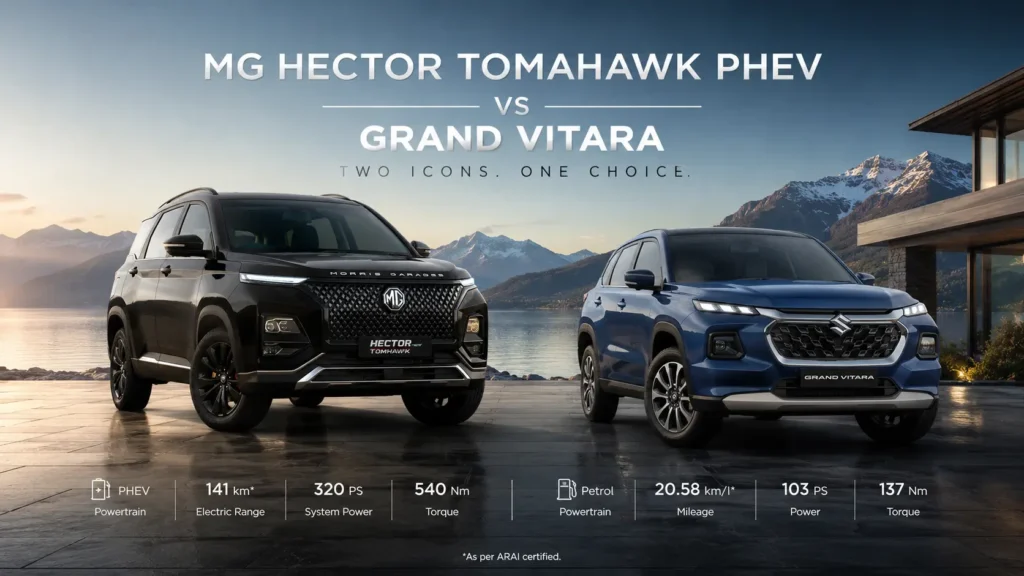
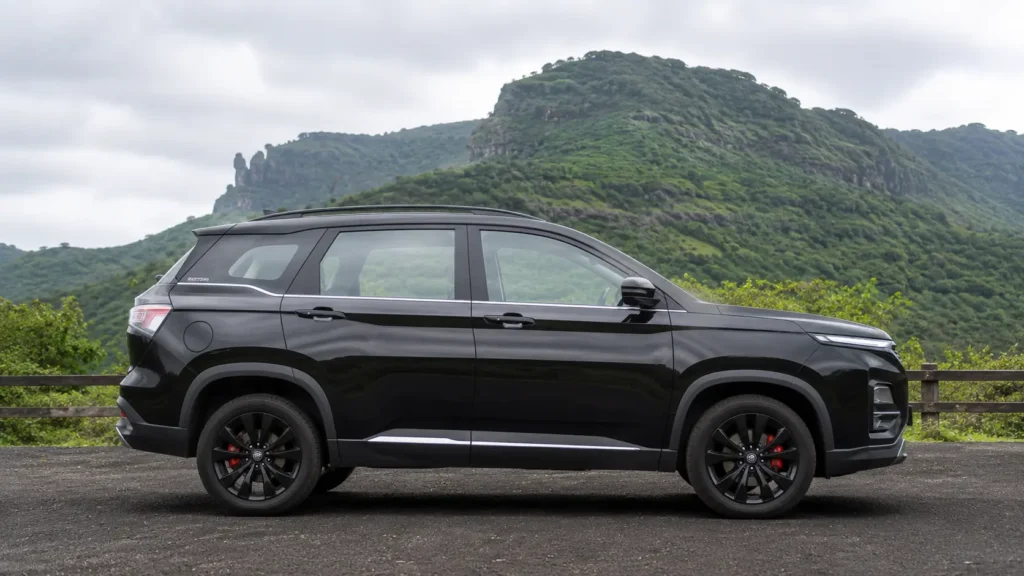
Two SUVs currently represent the two distinct flavours of hybrid technology available to Indian buyers. The MG Hector Tomahawk PHEV, launched on 26 August 2026, introduces plug-in hybrid (PHEV) technology to the mass-market segment for the first time. On the other side sits the Maruti Suzuki Grand Vitara, a proven strong hybrid that has been winning hearts since 2022 with its exceptional fuel efficiency. But how different are these two approaches, and which one makes more sense for your daily life?
Let us break it all down.
Understanding Hybrid Technology: The Basics
Before diving into the comparison, it is important to understand what “hybrid” actually means. In the broadest sense, any vehicle powered by more than one energy source qualifies as a hybrid. However, in everyday conversation, the term almost always refers to cars that combine a petrol engine with an electric motor and a battery pack.
Every hybrid system — whether strong hybrid or plug-in hybrid — shares three core components: an internal combustion engine (ICE), a battery pack managed by a battery management system (BMS), and one or more electric motors. These components work together intelligently to maximise fuel efficiency and minimise emissions.
The critical difference lies in how large the battery is, whether it can be charged externally, and how far the car can travel on electric power alone. This single distinction creates two very different ownership experiences.
How Does the Maruti Grand Vitara Strong Hybrid Work?
The Maruti Suzuki Grand Vitara strong hybrid uses Toyota’s proven Intelligent Electric Hybrid system. It pairs a 1.5-litre, three-cylinder M15D-FXE Atkinson-cycle petrol engine producing approximately 92 PS with an electric motor generating around 80 PS. The combined system output stands at roughly 116 PS, channelled through an eCVT (electronic continuously variable transmission) to the front wheels.
The battery pack is a compact 0.76 kWh lithium-ion unit operating at 177.6 volts. This small battery is designed to be self-charging — it recuperates energy through regenerative braking and engine-driven charging. You never need to plug it in.
The system operates across multiple modes seamlessly:
- EV Mode: At low speeds and light throttle inputs, the car runs purely on electric power for short distances — typically a few kilometres at best.
- Series Hybrid Mode: The petrol engine runs solely to charge the battery while the electric motor drives the wheels. This is common in stop-and-go city traffic.
- Parallel Hybrid Mode: Both the engine and motor work together to deliver maximum power, useful during overtaking or climbing steep gradients.
- Engine Mode: At sustained highway speeds, the petrol engine alone drives the wheels, as the electric motor becomes less efficient at higher velocities.
The result is an ARAI-certified mileage of approximately 27.97 kmpl, making the Grand Vitara one of the most fuel-efficient SUVs in India. The Grand Vitara hybrid is priced between ₹10.77 lakh and ₹19.77 lakh (ex-showroom), making it accessible to a wide range of buyers.
How Does the MG Hector Tomahawk PHEV Work?
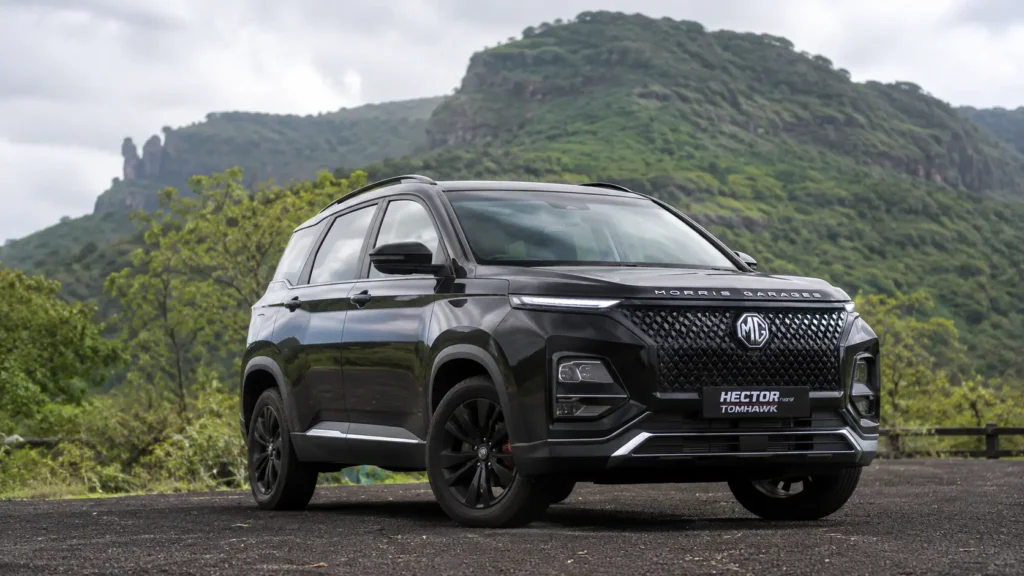
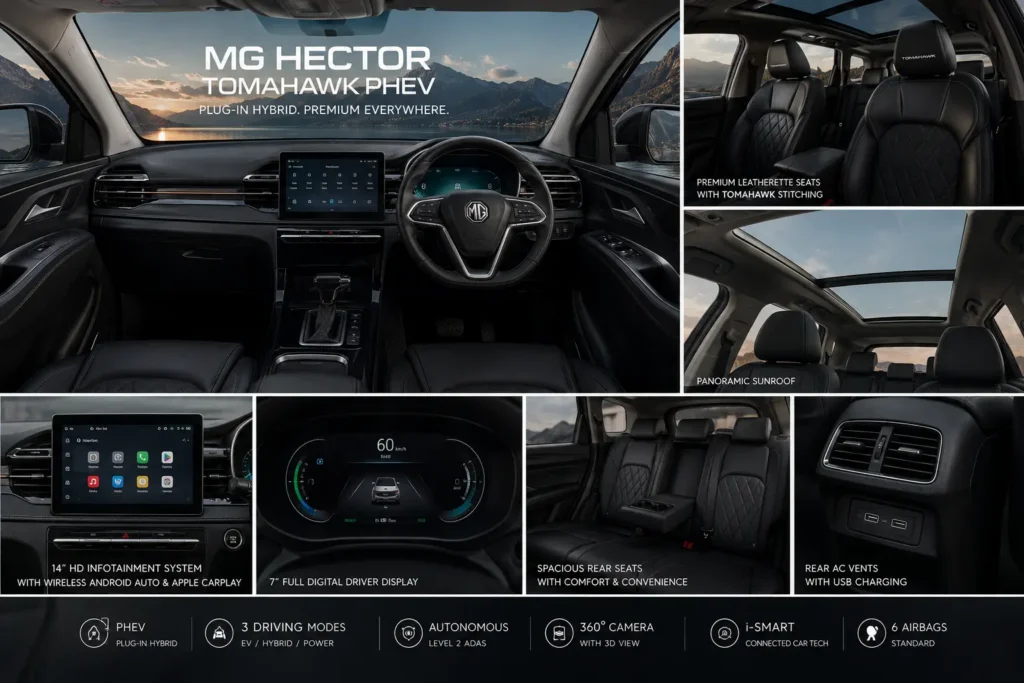
The MG Hector Tomahawk PHEV takes the hybrid concept several steps further. It pairs a 1.5-litre naturally aspirated Atkinson-cycle petrol engine with a substantially more powerful 148 kW electric motor, connected through a Dedicated Hybrid Transmission (DHT). The combined system output is a healthy 198 PS and 230 Nm of torque, making it significantly more powerful than the Grand Vitara.
The game-changer here is the battery. Instead of a sub-1 kWh unit, the Hector Tomahawk PHEV carries a massive 20.5 kWh lithium-ion battery pack. This large battery enables a claimed pure electric range of over 115 km — enough for most daily city commutes without burning a single drop of petrol.
And here is the headline figure: MG claims a combined range of over 1,100 km on a single tank of fuel plus a full battery charge. The 0–100 km/h sprint is dispatched in approximately 9 seconds.
The PHEV operates in the same four modes as a strong hybrid — EV, series, parallel, and engine — but the dramatically larger battery means it spends far more time in pure EV mode. Crucially, the battery can be charged externally using a home wall-box charger or a public AC charging station, which is something the Grand Vitara simply cannot do.
The Hector Tomahawk PHEV is priced between ₹25.69 lakh and ₹27.80 lakh (ex-showroom). MG also offers a Battery-as-a-Service (BaaS) option starting at ₹21.79 lakh plus ₹3.20 per km for battery rental, lowering the upfront cost.
Head-to-Head Specification Comparison
| Parameter | MG Hector Tomahawk PHEV | Maruti Suzuki Grand Vitara Hybrid |
|---|---|---|
| Engine | 1.5L NA Atkinson-cycle petrol | 1.5L 3-cyl Atkinson-cycle petrol |
| Electric Motor | 148 kW | 59 kW (80 PS) |
| Combined Output | 198 PS / 230 Nm | ~116 PS |
| Battery Capacity | 20.5 kWh | 0.76 kWh |
| Pure EV Range | 115+ km | 2–3 km (limited) |
| Total Claimed Range | 1,100+ km | 1,000+ km (fuel tank only) |
| Transmission | DHT (Automatic) | eCVT (Automatic) |
| External Charging | Yes (plug-in) | No (self-charging only) |
| Seating | 7-seater | 5-seater |
| Dimensions (L) | 4,745 mm | ~4,345 mm |
| Wheelbase | 2,810 mm | ~2,600 mm |
| Ground Clearance | 230 mm | ~210 mm |
| Price (ex-showroom) | ₹25.69 – ₹27.80 lakh | ₹10.77 – ₹19.77 lakh |
| BaaS Option | Yes (from ₹21.79 lakh + ₹3.20/km) | Not available |
Also Read:https://motormitra.in/2026-skoda-slavia-hits-and-misses/
Key Differences That Matter to Buyers
1. Battery Size and Electric Range
This is the most fundamental difference. The Grand Vitara’s 0.76 kWh battery is designed purely to assist the petrol engine and improve fuel economy. It can run in EV mode for only a couple of kilometres at low speeds. The Hector Tomahawk PHEV’s 20.5 kWh battery, on the other hand, delivers over 115 km of zero-emission driving. For someone with a daily office commute of 30–50 km, the PHEV could run entirely on electricity for days without needing petrol.
2. Charging Flexibility
The Grand Vitara is a self-charging hybrid — you never plug it in, and the battery charges itself through regenerative braking and engine power. This is convenient but limits the electric range. The Hector Tomahawk PHEV can be plugged into a standard home charger overnight, topping up the battery for the next day’s commute. This makes it behave like an EV for short trips and a hybrid for long journeys.
3. Performance
With 198 PS on tap versus approximately 116 PS, the Hector Tomahawk PHEV is the clear winner in outright performance. The larger electric motor provides instant torque, making city driving effortless and highway overtakes confident. The Grand Vitara, while adequate, has been noted by reviewers for lacking a performance “punch.”
4. Size and Practicality
The Hector Tomahawk PHEV is a substantially larger vehicle at 4,745 mm in length with a 2,810 mm wheelbase and seven-seat configuration. It is built for families that need space. The Grand Vitara is a compact five-seater SUV, easier to manoeuvre in tight city spaces and parking lots.
5. Price and Value
There is a significant price gap. The Grand Vitara hybrid starts at roughly ₹15 lakh for the strong hybrid variants, while the Hector Tomahawk PHEV begins at ₹25.69 lakh. However, MG’s BaaS programme narrows this gap to ₹21.79 lakh upfront. For buyers who drive primarily in the city, the PHEV’s near-zero fuel costs could offset the higher purchase price over time.
Running Cost Analysis: Who Saves More?
For a daily commuter covering 40 km in the city:
- Grand Vitara Hybrid: At ~28 kmpl and petrol at ₹105/litre, the daily fuel cost is approximately ₹150, or about ₹4,500 per month.
- Hector Tomahawk PHEV (on electric): At roughly ₹7–8 per kWh for home charging and ~7 km per kWh efficiency, the daily electricity cost is approximately ₹45–50, or about ₹1,500 per month.
The PHEV could save you around ₹3,000 per month or ₹36,000 per year on fuel alone for city commuting. Over five years, that adds up to ₹1.8 lakh — a meaningful offset against the higher purchase price.
PHEV and Hybrid Cars Currently Available in India
| Plug-in Hybrid (PHEV) | Strong/Regular Hybrid |
|---|---|
| MG Hector Tomahawk PHEV | Maruti Suzuki Grand Vitara |
| BMW M5 | Toyota Urban Cruiser Hyryder |
| Mercedes-Benz S-Class | Honda City Hybrid |
| Range Rover Sport | Toyota Vellfire |
| BYD Seal U DM-i (Upcoming) | Toyota Innova Hycross |
As the table shows, affordable PHEV options are still rare in India, making the Hector Tomahawk PHEV a pioneering product in the mass-market space.
Which One Should You Buy?
The answer depends entirely on your driving patterns and budget:
Choose the Maruti Grand Vitara Hybrid if:
- You want a proven, affordable, and hassle-free hybrid experience
- Your driving is a mix of city and highway with no access to home charging
- You prioritise low purchase price and excellent resale value
- You prefer a compact, easy-to-drive SUV for urban environments
Choose the MG Hector Tomahawk PHEV if:
- You have a daily city commute under 100 km and access to home or workplace charging
- You want the flexibility of an EV for daily use and a petrol car for road trips
- You need a larger, seven-seat SUV for family use
- You are willing to invest more upfront for significantly lower running costs
- You want stronger performance and the latest hybrid technology
Final Verdict
Both the MG Hector Tomahawk PHEV and the Maruti Suzuki Grand Vitara represent smart, forward-thinking choices in India’s evolving automotive market. The Grand Vitara remains the sensible, budget-friendly hybrid that delivers outstanding mileage without any lifestyle changes. The Hector Tomahawk PHEV, however, pushes the envelope by offering genuine electric driving capability alongside the safety net of a petrol engine — a true bridge between ICE and EV ownership.
If India’s charging infrastructure continues to grow and fuel prices keep climbing, the PHEV formula could become the dominant powertrain choice in the years ahead. For now, having both options on the market is a win for every Indian car buyer.
(FAQs)
1. What is the main difference between a plug-in hybrid (PHEV) and a strong hybrid?
The primary difference lies in the battery size and charging capability. A plug-in hybrid like the MG Hector Tomahawk PHEV has a large battery (20.5 kWh) that can be charged externally via a wall charger or charging station, offering over 115 km of pure electric range. A strong hybrid like the Maruti Grand Vitara has a small battery (0.76 kWh) that charges itself through regenerative braking and the engine — it cannot be plugged in and offers only 2–3 km of limited EV range.
2. Can the MG Hector Tomahawk PHEV run entirely on electricity?
Yes. The Hector Tomahawk PHEV can run in pure EV mode for over 115 km on a full charge. If your daily commute is within this range and you charge the car overnight at home, you can drive for days without using any petrol at all.
3. Does the Maruti Grand Vitara hybrid need to be charged?
No. The Grand Vitara strong hybrid is a self-charging hybrid. Its battery recharges automatically through regenerative braking and engine-driven charging during normal driving. You never need to plug it into any external power source.
4. Which is more fuel-efficient — the Hector Tomahawk PHEV or the Grand Vitara hybrid?
It depends on your usage. For city commutes under 100 km, the Hector Tomahawk PHEV is significantly cheaper to run because it can operate entirely on electricity (costing roughly ₹1,500/month). For mixed city-highway driving without access to charging, the Grand Vitara hybrid’s 27.97 kmpl ARAI mileage makes it extremely efficient without any charging hassle.
5. What is the price difference between the two cars?
The Maruti Grand Vitara hybrid range starts at approximately ₹10.77 lakh and goes up to ₹19.77 lakh (ex-showroom). The MG Hector Tomahawk PHEV is priced between ₹25.69 lakh and ₹27.80 lakh (ex-showroom). However, MG offers a Battery-as-a-Service (BaaS) plan starting at ₹21.79 lakh plus ₹3.20 per km for battery rental, which reduces the upfront cost.
6. How long does it take to charge the MG Hector Tomahawk PHEV at home?
Using a standard home AC wall-box charger, the 20.5 kWh battery of the Hector Tomahawk PHEV can be fully charged overnight in approximately 6–8 hours, making it convenient for daily use when plugged in before bedtime.
7. Is the MG Hector Tomahawk PHEV available as a 5-seater?
No. The Hector Tomahawk PHEV is currently available only in a 7-seater configuration. If you need a 5-seater option from MG’s Tomahawk range, you can consider the Hector Tomahawk EV, which is offered in both 5-seater and 7-seater layouts.
8. Which hybrid SUV has better resale value in India?
As of 2026, the Maruti Suzuki Grand Vitara enjoys stronger resale value due to Maruti’s extensive service network, brand trust, and the car’s proven track record since 2022. The MG Hector Tomahawk PHEV is a newly launched product, so its long-term resale value is yet to be established.
9. Are there other affordable PHEV options in India besides the Hector Tomahawk PHEV?
Currently, the MG Hector Tomahawk PHEV is the only mass-market affordable PHEV in India. Other PHEVs like the BMW M5, Mercedes-Benz S-Class, and Range Rover Sport are luxury vehicles priced significantly higher. The BYD Seal U DM-i is an upcoming affordable PHEV expected to launch soon.
10. Can I use the MG Hector Tomahawk PHEV for long road trips?
Absolutely. Once the electric range is depleted, the 1.5-litre petrol engine seamlessly takes over and also recharges the battery while driving. MG claims a combined range of over 1,100 km on a full battery charge plus a full tank of fuel, making it an excellent road-trip companion with minimal fuel stops.
Disclaimer: All prices mentioned are ex-showroom and subject to change. Specifications and range figures are based on manufacturer claims and may vary under real-world driving conditions.
For more such updates on latest cars, bikes and EVs stay connected to MotorMitra. #gaadiyonkismartguide