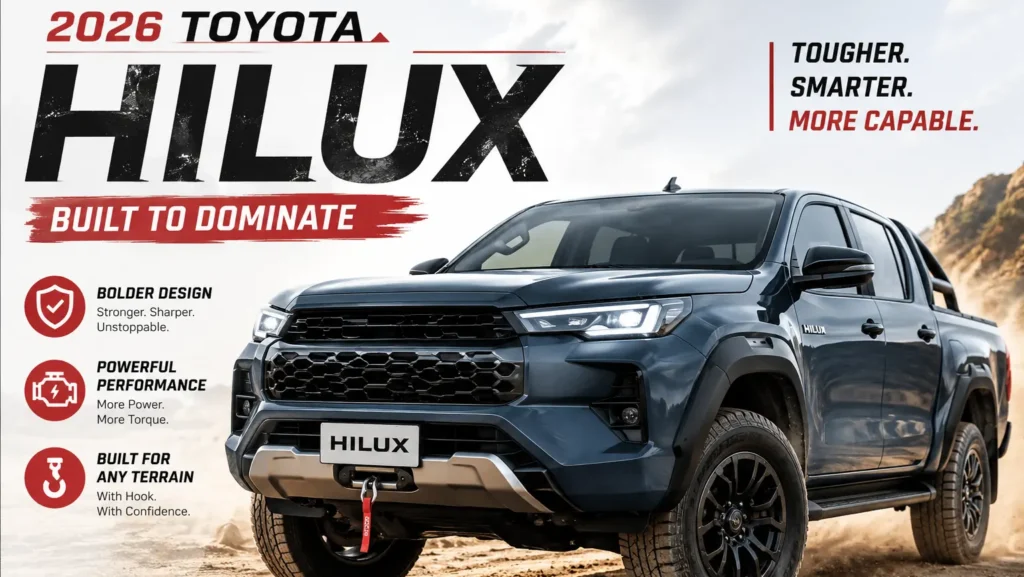
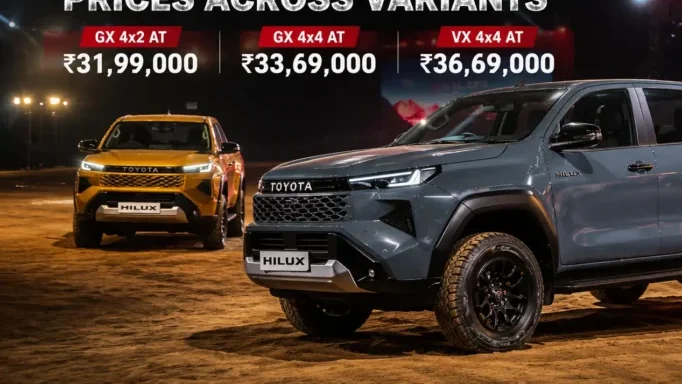
The Toyota Hilux is one of those vehicles that inspires genuine passion among its owners. It is not just a mode of transportation – it is a lifestyle choice, a statement of intent, and for many, a vehicle that enables adventures that would be impossible in a conventional car or SUV. The 2026 facelift has made the Hilux more accessible and more feature-rich than ever before, but at prices starting from Rs 31.99 lakh, it remains a significant investment that demands careful consideration. Not everyone needs a pickup truck, and not everyone who wants one should necessarily buy one. Here are five compelling reasons why the 2026 Hilux deserves your attention, and three honest reasons why you might want to consider alternatives.
Reasons to Buy
1. The 2.8-Litre Diesel is a Masterpiece of Engineering
The Hilux’s 2.8-litre four-cylinder turbocharged diesel engine producing 204 HP and 500 Nm of torque is genuinely one of the finest diesel engines available in any vehicle sold in India today. The 500 Nm torque figure is extraordinary – it provides the kind of effortless pulling power that makes the Hilux feel unstoppable regardless of the load it is carrying or the gradient it is climbing. Whether you are towing a trailer loaded with equipment, climbing a steep mountain pass fully loaded with camping gear, or simply overtaking a truck on the highway, the engine delivers power with a calm confidence that inspires trust.
Toyota’s diesel engineering heritage spans decades, and the 1GD-FTV engine in the Hilux is the culmination of that experience. It is refined enough for comfortable daily driving, powerful enough for demanding work, and reliable enough to last hundreds of thousands of kilometres with basic maintenance. The six-speed automatic transmission complements the engine perfectly, providing smooth shifts during normal driving and holding gears appropriately when you need maximum performance. The 80-litre fuel tank means you can cover over 800 km on a single fill during highway driving – genuine touring capability that eliminates fuel anxiety on long road trips.
Also Read: 2026 Toyota Hilux Facelift Launched in India at Rs 31.99 Lakh – New 4×2 Variant, 204 HP
2. The New 4×2 Makes Hilux Ownership Accessible
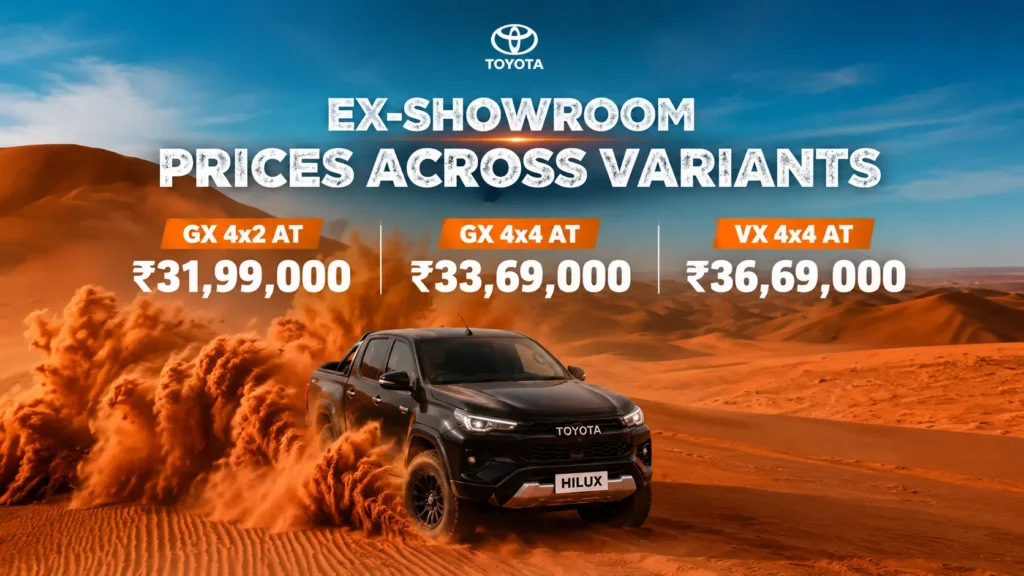
The introduction of the GX 4×2 AT at Rs 31.99 lakh is a game-changing move by Toyota. Previously, the Hilux’s 4×4-only lineup meant that buyers who wanted the pickup truck lifestyle but did not need off-road capability were forced to pay for hardware they would never use. The 4×2 variant removes this barrier, offering the complete Hilux experience – the commanding driving position, the muscular styling, the open cargo bed, the powerful diesel engine, and Toyota’s legendary reliability – at a more accessible price point.
For urban buyers who love the idea of a pickup truck but live in cities where four-wheel drive is unnecessary, the 4×2 is the perfect proposition. It is simpler mechanically, potentially more fuel-efficient, and costs Rs 1.70 lakh less than the equivalent 4×4. This is Toyota acknowledging that the Hilux’s appeal extends far beyond the adventure community – it is a lifestyle vehicle that resonates with anyone who values individuality, practicality, and the freedom that an open cargo bed provides.
3. Unmatched Versatility and Practicality
No other vehicle type offers the combination of passenger comfort and cargo versatility that a pickup truck provides. The Hilux’s cabin seats five adults in comfort with air conditioning, a modern infotainment system, and all the amenities you expect from a Rs 32 lakh vehicle. Behind the cabin, the open cargo bed can carry virtually anything – from bicycles and surfboards to building materials and furniture, from camping equipment and kayaks to motorcycles and generators.
This dual-purpose nature makes the Hilux uniquely practical. On weekdays, it is a comfortable commuter and family vehicle. On weekends, it transforms into an adventure machine or a practical workhorse that can handle tasks that would require hiring a tempo or pickup service if you owned a conventional car or SUV. The rear deck boarding step makes loading and unloading easier, and the tailgate assist with lockable door ensures your cargo is secure. For buyers who regularly need to transport large, bulky, or dirty items that would damage the interior of a conventional vehicle, the Hilux’s open bed is an invaluable asset.
4. Toyota Reliability and Resale Value
The Toyota Hilux has a global reputation for being virtually indestructible. From war zones to polar expeditions, from construction sites to family road trips, the Hilux has proven its reliability in conditions that would destroy lesser vehicles. This reputation is not marketing hyperbole – it is backed by millions of units sold worldwide over multiple decades, with many examples accumulating hundreds of thousands of kilometres with minimal issues.
In the Indian context, this reliability translates to lower long-term ownership costs, fewer unexpected repair bills, and the peace of mind that comes with knowing your vehicle will start every morning regardless of conditions. Toyota’s extensive service network ensures that maintenance is convenient and parts are readily available. And when the time comes to sell, the Hilux commands strong resale values – Toyota vehicles consistently depreciate less than competitors, which means your initial investment is better protected over the ownership period.
5. Safety and Modern Technology
The 2026 facelift has brought the Hilux firmly into the modern era of automotive technology. The 12.3-inch touchscreen infotainment system provides a premium in-cabin experience, while Toyota’s i-Connect connected car technology adds remote monitoring, geo-fencing, and emergency assistance. The 360-degree camera system makes parking and manoeuvring this large vehicle significantly easier in urban environments.
Safety has been comprehensively addressed with seven airbags, ABS with EBD and Brake Assist, TPMS, and Toyota’s GOA body structure. For the 4×4 variants, Multi-Terrain Select and Downhill Assist Control add electronic safety nets during off-road driving. This combination of modern technology and comprehensive safety means the Hilux is no longer a rugged workhorse that compromises on comfort and convenience – it is a genuinely modern vehicle that happens to have the capability of a purpose-built off-roader.
Reasons to Skip
1. Fuel Efficiency is Poor by Any Standard
There is no way to sugarcoat this – the Toyota Hilux is thirsty. The 2.8-litre diesel engine, despite its impressive power output, delivers real-world fuel efficiency of approximately 8 to 10 kmpl in mixed driving conditions. In heavy city traffic with frequent stops, figures can drop to 6 to 8 kmpl. Even on highways at steady speeds, you are unlikely to exceed 12 kmpl consistently.
At current diesel prices of approximately Rs 92 per litre, the Hilux costs between Rs 9.20 and Rs 11.50 per kilometre just for fuel. For a buyer driving 50 km daily, that translates to Rs 460 to Rs 575 per day in fuel costs alone – approximately Rs 14,000 to Rs 17,000 per month. Over five years of ownership covering 75,000 km, total fuel expenditure could reach Rs 6.9 to Rs 8.6 lakh. These are significant running costs that buyers must factor into their ownership budget, and they are substantially higher than what a conventional SUV or sedan would cost to run.
2. Size Makes Urban Driving Challenging
The Hilux is a large vehicle – significantly larger than any SUV in its price range. At over 5.3 metres in length and nearly 1.9 metres in width, it demands space that Indian urban infrastructure often cannot provide. Narrow lanes, crowded parking lots, tight multi-storey car parks, and congested market areas become genuine challenges when you are piloting a vehicle of this size.
Parking is perhaps the biggest daily frustration. Many residential parking spaces, shopping mall basements, and office parking areas are designed for vehicles up to 4.5 metres in length. The Hilux exceeds this by nearly a metre, which means it may not fit in standard parking bays, may require multiple-point turns in tight spaces, and may not clear height restrictions in some basement parking areas due to its tall profile. The 360-degree camera helps with visibility, but it cannot make the vehicle physically smaller.
For buyers who live in congested urban areas and deal with tight spaces daily, the Hilux’s size can transform from a commanding presence into a daily inconvenience. This is a genuine lifestyle consideration that goes beyond specifications and features – you need to honestly assess whether your daily driving environment can accommodate a vehicle of this size without causing frustration.
3. Limited Competition Means Limited Negotiation Power
The Indian pickup truck market has exactly two players – Toyota and Isuzu. This duopoly means that buyers have limited options and limited negotiation leverage. Unlike the SUV segment where intense competition drives aggressive pricing, discounts, and value additions, the pickup truck segment operates with minimal competitive pressure. Toyota can price the Hilux at a premium because buyers who want a pickup truck have nowhere else to go except Isuzu.
This limited competition also means slower feature adoption compared to the fiercely competitive SUV segment. Features that are standard on Rs 20 lakh SUVs – like ADAS, panoramic sunroofs, ventilated seats, and wireless charging – are absent from the Hilux despite its Rs 32 to Rs 37 lakh pricing. The lack of competitive pressure means Toyota has less incentive to load the Hilux with features, as buyers who want a pickup will buy one regardless of whether it has the latest convenience features.
Additionally, the niche nature of the pickup truck segment means lower production volumes, which can occasionally result in longer waiting periods, limited colour availability, and fewer dealer-level discounts compared to mainstream vehicles.
Also Read: 2026 Maruti Suzuki Brezza Facelift – Top 10 Features That Make It the Segment Benchmark
The Final Word
The 2026 Toyota Hilux is a vehicle that makes perfect sense for the right buyer and absolutely no sense for the wrong one. If you genuinely need or want a pickup truck – for its versatility, its capability, its lifestyle appeal, or its workhorse practicality – the Hilux is the best option available in India, period. The new 4×2 variant makes it more accessible, the technology upgrades make it more liveable, and the proven diesel engine makes it unstoppable.
But if you are considering the Hilux simply because it looks cool or because you want something different, honestly evaluate whether you can live with the fuel costs, the size challenges, and the feature compromises that come with pickup truck ownership. A Toyota Fortuner at a similar price offers more features, better fuel efficiency, and easier urban manoeuvrability – though it cannot match the Hilux’s cargo versatility or lifestyle statement.
FAQ
1. Is Toyota Hilux good for daily use?
Yes, with caveats. The Hilux is comfortable, powerful, and well-equipped for daily driving. However, its large size makes urban parking challenging, and fuel efficiency of 8-10 kmpl means high running costs. Best suited for buyers with adequate parking space and who drive on wider roads.
2. What is the mileage of 2026 Toyota Hilux?
Real-world mileage is approximately 8-10 kmpl in mixed driving, 6-8 kmpl in heavy city traffic, and 10-12 kmpl on highways. The 80-litre fuel tank provides a range of approximately 640-960 km depending on driving conditions.
3. Is Toyota Hilux worth Rs 32 lakh?
For buyers who genuinely need a pickup truck’s versatility and capability, yes. The 204 HP engine, Toyota reliability, comprehensive safety, and unique lifestyle appeal justify the price. For buyers who just want an SUV, alternatives like the Fortuner offer better value.
4. Can Toyota Hilux be used as a family car?
Yes, the Hilux seats five comfortably with modern features, AC, and a good infotainment system. However, the ride quality is firmer than SUVs due to the leaf-spring rear suspension, and the cargo bed is open (no enclosed boot). Families who need enclosed cargo space may prefer an SUV.
5. What are the disadvantages of Toyota Hilux?
Main disadvantages are poor fuel efficiency (8-10 kmpl), large size making urban driving difficult, firm ride quality from leaf-spring suspension, no ADAS features, limited competition meaning fewer discounts, and open cargo bed requiring accessories for weather protection.
For more such updates on latest cars, bikes and EVs stay connected to MotorMitra. #gaadiyonkismartguide