
The Hyundai Aura has been one of the most sensible choices in the compact sedan segment for years now, offering a well-rounded package of features, comfort, and efficiency at a price point that makes it accessible to a wide range of buyers. But for those looking at the Aura today, one of the biggest decisions they face is not about which variant to pick or which colour looks best – it is the fundamental question of whether to go with the standard petrol version or spend the extra money on the factory-fitted CNG option. It is a question that thousands of Indian car buyers grapple with every single day, and the answer is not as straightforward as it might seem at first glance.
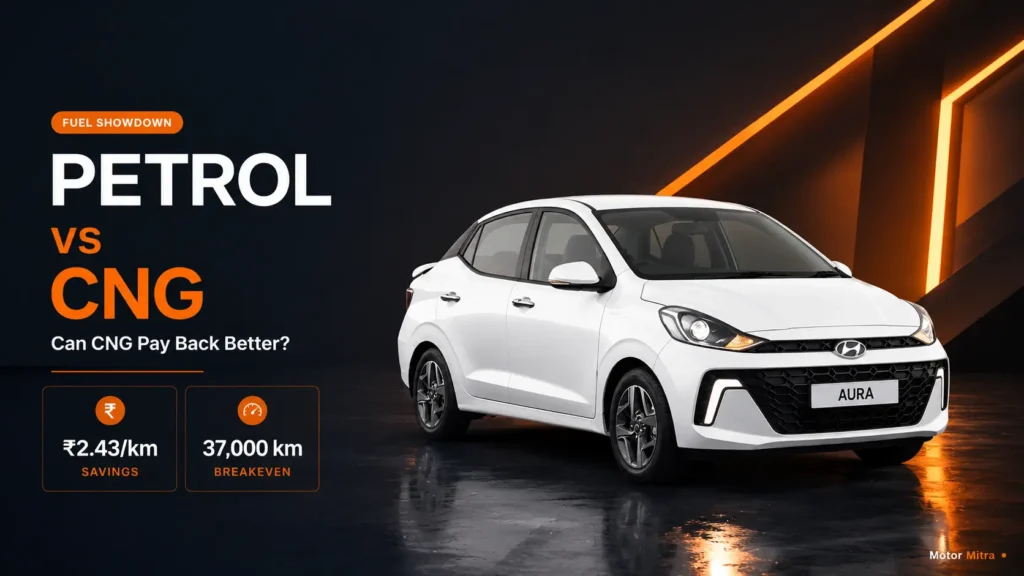
The Hyundai Aura CNG commands a premium of approximately Rs 90,000 over its equivalent petrol variant. That is not an insignificant amount of money, and it naturally raises the question – will you actually save enough on fuel to recover that extra investment, and if so, how long will it take? To answer this properly, we need to look beyond the simple per-kilometre cost difference and consider the complete picture including daily running patterns, fuel prices, real-world mileage figures, and the total cost of ownership over a typical ownership period.
The Price Premium – What You Pay Extra for CNG
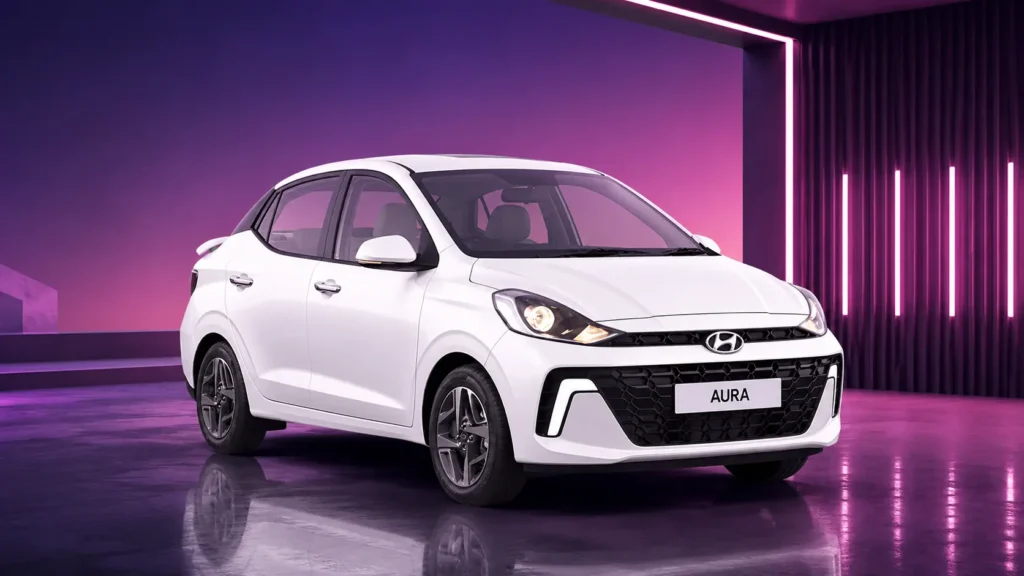
The Hyundai Aura’s price range starts at Rs 5.99 lakh for the base petrol variant and goes up to approximately Rs 9.11 lakh for the top-spec SX CNG variant. When comparing like-for-like variants, the CNG version costs roughly Rs 90,000 more than its petrol counterpart. This premium covers the factory-fitted CNG kit, the CNG tank, associated plumbing, and the ECU calibration that allows the engine to run seamlessly on both fuels.
It is worth noting that a factory-fitted CNG system from Hyundai comes with the full manufacturer warranty and is engineered to work perfectly with the engine from day one, unlike aftermarket kits that can sometimes compromise reliability and void warranty coverage. This peace of mind is part of what you are paying for with that Rs 90,000 premium.
Engine and Performance – What Changes on CNG
The Hyundai Aura CNG uses a 1.2-litre petrol engine that has been calibrated to run on both petrol and CNG. On petrol, this engine produces 83 bhp and 114 Nm of torque, which is adequate for city driving and occasional highway runs. However, when switched to CNG mode, the power output drops to 68 bhp and 95 Nm of torque. This roughly 18 percent reduction in power is noticeable, particularly during overtaking manoeuvres and uphill climbs, but for the majority of daily city driving, it remains perfectly acceptable.
The CNG variant is available exclusively with a manual transmission, which means buyers who prefer an automatic will need to stick with the petrol version. This is a limitation worth considering if your daily commute involves heavy traffic where an automatic gearbox can significantly reduce fatigue.
The Mileage Numbers – Where CNG Shines
This is where the CNG variant starts to make its case convincingly. The Hyundai Aura petrol delivers an ARAI-certified mileage of 20.5 kmpl, which translates to approximately 18 kmpl in real-world driving conditions depending on traffic, driving style, and route. The CNG variant, on the other hand, delivers an ARAI-certified 28.4 km per kg, with real-world figures settling around 25 km per kg for most drivers.
Now, when you factor in fuel prices, the picture becomes even clearer. With petrol priced at approximately Rs 105 per litre and CNG at around Rs 85 per kg in most Indian cities, the running cost per kilometre works out to Rs 5.83 for petrol and just Rs 3.40 for CNG. That is a saving of Rs 2.43 on every single kilometre you drive on CNG. It might not sound like much in isolation, but when you multiply it across thousands of kilometres driven every month, the numbers add up remarkably quickly.
Also Read: May 2026 Sedan Sales Shocker: Dzire Leaves Amaze, Aura, Verna, Virtus & Slavia Chasing Shadows
The Payback Calculation – When Does CNG Break Even?
This is the section that every potential CNG buyer wants to read, and the answer depends entirely on how much you drive daily. Here is how the payback period works out at different daily running patterns:
If you drive 30 km per day, which is typical for someone with a short urban commute, your monthly savings on CNG will be approximately Rs 2,190. At this rate, it will take you about 41 months or roughly 3.4 years to recover the Rs 90,000 CNG premium. That is a long time, and for low-mileage drivers, the CNG option becomes harder to justify purely on financial grounds.
If you drive 50 km per day, which represents a moderate daily commute plus some weekend driving, your monthly savings jump to Rs 3,650. The payback period drops to approximately 24.7 months or just over 2 years. This is the sweet spot where CNG starts making strong financial sense for most buyers.
If you drive 70 km per day, perhaps because you have a longer commute or use your car extensively for work, the monthly savings reach Rs 5,110 and the payback period shrinks to just 17.6 months or about 1.5 years. At this level of usage, CNG is almost a no-brainer from a financial perspective.
And if you are a high-mileage driver covering 100 km per day – think cab operators, sales professionals, or those with very long commutes – the monthly savings hit Rs 7,300 and the payback happens in just 12.3 months, essentially one year. For these buyers, not choosing CNG would actually be leaving money on the table.
Regardless of daily running, the magic number to remember is approximately 37,000 km. That is the total distance at which the CNG variant breaks even on its additional cost. Every kilometre driven beyond that point is pure savings in your pocket.
The 5-Year Ownership Picture
For a buyer driving 50 km per day, the five-year fuel cost comparison paints a dramatic picture. Over five years, the petrol variant would consume approximately Rs 5.32 lakh worth of fuel. The CNG variant, covering the same distance, would spend only Rs 3.10 lakh on fuel. That is a total fuel saving of Rs 2.22 lakh over five years. After subtracting the Rs 90,000 CNG premium, you are still left with a net saving of Rs 1.32 lakh. That is essentially free money that stays in your bank account simply because you chose the CNG variant.
While the financial case for CNG is strong for moderate to high-mileage drivers, there are some practical trade-offs worth considering. The CNG tank occupies a significant portion of the boot space, reducing the Aura’s luggage capacity noticeably. If you frequently travel with family and luggage, this could be an inconvenience. The reduced power output on CNG means the car feels slightly less responsive, particularly at higher speeds. CNG station availability, while improving rapidly across India, is still not as ubiquitous as petrol pumps, especially on highways and in smaller towns. And finally, the CNG variant’s limitation to manual transmission only means you miss out on the convenience of an AMT gearbox.
The Verdict – Who Should Buy CNG?
The Hyundai Aura CNG makes excellent financial sense if you drive more than 40 to 50 km daily, primarily in cities where CNG infrastructure is well-developed, and do not mind the boot space compromise. For cab operators, ride-share drivers, and professionals with long daily commutes, the CNG variant is an overwhelmingly smart choice that will save lakhs over the ownership period.
However, if your daily running is below 30 km, you frequently travel on highways where CNG stations are scarce, or you need the automatic transmission for traffic comfort, the petrol variant remains the more practical choice. The Rs 90,000 premium simply takes too long to recover at low mileage levels, and the convenience factors of petrol outweigh the marginal savings.
FAQ
1. How much extra does the Hyundai Aura CNG cost over petrol?
The Hyundai Aura CNG variant costs approximately Rs 90,000 more than the equivalent petrol variant. This premium covers the factory-fitted CNG kit with full manufacturer warranty.
2. What is the payback period for Hyundai Aura CNG?
The payback period depends on daily running. At 50 km per day, it takes about 25 months. At 70 km per day, it drops to 17.6 months. At 100 km per day, the CNG premium is recovered in just over 12 months.
3. How much does the Hyundai Aura CNG save per kilometre?
The CNG variant saves approximately Rs 2.43 per kilometre compared to petrol, based on real-world mileage of 25 km per kg for CNG and 18 kmpl for petrol at current fuel prices.
4. What is the mileage of Hyundai Aura CNG?
The Hyundai Aura CNG delivers an ARAI-certified mileage of 28.4 km per kg, with real-world figures of approximately 25 km per kg depending on driving conditions.
5. Does the Hyundai Aura CNG come with automatic transmission?
No, the Hyundai Aura CNG is available only with a manual transmission. Buyers who want an AMT gearbox will need to opt for the petrol variant.
For more such updates on latest cars, bikes and EVs stay connected to MotorMitra. #gaadiyonkismartguide