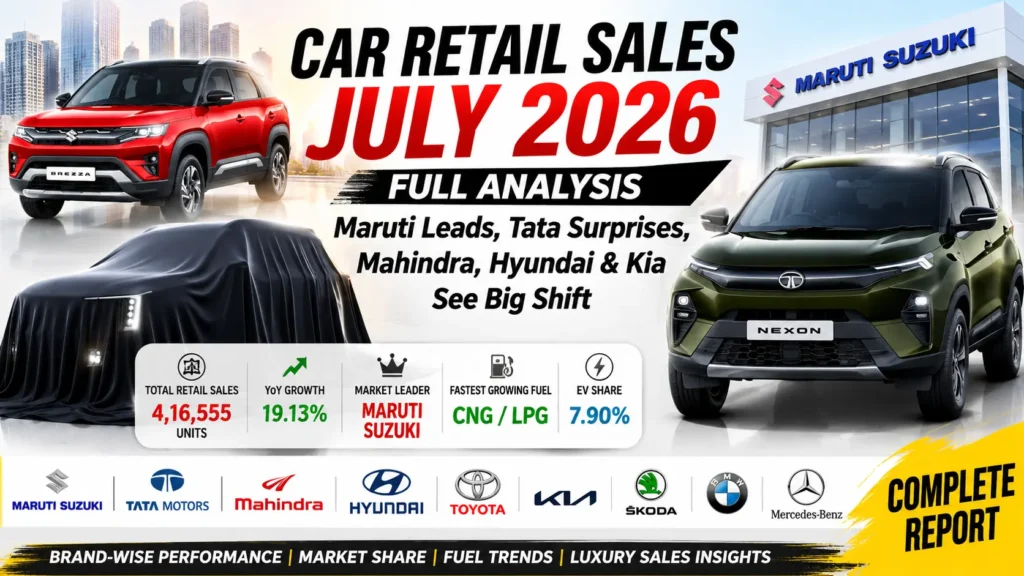
India’s passenger vehicle market delivered another closely watched month in July 2026, and the latest Car Retail Sales July 2026 figures reveal far more than a familiar winner. While Maruti Suzuki comfortably retained its leadership position, the real story lies in the impressive gains posted by brands like Tata Motors, Mahindra and Kia, highlighting how buyer preferences continue shifting toward SUVs, premium features and alternative powertrains.
The July report also underlines the growing intensity of competition across the industry. Established players are strengthening their positions with refreshed product portfolios, while premium manufacturers continue expanding their footprint. From mass-market hatchbacks to luxury sedans and SUVs, nearly every segment witnessed meaningful movement during the month.
Maruti Suzuki Stays Well Ahead Of The Competition
Maruti Suzuki once again dominated India’s passenger vehicle retail market, recording 1,61,873 retail registrations in July 2026. With a 38.86% market share and 19.70% year-on-year growth, the company continued to benefit from its wide-ranging lineup spanning hatchbacks, sedans, SUVs and MPVs.
Its extensive sales network, affordable ownership costs and strong brand recall remain key advantages. Even as rivals expand their SUV portfolios, Maruti’s ability to serve multiple customer segments continues to reinforce its position as the country’s undisputed market leader.
Also Read:- Honda Cars Sales Jump 48% In July 2026 – Something Big Is Changing
Tata And Mahindra Continue Building Strong Momentum
This strong growth highlights Tata’s continued success in attracting buyers looking for safety-focused SUVs and electric mobility options, allowing the company to further strengthen its position among India’s leading passenger vehicle manufacturers.
Mahindra followed closely with 56,219 retail registrations, posting 23.69% year-on-year growth. Sustained demand for its SUV range has helped the company strengthen its position in one of India’s fastest-growing automotive segments. The latest figures once again demonstrate that buyers continue favouring rugged, feature-rich utility vehicles.
Hyundai, Toyota And Kia Keep The Pressure On
Hyundai maintained a stable performance with 47,853 retail sales, supported by its balanced lineup of hatchbacks, sedans and SUVs. While growth remained relatively modest compared to some rivals, the brand continues to enjoy strong customer acceptance across multiple categories.
Toyota recorded 29,443 retail registrations, reflecting healthy demand for its SUVs and hybrid offerings. Kia also delivered another encouraging month with 25,551 units, registering 21.84% year-on-year growth as its technology-focused SUV lineup continued attracting urban buyers.
Car Retail Sales July 2026 – Key Brands
| Brand | Retail Sales (Jul’26) | YoY Growth | Market Share | Key Insight |
|---|---|---|---|---|
| Maruti Suzuki | 1,61,873 | +19.70% | 38.86% | Clear market leader with broad portfolio |
| Tata Motors | 58,774 | +36.84% | 14.11% | Strong SUV and EV-driven momentum |
| Mahindra | 56,219 | +23.69% | 13.50% | SUV demand continues to accelerate |
| Hyundai | 47,853 | +5.69% | 11.49% | Stable volumes across key segments |
| Toyota | 29,443 | +6.17% | 7.07% | Hybrids and SUVs remain growth drivers |
| Kia | 25,551 | +21.84% | 6.13% | Healthy growth backed by feature-rich lineup |
| Skoda Volkswagen | 8,221 | -7.65% | 1.97% | Faced pressure despite premium offerings |
| JSW MG | 7,030 | +1.49% | 1.69% | Retail volumes remained largely stable |
| Honda | 5,822 | +20.61% | 1.40% | Positive recovery supported by core models |
A Market That Continues To Evolve
Car Retail Sales July 2026 once again demonstrated that India’s passenger vehicle market is becoming increasingly competitive. While Maruti Suzuki remains comfortably ahead in overall volumes, brands like Tata Motors, Mahindra and Kia are steadily narrowing the gap through strong SUV demand and well-targeted product strategies.
At the same time, Toyota continues strengthening its hybrid presence, Hyundai remains a dependable volume player, and premium manufacturers are gradually expanding their share of the market. As manufacturers prepare fresh product launches and buyers increasingly prioritise SUVs, hybrids and technology-rich vehicles, the battle for market share is expected to become even more competitive during the remainder of 2026.
Fuel Preferences Continue To Shift Across The Market
Beyond brand-wise retail performance, the July 2026 report also highlights a gradual but meaningful shift in consumer fuel preferences. While petrol-powered vehicles continued to account for the largest share of passenger vehicle registrations, their contribution declined to 41.68%, compared to 43.15% in June 2026 and 47.62% in July 2025.
At the same time, CNG/LPG-powered vehicles continued strengthening their position, increasing their market share to 24.67% as more buyers looked for lower running costs without compromising practicality. Hybrid vehicles accounted for 8.02% of total registrations, while electric vehicles (EVs) maintained a healthy 7.90% market share. Although EV penetration remained almost unchanged on a month-on-month basis, it was significantly higher than the 5.14% recorded a year earlier, indicating that EV adoption is gradually moving from an early-growth phase toward a more stable and sustainable expansion.
Passenger Vehicle Fuel Mix – July 2026
| Fuel Type | Jul’26 | Jun’26 | Jul’25 | Market Trend |
|---|---|---|---|---|
| Petrol / Ethanol | 41.68% | 43.15% | 47.62% | Share continues to decline as buyers explore alternatives |
| Diesel | 17.73% | 16.32% | 17.97% | Stable demand across utility-focused segments |
| CNG / LPG | 24.67% | 24.35% | 21.38% | Strong growth driven by lower ownership costs |
| Hybrid | 8.02% | 8.27% | 7.89% | Demand remains healthy among premium buyers |
| Electric Vehicles (EVs) | 7.90% | 7.91% | 5.14% | Long-term adoption continues to improve |
Luxury Brands Continue Expanding Their Presence
While mainstream manufacturers dominated overall retail volumes, the luxury segment also delivered encouraging results, reflecting rising customer confidence in premium mobility. BMW recorded 1,702 retail registrations, representing a 19.27% year-on-year increase, while remaining broadly stable compared to June. The figures underline healthy demand for premium sedans and SUVs despite wider market fluctuations.
Mercedes-Benz followed with 1,527 retail registrations, posting 4.16% year-on-year growth. Although the brand recorded a slight month-on-month decline, it maintained a stable presence in India’s expanding luxury vehicle market. Together, these results demonstrate that premium mobility continues to attract buyers seeking advanced technology, refinement and long-term ownership value.
Also Read:- New Hyundai Neira Vs Kia Clavis EV – One Comes Out on Top
Quick Market Snapshot – July 2026
| Category | Leading Brand / Trend |
|---|---|
| Overall Market Leader | Maruti Suzuki |
| Strong Mainstream Momentum | Tata Motors |
| SUV Growth Leader | Mahindra |
| Hybrid Strength | Toyota |
| Luxury Momentum | BMW |
| Fastest Growing Fuel Trend | CNG / LPG |
The July 2026 retail sales report paints a clear picture of an Indian passenger vehicle market that continues to evolve at a rapid pace. Maruti Suzuki remains the undisputed volume leader, while Tata Motors, Mahindra and Kia continue strengthening their positions through competitive SUV portfolios. At the same time, Toyota is steadily expanding its hybrid footprint, and premium manufacturers such as BMW and Mercedes-Benz are benefiting from growing demand in the luxury segment.
Another equally significant takeaway is the gradual shift in fuel preferences. While petrol continues to dominate overall registrations, CNG, hybrid and electric vehicles are steadily increasing their presence, reflecting changing customer priorities around efficiency, technology and long-term ownership costs.
With several new SUVs, hybrid models and electric vehicles expected to arrive over the coming months, July 2026 could prove to be an important turning point in shaping the next phase of India’s passenger vehicle market. As competition continues to intensify across every segment, the battle for market share is likely to become even more dynamic through the remainder of the year.