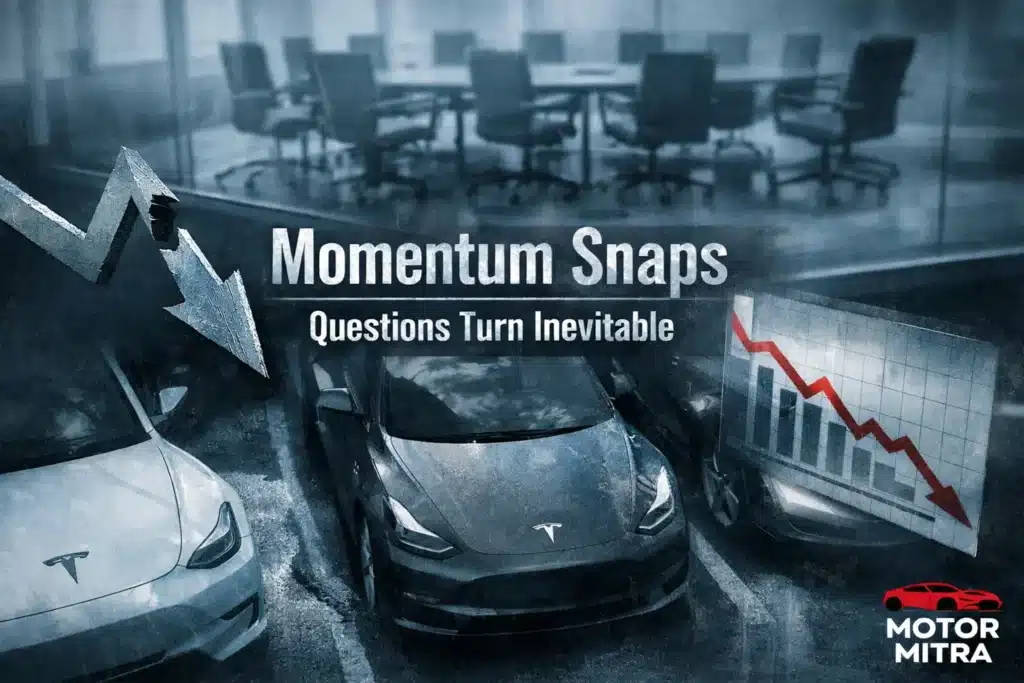
Tesla’s latest numbers don’t arrive with drama. They arrive with something more dangerous — clarity. A double-digit revenue decline in Tesla’s automotive business has quietly shifted the conversation, and this time it’s not something that can be brushed aside as a temporary fluctuation. It’s a deeper signal, and for a company built on constant growth, that matters more than ever. Tesla revenue decline 2026 is raising serious questions about EV demand and future growth, especially at a time when the market itself is evolving rapidly.
For years, Tesla’s story was simple — growth may slow, but it never truly breaks. That assumption is now under pressure, and what we are seeing may not be a short-term dip but the beginning of a structural shift.
Why This Matters
- Tesla revenue decline signals a slowdown in EV growth
- Rising competition is affecting pricing power
- Buyers may see better deals and more options
Also Read:- Tesla Cuts Model Y Prices In India As Inventory Builds Up 2026
Revenue contraction in Tesla’s automotive segment hits differently because Tesla has always been seen as a growth-first company. When growth slows, people wait. When revenue drops sharply, people rethink. This is not just about fewer cars being sold — it reflects the growing friction in a market that once seemed unstoppable. Competition is rising, pricing power is weakening, and demand is becoming more cautious.
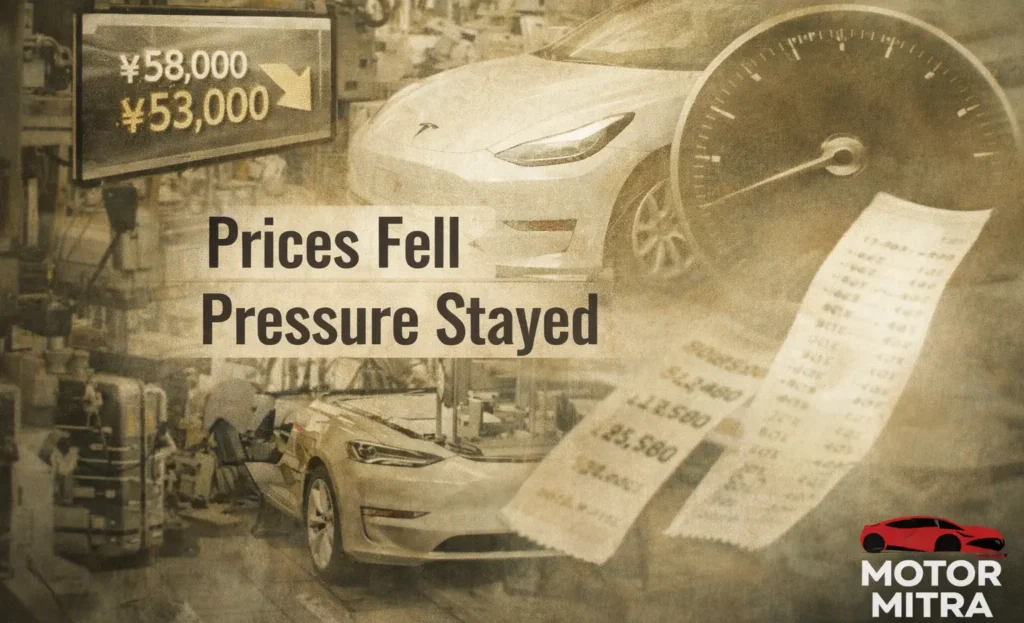
Tesla’s aggressive price cuts helped maintain sales volume, but they came at a cost. While factories kept running and deliveries stayed stable, revenue still declined. This clearly shows that Tesla is now absorbing market pressure instead of passing it on to customers, which is a significant shift from its earlier strategy. Pricing power, once Tesla’s biggest strength, is no longer guaranteed.
The EV Market Is Changing Fast
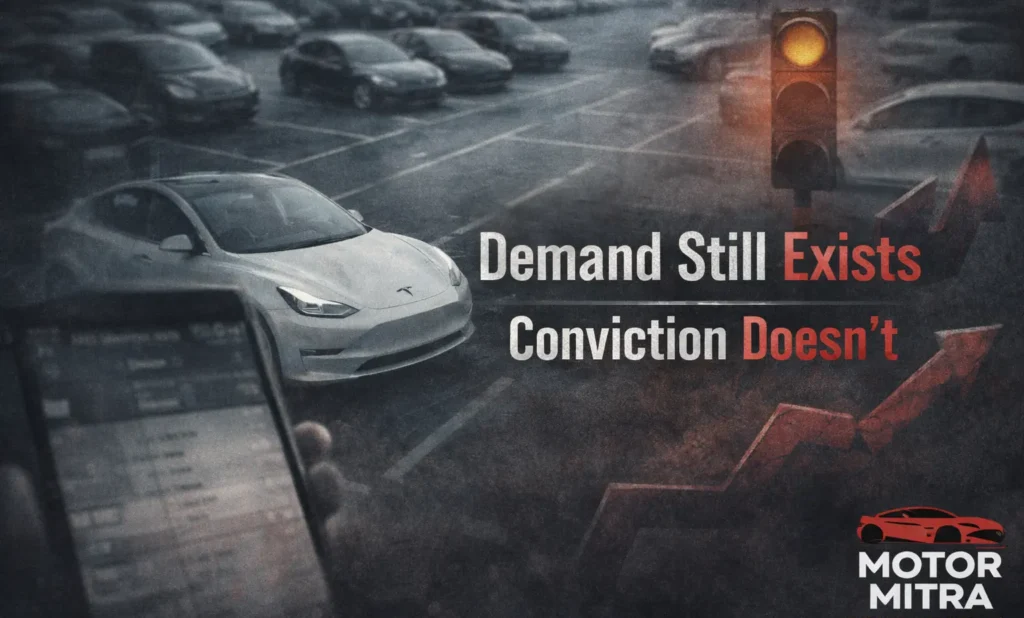
The EV market itself has changed faster than expected. What was once a supply-driven opportunity has now become a competitive and value-driven space. Buyers are no longer rushing into EVs blindly; they are comparing options, waiting for better pricing, and making more calculated decisions. Growth now depends on strong pricing discipline, clear product differentiation, and consistent demand — and Tesla is now being tested on all three fronts.
But this is where things get interesting…
This situation feels bigger than just one quarter. Tesla was always seen as a fast-growing company, but that growth is now slowing down, and that changes how the market reacts. A revenue decline today signals that Tesla is dealing with multiple pressures at once — competition, pricing challenges, and changing demand — all at the same time.
Leadership is now being tested in a different way. It’s no longer about how fast Tesla can grow, but how effectively it can adapt. Can new models restore demand? Can Tesla maintain pricing without losing buyers? Can innovation bring back momentum instead of just defending its position? These questions are becoming more important than ever.
Also Read:- BYD Overtakes Tesla: China’s EV Giant Becomes the World’s Top Electric Car Seller
There is also the risk of normalisation, which might be the most important shift of all. Tesla is not collapsing, but it may be entering a phase where growth slows, competition increases, and expectations become more realistic. Once a company moves out of hyper-growth, every quarter carries more weight, and every dip becomes more significant.
What This Means for Buyers
For buyers, this shift could actually turn into an advantage. EV prices may become more competitive, more brands will offer strong alternatives, and Tesla itself may focus more on value rather than premium pricing. This means buyers could benefit from better deals and a wider range of choices in the coming months.
Looking ahead, Company’s future will depend entirely on execution. New product launches, smarter pricing strategies, and the ability to stand out in an increasingly crowded EV market will decide what happens next. The next few quarters will be crucial in determining whether this is just a temporary slowdown or a long-term shift.
Company’s revenue decline may not signal a crisis, but it clearly shows that the EV market is changing. For buyers, this could mean better pricing, more competition, and smarter choices ahead. The real question now is not whether Tesla will recover, but how quickly it can regain its momentum.
For more such updates and latest news on cars and bikes stay connected to motormitra.in
Thank you ..
auto.motormitra
Latest Auto News and Trends

ऐसी ही और ताज़ा खबरों और अपडेट्स के लिए जुड़े रहें Auto.MotorMitra के साथ।
धन्यवाद!
Times Mitra
Latest bytes of news.

Also Read:- India’s New Phone Boom: Wobble One and Lava Agni 4 Challenge Global Giants
For more such updates and latest news on cars and bikes stay connected to times.motormitra.in
Thank you ..