Choosing the right midsize SUV variant is an exercise in balancing your tech wishlist against your styling priorities. With the launch of the updated Kia Seltos lineup, this decision matrix has become highly interesting right below the absolute top-spec trims.
Buyers looking at automatic options find themselves stuck in a classic automotive dilemma: should you opt for the heavily loaded, tech-centric Seltos HTX (A) or stretch your budget slightly for the sportier GT-Line GTX variant? The price difference is surprisingly minimal—hovering at just ₹20,000 for the diesel automatic and around ₹40,000 for the petrol automatic trims—making it critical to understand exactly what you gain and surrender when cross-shopping these variants.
Clean Elegance vs Aggressive GT-Line Styling
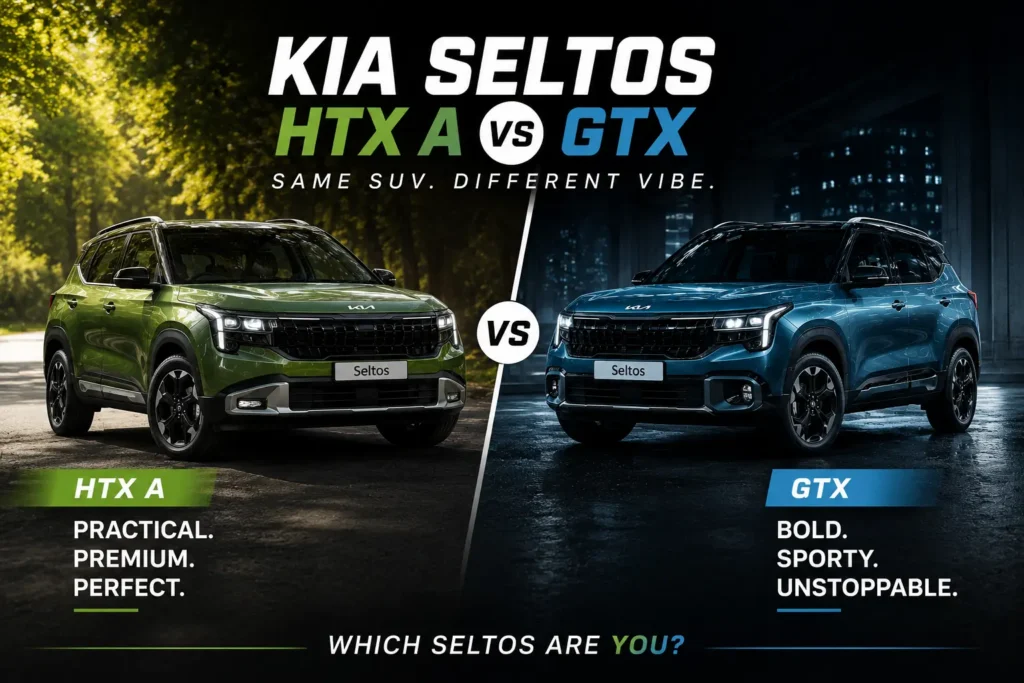
The most immediate differentiator between the two trims lies in their visual execution. The Seltos HTX (A) follows a clean, understated aesthetic theme defined by a traditional gloss black grille flanked by all-LED headlights, LED daytime running lights, and distinctive LED fog lights. Its front and rear bumpers adopt a rugged profile featuring chunky black body cladding and sharp silver skid plates. It rides on balanced 17-inch alloy wheels that blend visual presence with a comfortable tire sidewall cushion.
Step up to the GTX variant, and you are officially entering Kia’s premium GT-Line aesthetic territory. The exterior elements trade silver highlights for a darker, more aggressive look. The front grille is finished in dark gunmetal, matching the custom-profiled front and rear skid plates. The profile is instantly elevated by larger 18-inch alloy wheels with distinct neon brake calipers peeking through, complemented by high-gloss black body cladding and body-colored door accents. The lighting setup is also upgraded to sophisticated LED projector headlamps featuring integrated dynamic welcome animations.
Inside the cabin, the styling philosophies diverge completely. The HTX (A) offers a warm, premium dual-tone Brown and Grey cabin treatment accented with neon green stitching along the leatherette upholstery. Conversely, the GTX embraces a high-contrast, sophisticated Black and White dual-tone interior theme. While both share essentials like a dual-pane panoramic sunroof, rear AC vents, personal LED lamps, and 60:40 split-folding rear seats, the GTX delivers an premium luxury feel.

Also Read: Royal Enfield’s: Flying Flea C6 Delivery Starts in Bengaluru
Comfort vs Advanced Safety Tech
The most surprising twist in this comparison is that stepping up to the more expensive Seltos GTX variant actually means losing out on some highly advanced driver assistance technology that comes standard on the cheaper HTX (A).
The Seltos HTX (A) stands out as a high-tech powerhouse. It proudly features a massive 12.3-inch fully digital driver instrument display that anchors the dashboard layout. More importantly, the HTX (A) comes fully equipped with a comprehensive Level-2 ADAS (Advanced Driver Assistance Systems) suite, a high-definition 360-degree surround-view parking camera, and side parking sensors.
The GTX variant drops the fully digital driver’s display, the 360-degree camera workspace, and the entire Level-2 ADAS suite. Instead, it redirects your money toward premium, luxury-grade physical hardware. Over the Seltos HTX (A), the GTX adds an advanced 10-way electrically adjustable driver’s seat with multi-user memory functions, outside rearview mirror (ORVM) memory storage, an automated driver-side welcome retract mechanism, and auto-reverse tilting ORVMs to aid manual parking.
Both trims carry a strong baseline safety net including 6 airbags, all-wheel disc brakes, Electronic Stability Control (ESC), ABS with EBD, front and rear parking sensors, and a Tyre Pressure Monitoring System (TPMS).
Powertrain and Pricing
When it comes to picking your transmission, mechanical availability varies slightly. The Seltos HTX (A) range is highly flexible, offering both manual and automatic options across its naturally aspirated petrol and diesel engines. The GTX variant simplifies your choice by completely deleting manual options, remaining solely available with automatic gearboxes—specifically matching the iVT automatic for the naturally aspirated engine, the 7-speed DCT for the turbo petrol, and the torque converter automatic for the diesel mill.
Financially, the Seltos HTX (A) begins its pricing structure at ₹16.71 Lakh for manual configurations, climbing up to ₹18.01 Lakh for petrol automatics and ₹19.61 Lakh for the diesel automatic trim. The strictly automatic GTX lineup steps in slightly higher, starting at ₹18.41 Lakh for the petrol automatic and topping out at ₹19.81 Lakh for the diesel automatic option.
Also Read: Tata Punch EV Finally Has A New Rival — Hyundai’s Upcoming EV Could Change The Game
Motor Mitra Verdict
The choice between the HTX (A) and the GTX comes down to what you prioritize: cutting-edge driver assistance software or high-end physical luxury.
If you spend long hours commuting on structural highways, navigate tight city streets daily, and want the unparalleled security of Level-2 ADAS alongside a 360-degree camera, the Seltos HTX (A) remains the smarter, highly rational, value-for-money choice. However, if you are a driving purist who doesn’t care for automated braking assistance, but desperately wants the aggressive, head-turning looks of the GT-Line trim along with the everyday indulgence of memory-linked powered seats, stretching slightly for the GTX delivers that elusive premium factor.
For more such updates on latest cars, bikes and EVs stay connected to MotorMitra. #gaadiyonkismartguide