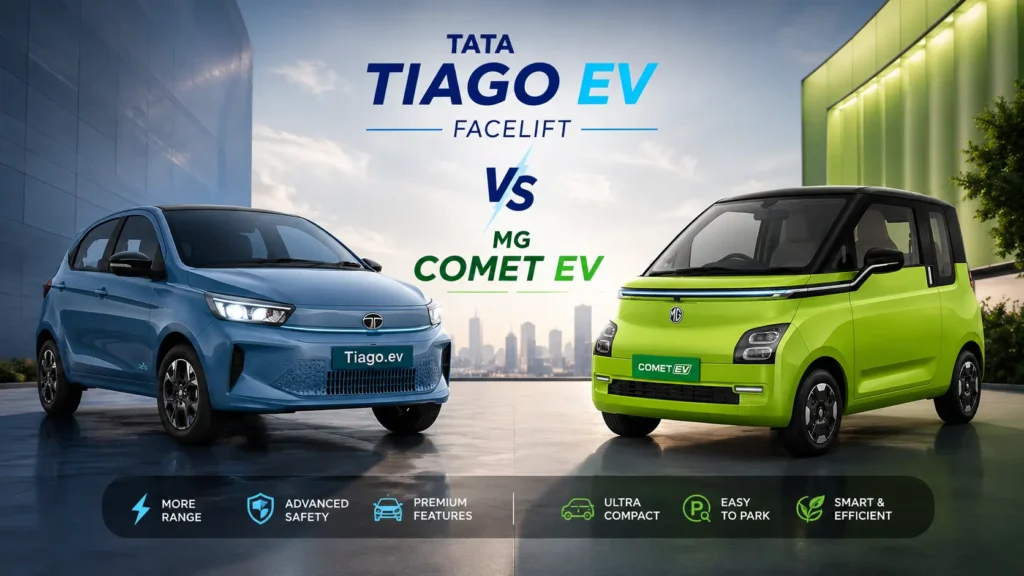
Tata Tiago EV Facelift vs MG Comet EV: The Ultimate Entry-Level EV
The landscape of entry-level electric mobility in India has shifted dramatically. With the arrival of the 2026 Tata Tiago EV Facelift at a disruptive starting price of ₹6.99 Lakh (ex-showroom), budget-conscious buyers are no longer asking if they should go electric—they are asking which unconventional philosophy fits their garage.
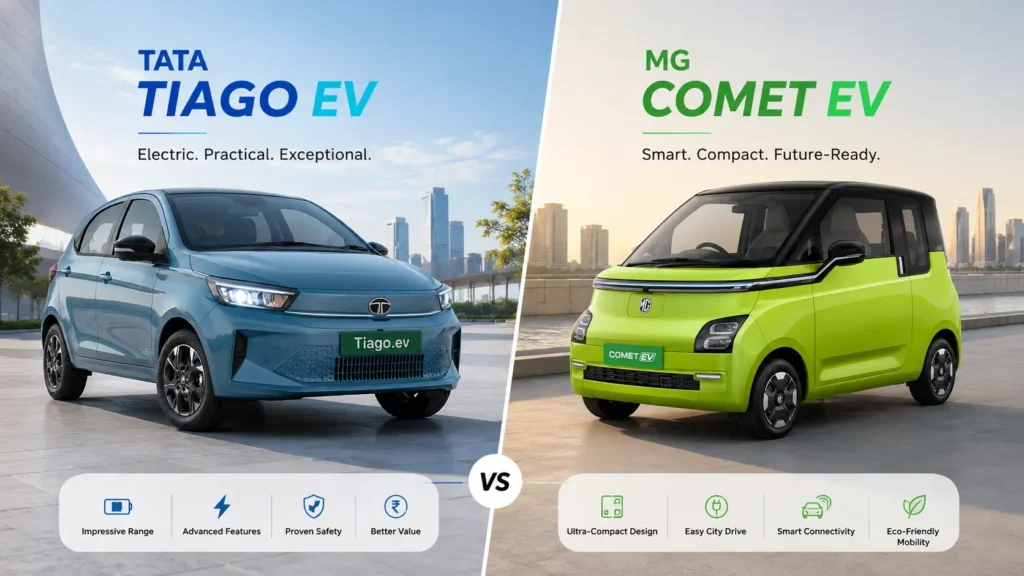
On one side stands Tata’s refreshed, classically proportioned 5-door hatchback. On the other sits the radical, polarising, 2-door ultra-compact urban cube: the MG Comet EV (₹7.50 – ₹9.97 Lakh). For an automotive journalist, this isn’t just a comparison of spec sheets; it’s a battle between a downsized traditional car and a purpose-built urban mobility tool. Here is how they stack up across the pillars that actually matter.
Also Read: 2026 Tata Tiago Facelift Interior Revealed: Bigger Screens & Premium Cabin
Under the skin, these two vehicles approach electrification from entirely different zip codes. Tata offers structural flexibility by retaining its proven high-voltage Ziptron architecture split across two variants, while MG relies on a singular urban setup.
| Feature / Specification | 2026 Tata Tiago EV (Medium Range) | 2026 Tata Tiago EV (Long Range) | MG Comet EV |
| Battery Capacity | 19.2 kWh | 24.0 kWh | 17.3 kWh |
| Max Power Output | 61 PS | 75 PS | 42 PS |
| Max Torque Output | 110 Nm | 114 Nm | 110 Nm |
| Claimed Range (MIDC) | 226 km | 285 km | 230 km |
| Real-World Range | ~150 – 160 km | ~200 – 210 km | ~160 – 170 km |
| DC Fast Charging (10-80%) | Yes (35 Mins) | Yes (35 Mins) | No (Supports up to 7.4kW AC) |
Out on the tarmac, the Tiago EV behaves exactly like a modern petrol hatchback, only smoother and significantly quieter. Even the 19.2 kWh Medium Range variant delivers a brisk, nippy performance that handles highway flyovers and overtake maneuvers with absolute dignity. Opt for the 24 kWh Long Range, and its 75 PS motor happily sustains 100 km/h cruising speeds with plenty of top-end confidence.
The MG Comet EV, putting out 42 PS, tells a different story. Off the line, its instant torque makes it remarkably sprightly up to 50 km/h—perfect for darting through traffic gaps. However, push it past 80 km/h, and its boxy aerodynamics and small footprint quickly remind you that this is not a highway machine.
Also Read: New Tata Tiago EV Facelift 2026: Battery, Range & Colour Options Explained
This is where Tata delivers a decisive blow. Every single variant of the 2026 Tiago EV comes standard with DC Fast Charging capability, allowing you to juice up from 10 to 80 percent at a public station in just 35 minutes. The MG Comet EV completely lacks DC fast-charging hardware. Even if you pick a higher-spec Comet variant with the 7.4 kW AC fast-charger upgrade, a quick top-up during an inter-city highway haul is out of the question.
2. Cabin Layout, Practicality, and Real-World Space
The architectural layouts of these two cabins reflect entirely different target audiences.
Tata Tiago EV: [Engine/Motor] -> [Row 1] -> [Row 2] -> [240L Boot]  (Traditional 5-Door)
MG Comet EV: [Short Nose]   ->  [Row 1] -> [Row 2 / Zero Boot]     (Ultra-Compact 2-Door)
Tata Tiago EV
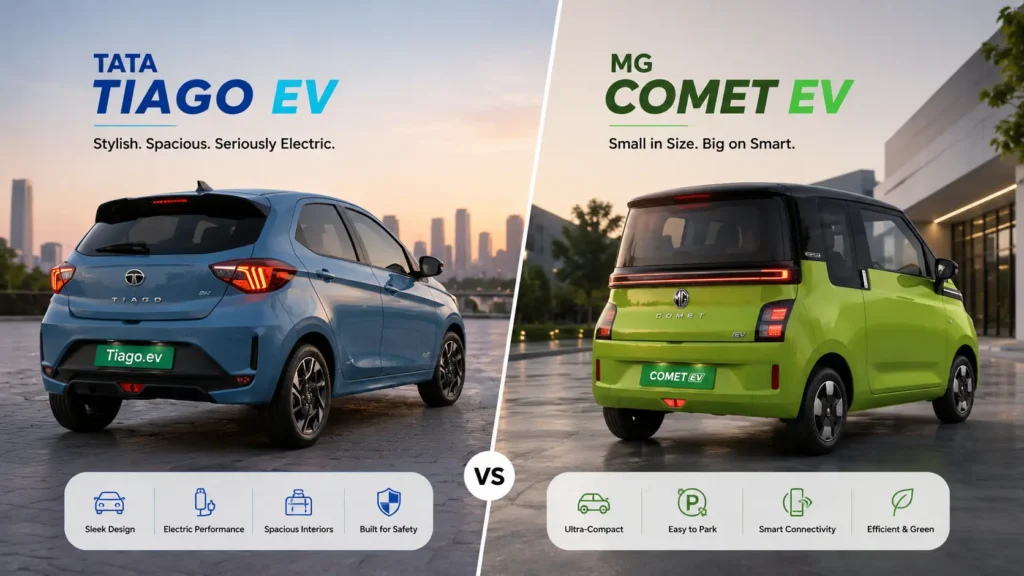
The Tiago EV remains a proper car. It seats four adults comfortably—five in a pinch—and features standard rear doors so passengers don’t have to engage in gymnastics to get to the back seat. Crucially, it retains a legitimate 240-litre boot space, making it perfectly capable of handling weekend luggage or airport runs. Its 14-inch wheels and mature suspension setup absorb sharp bumps and potholes without unsettling the cabin.
MG Comet EV
The Comet throws the rulebook out the window. Sliding into the front seat feels like entering a high-end sci-fi pod, thanks to its flat floor, airy glasshouse, and premium materials. Because the wheels are pushed to the absolute corners, legroom for four passengers is surprisingly generous. However, the compromise is absolute: with the rear seats in place, boot space is virtually non-existent. Furthermore, its tiny 12-inch wheels translate to a busier ride over broken city asphalt.
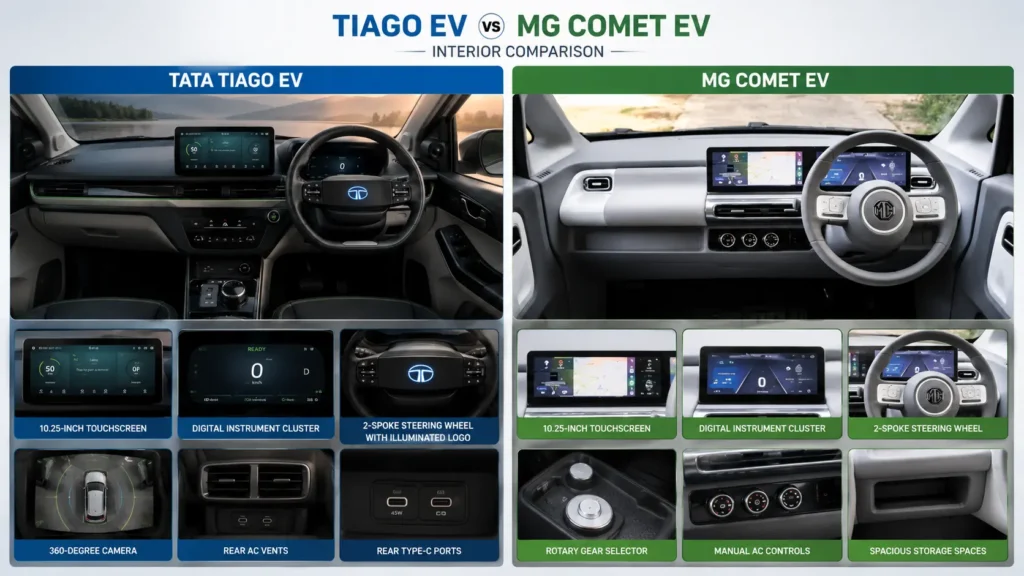
With the 2026 facelift, Tata has aggressively targeted MG’s tech-first advantage by loading the Tiago EV cabin with premium creature comforts.
- 2026 Tiago EV Upgrades: The new cabin steps up the premium quotient with a dual-tone black and light grey layout. It adds highly requested additions such as a larger 10.25-inch floating infotainment screen with wireless Android Auto and Apple CarPlay, rear AC vents to beat the Indian summer, dual wireless phone chargers, and a sophisticated 360-degree camera system with a blind-view monitor in higher trims.
- MG Comet EV Strengths: The Comet’s interior remains a masterpiece of minimalist minimalism. The dual interconnected 10.25-inch screens (one for infotainment, one for the driver instrument cluster) look incredibly sleek. The pod-like steering controls feel premium to touch, and the intelligent keyless entry functions flawlessly.
Also Read: How Do Paddle Shifters Work on an AMT Gearbox? (Motormitra Guide)
Tata takes a noticeable lead in structural reassurance. The 2026 Tiago EV Facelift comes equipped with 6 standard airbags, Electronic Stability Control (ESC), and a proven platform layout. The MG Comet EV offers dual front airbags and basic safety tech, but its ultra-light, short-wheelbase body naturally lacks the planted, high-speed stability of the heavier Tiago.
Both manufacturers recognize that lowering the entry barrier is critical to mass adoption, leading to identical financial strategies with distinct price advantages.
- Outright Purchase: At a starting sticker price of ₹6.99 Lakh, the entry-level Tiago EV Smart undercuts the base MG Comet EV (which starts around ₹7.50 Lakh). Getting a structurally larger, faster-charging car for less money represents incredible market disruption from Tata.
- Battery-as-a-Service (BaaS): If you prefer to de-link the cost of the battery, Tata’s new BaaS program lets you drive the entry-level Tiago home at an acquisition cost of roughly ₹4.69 Lakh plus a minimal battery rental per kilometer. This runs neck-and-neck with MG’s alternative financing model, making both highly accessible for fleet operators and salaried commuters alike.
Verdict: Which One Belongs in Your Driveway?
This comparison does not yield a singular, one-size-fits-all winner because both vehicles execute their engineering mandates flawlessly.
Go for the 2026 Tata Tiago EV if:
You are looking for the primary or only car in your household. You require a traditional, no-compromise 5-door vehicle that can comfortably haul family members, manage grocery runs with a usable boot, handle highway stretches, and utilize the national public DC fast-charging grid. At its current price point, it is the most complete, value-packed EV in India.
Go for the MG Comet EV if:
You are strictly seeking a secondary or tertiary urban appliance. If your garage already houses a large petrol or diesel SUV for family trips, and you simply need a quirky, hyper-efficient commuter car that can park in spaces nothing else can, zip through congested metropolitan alleys, and look futuristic doing it, the Comet remains an unbeatable piece of urban design.
Stay tuned to MotorMitra for more exclusive deep dives into the world of Indian automotive excellence!