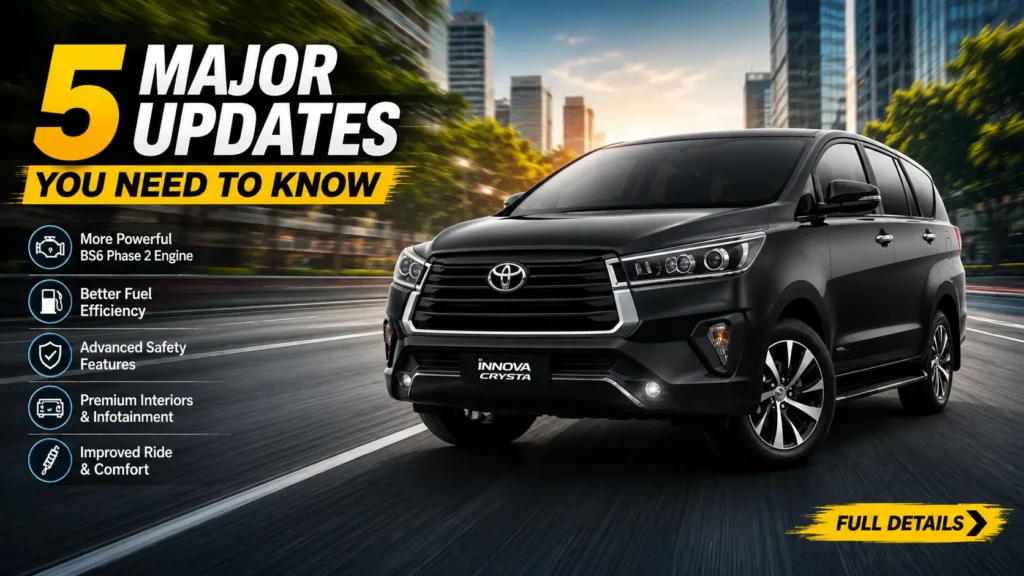
The Legend Refined: 2026 Toyota Innova Crysta vs Old Model – What Exactly Has Changed?
In the Indian automotive market, very few nameplates command the sheer reverence, emotional equity, and resale value of the Toyota Innova. While the newer, monocoque-based Innova HyCross caters to tech-focused buyers leaning toward hybrid efficiency, the ladder-frame diesel workhorse—the Innova Crysta—remains the undisputed first choice for long-distance fleet operators, political convoys, and large families who demand bulletproof reliability over broken roads.
Recognizing that demand for the rear-wheel-drive diesel icon shows no signs of slowing down, Toyota Kirloskar Motor (TKM) has officially rolled out a mid-lifecycle facelift for the vehicle. This update keeps it fresh against modern competition while complying with tightening safety and emission standards.
If you are currently evaluating whether to trade in your older Crysta for the new model or are hunting for a deal in the pre-owned market, this detailed comparison breaks down the key changes between the new version and the outgoing model.
1. Exterior Changes
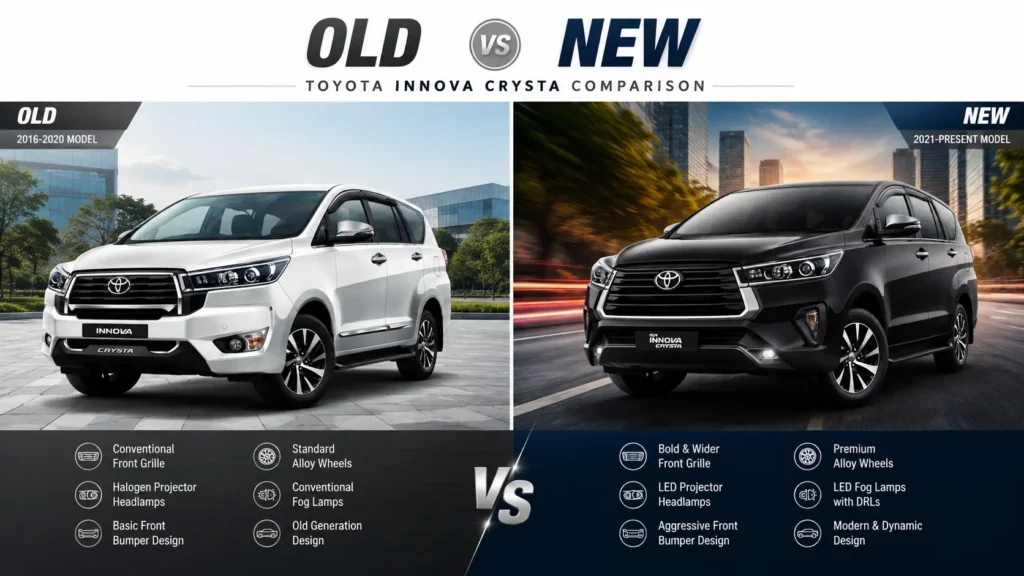
The most visible changes on the updated model are concentrated entirely on the front profile. The outgoing Innova Crysta featured a relatively restrained, horizontal dual-slat chrome grille that integrated smoothly into the headlamp clusters. While elegant, it was beginning to look dated alongside Toyota’s modern global design language.
For the new model, Toyota’s design team went for a much tougher look. The front features a significantly larger, more prominent trapezoidal grille finished in high-gloss piano black, accented by an updated chrome surround. The lower front bumper has been completely reshaped, incorporating sharp, angular housing for the revised LED fog lamps and a more muscular silver chin skid plate.
From the side and rear profiles, however, the sheet metal remains unchanged. The silhouette, the distinct third-row glass quarter panel, and the signature inverted L-shaped tail lamp clusters carry over directly from the older version, making the front face the primary identifier of the facelift.
2. Cabin Environment and Upgraded Infotainment
Step inside, and the differences between the two generations become a matter of feature distribution and material choices rather than a complete structural dashboard redesign.
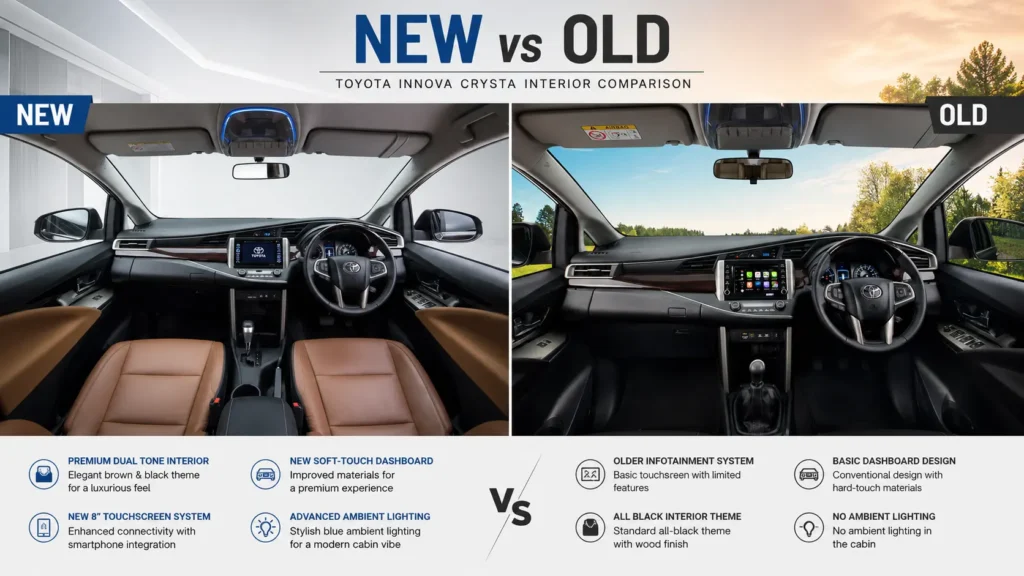
The outgoing Crysta was often critiqued for its aging 8-inch infotainment unit, which featured slow touch responses and required wired connections for basic smartphone mirroring. In the new version, Toyota addresses this bottleneck by introducing a larger, crisper touchscreen infotainment display on mid- and top-tier variants. This updated system brings much smoother user interface transitions and, crucially, supports wireless Apple CarPlay and Android Auto.
Additionally, Toyota has tweaked the interior color palettes. While the older model relied heavily on a standard tan or dark black leatherette finish, the updated model introduces a premium Camel Tan leather option on top-spec trims, complete with revised wooden dashboard inserts that noticeably elevate the premium feel of the cabin. The charging layout has also been modernized, replacing older USB-A slots with multiple high-output Type-C fast-charging ports across all three rows.
Also Read: Suzuki Just Made Family Travel More Interesting: New 8-Seater Hybrid Debuts
3. Powertrain and Mechanical Continuity
Mechanically, the new model chooses continuity over reinvention—a decision highly praised by long-distance drivers. The vehicle continues to rely on the proven 2.4-litre, four-cylinder 2GD-FTV turbocharged diesel engine.
| Technical Parameter | Outgoing Model Spec | New Model (Facelift) Spec |
| Engine Displacement | 2,393 cc, Four-Cylinder Turbo Diesel | 2,393 cc, Four-Cylinder Turbo Diesel |
| Peak Power Output | 150 PS @ 3,400 rpm | 150 PS @ 3,400 rpm |
| Peak Torque Output | 343 Nm @ 1,400–2,800 rpm | 343 Nm @ 1,400–2,800 rpm |
| Transmission Type | 5-Speed Manual Only | 5-Speed Manual Only |
| Drive Layout | Rear-Wheel Drive (RWD) | Rear-Wheel Drive (RWD) |
The real differentiator between the current version and older model years is the transmission choice. While older iterations of the diesel Crysta could be optioned with a smooth 6-speed torque converter automatic, Toyota has decided to retain the 5-speed manual gearbox exclusively for this update.
This move is a strategic decision to keep the Crysta firmly positioned as a durable fleet vehicle, avoiding price and component overlap with the automatic-only petrol-hybrid variants of the Innova HyCross.
4. Safety and Structural Compliance
Safety engineering has become a core focus for buyers in this price segment, and Toyota has quietly updated the vehicle’s safety features to keep up with current expectations.
The older model provided a robust safety foundation, offering three airbags as standard on base trims and scaling up to seven on top variants, alongside basic electronic aids like ABS, EBD, and Brake Assist.
The new version standardizes crucial electronic driver aids across the entire variant tree. Features that were previously exclusive to high-end trims—such as Vehicle Stability Control (VSC), Hill-Start Assist Control (HAC), and reverse parking sensors—are now standard equipment from the entry-level trim upward. The structural crumple zones and cabin pillars have also received minor internal reinforcements to meet evolving local crash-test protocols, offering improved peace of mind during long-distance highway trips.
5. Variant Realignment and Price Positioning
The final major shift lies in how Toyota positions these two models in the market. The outgoing Crysta was positioned as Toyota’s premium flagship MPV, spanning a wide price bracket that went all the way up to the luxurious ZX trim.
With the new model, Toyota has intentionally streamlined the variant tree into specific trims—primarily focusing on the G, GX, VX, and ZX configurations—and optimized the features to appeal directly to commercial tour operators and practical family buyers.
Because of the updated front design, upgraded infotainment tech, and standard safety features, the new model carries a minor price premium of approximately Rs. 35,000 to Rs. 60,000 over corresponding older variants, depending on whether you choose the 7-seater captain seat or the 8-seater bench configuration.
Should You Upgrade?
The update shows that Toyota understands exactly why people buy this vehicle. Instead of chasing experimental tech or radical body changes that could compromise durability, the brand focused on fixing real-world pain points: the dated front-end styling, the lack of wireless phone connectivity, and the need for standardized safety features across lower trims.
If you currently own an older version with low mileage, the mechanical similarities mean you don’t need to rush out and upgrade immediately. However, if you are looking to buy a new, tough, long-distance highway cruiser, the styling and interior tech updates make the new version a more polished and future-proof choice than before.