Bajaj’s Camouflaged Test Mule Signals Impending Entry into the Pure Dual-Sport Territory
For over a decade, Bajaj Auto has served as the back-end manufacturing muscle for KTM’s globally acclaimed small-displacement Adventure series, building sub-400cc off-roaders for international export from its Chakan facility. Yet, under its own branding, the homegrown manufacturer has curiously stayed away from building a purpose-built, long-travel motorcycle, choosing instead to push the sports-touring Dominar series.
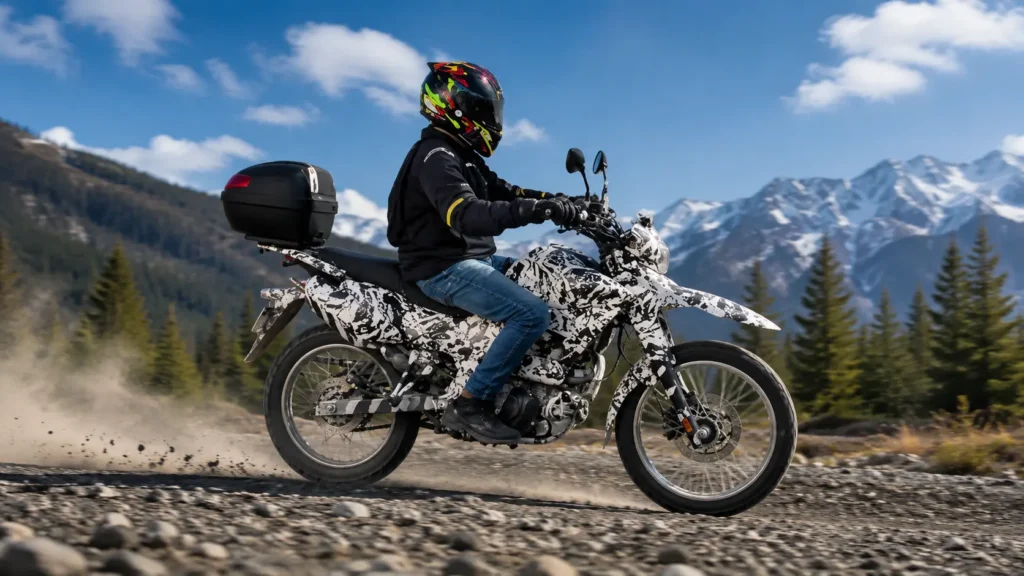
That structural vacuum is finally ending. A heavily camouflaged test mule, captured undergoing high-speed real-world testing runs on the outskirts of Pune, has provided the clearest indication yet that Bajaj is preparing its own dedicated adventure platform.
Rather than executing a basic roadster upgrade—a strategy often seen when standard streetfighters are dressed in high front plastic beaks—the structural cues on this test prototype reveal a machine leaning aggressively toward a lightweight dual-sport aesthetic. This positions it directly as a highly functional, entry-level challenger capable of handling tough trails.
Functional Dual-Sport Geometry
The side profile of the spied Bajaj test vehicle reveals a massive evolutionary jump from any current frame geometry in the Pulsar or Dominar families. The bike features a tall, commanding ground clearance matched with a distinctly slim mid-section designed to allow riders to easily lock their knees while standing up on the footpegs during rough off-road sections.

Also Read: 2026 Toyota Innova Crysta vs Old Model: 5 Major Updates You Need to Know
Hardware Breakdown:
- The Wheel Configuration: The test mule runs on heavy-duty, classic wire-spoke wheels, using a 19-inch front and 17-inch rear combination. This specific setup is highly favored in the lightweight ADV space, as it balances agile handling on loose dirt with stable cruising traits on open highways.
- Suspension Layout: Suspension duties are handled by long-travel offset telescopic front forks and a rugged, link-type rear monoshock setup. The visible wheel travel appears significantly higher than any standard streetbike, hinting at excellent pothole-tackling capability.
- Ergonomic Triangle: The test vehicle features a high-set, wide handlebar, forward-neutral footpegs, and a long, single-piece continuous saddle. This design leaves plenty of room for a pillion passenger or allows for easy mounting of a top rack and heavy luggage panniers, pointing to clear long-distance touring intentions.
The Powertrain: The Pulsar N250 vs. KTM Dilemma
While Bajaj has maintained complete silence regarding the exact internal specifications, the spy images offer crucial clues about what’s under the tank. The prototype was spotted running right next to a benchmark Pulsar N250, indicating a strong likelihood that the upcoming ADV shares its platform with Bajaj’s current quarter-liter block.
If Bajaj utilizes the 249cc single-cylinder, oil-cooled engine from the Pulsar N250, the motor will undergo major internal re-gearing. Expect a larger rear sprocket to maximize low-to-mid range torque delivery—a necessary trait for pulling out of deep mud or carrying heavy touring gear up steep inclines.
However, an alternative industry theory suggests Bajaj might use a reworked, lower-cost derivative of the KTM 250 Adventure’s liquid-cooled DOHC motor. This would provide a more powerful setup with better high-revving highway performance to take on premium mid-capacity rivals.
Positioning, Expected Pricing and Market Battle
This upcoming dual-sport motorcycle is part of Bajaj’s broader product offensive, which includes rolling out eight new motorcycle iterations in the 125cc to 250cc brackets. Given that the test mule carried production-ready components—such as finalized passenger footpeg mounts, a production-spec upswept exhaust system, and integrated rear grab rails—the project has clearly advanced past the initial testing phases.
| Target Competitor | Engine Type | Projected Price Bracket |
| Hero XPulse 200 4V | 199.6cc Oil-Cooled | Rs. 1.45 Lakh – Rs. 1.55 Lakh |
| Upcoming Bajaj 250 ADV | 249cc Oil/Liquid Cooled | ~ Rs. 1.85 Lakh – Rs. 2.10 Lakh |
| Suzuki V-Strom SX | 249cc Oil-Cooled | Rs. 2.12 Lakh |
| KTM 250 Adventure | 249cc Liquid-Cooled | Rs. 2.45 Lakh |
Also Read: Suzuki Just Made Family Travel More Interesting: New 8-Seater Hybrid Debuts
By launching a 250cc adventure bike, Bajaj is aiming for a sweet spot in the Indian motorcycle market. It sits comfortably above the entry-level Hero XPulse 200 4V in terms of raw highway performance, while remaining significantly more accessible and affordable than the premium KTM 250 Adventure or Suzuki V-Strom SX.
A First-Mover Advantage
The spied prototype looks like a highly promising addition to the segment. Bajaj appears to be building a rugged, versatile machine designed to handle challenging road conditions, rather than just building a standard commuter styled with plastic body cladding.
If Bajaj equips this upcoming model with modern tech like switchable rear-wheel ABS (for off-road sliding), Bluetooth-enabled turn-by-turn navigation, and hits a competitive price target of around Rs. 1.95 lakh (ex-showroom), its first purpose-built adventure motorcycle could quickly become a highly popular option for Indian riders looking to enter the dual-sport world on a budget.