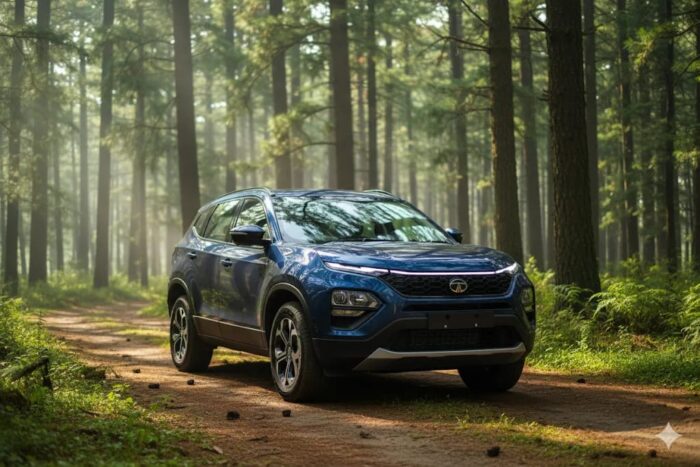
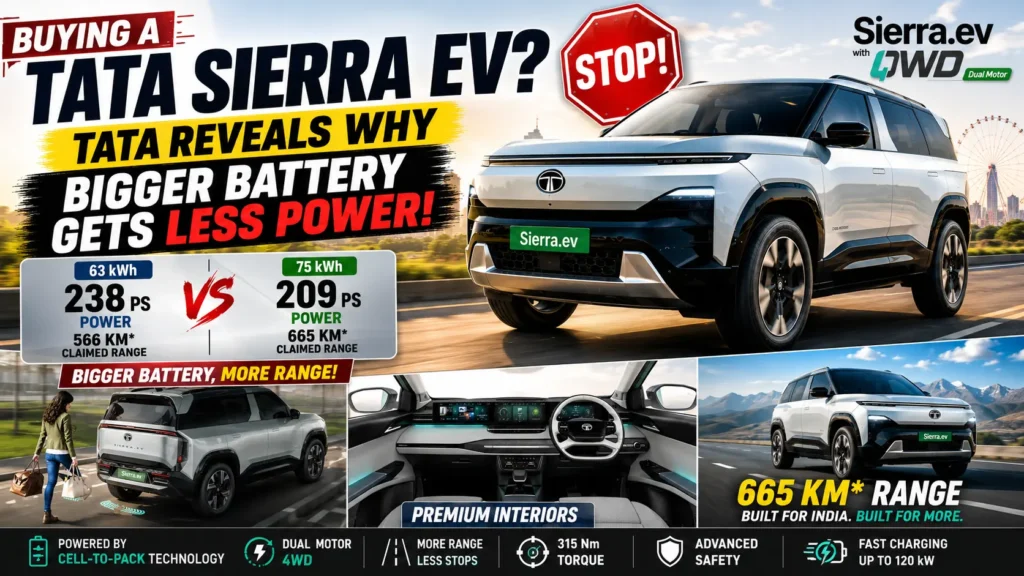
If you’re comparing the two Tata Sierra EV variants, one specification immediately stands out—and not in the way you’d expect. The bigger battery model actually produces less power than the smaller one—a specification that has left many enthusiasts wondering if Tata made a mistake. After all, a larger battery is usually associated with both stronger performance and longer driving range. But the Sierra EV follows a completely different engineering philosophy.
Instead of chasing impressive power figures for the brochure, Tata has prioritised real-world efficiency, longer range and a more balanced driving experience. It’s a decision that may look confusing at first, but once you understand the engineering behind it, the logic becomes surprisingly clear. Before deciding which Sierra EV variant deserves your money, here’s what you need to know.
At A Glance
- 238 PS from the 63 kWh rear-wheel-drive variant.
- 209 PS from the 75 kWh rear-wheel-drive variant.
- Larger battery delivers an impressive 665 km claimed range.
- Cell-to-Pack (C2P) battery architecture improves energy density and packaging efficiency.
- Both variants continue to produce 315 Nm of peak torque.
- Tata has prioritised efficiency and range over higher peak power.
Also Read:- 5-Star Safety Isn’t Enough? Euro NCAP Reveals Why Cars Still Fail In Deadly Truck Underrun Crashes
Why Tata Chose Less Power For The Bigger Battery
At first glance, the specifications seem difficult to understand. If the battery is larger, why doesn’t it produce more power? The answer lies in the battery’s engineering rather than its physical size. Both battery packs occupy almost the same space inside the Sierra EV. To increase capacity from 63 kWh to 75 kWh, Tata has adopted a Cell-to-Pack (C2P) battery architecture along with higher energy-density battery cells. This allows the larger pack to store significantly more usable energy without increasing its overall dimensions. It also improves packaging efficiency by reducing unused space within the battery assembly.
Instead of extracting maximum peak output, Tata has chosen to optimise overall efficiency. The result is a battery pack capable of delivering substantially longer driving range, even if that means sacrificing a small amount of peak power. It’s an engineering decision focused on delivering better real-world usability rather than simply producing bigger numbers on the specification sheet.
Why Tata Chose Range Over Bigger Power Figures
For most electric vehicle buyers, driving range remains a far bigger priority than outright acceleration. That’s exactly where the 75 kWh Sierra EV gains its biggest advantage. It offers a claimed driving range of 665 km, which is 99 km more than the 63 kWh version.
Equally important, both rear-wheel-drive variants continue to produce the same 315 Nm of peak torque. Since instant torque has the biggest influence on everyday EV performance, Tata believes most drivers are unlikely to notice a major difference during city commutes or normal highway cruising. The additional power available in the smaller battery variant is expected to become noticeable mainly during hard acceleration or more enthusiastic driving.
63 kWh Vs 75 kWh – Which One Makes More Sense?
| Category | Tata Sierra EV 63 RWD | Sierra EV 75 RWD | Buyer Benefit |
|---|---|---|---|
| Battery Pack | 63 kWh | 75 kWh | Choose according to your driving needs |
| Peak Power | 238 PS | 209 PS | Better acceleration in the 63 kWh variant |
| Peak Torque | 315 Nm | 315 Nm | Similar everyday driving response |
| Claimed Range | 566 km | 665 km | Fewer charging stops with the 75 kWh variant |
| Best For | Drivers who prioritise performance | Buyers who prioritise maximum range | Pick the variant that matches your driving style |
So, should you choose the extra power or the extra range? The answer depends entirely on how you plan to use your Sierra EV—and that’s where the bigger picture becomes even more interesting. For most buyers, the answer is likely to be far less dramatic than the specifications suggest—and that’s where the Sierra EV’s real-world driving experience becomes far more important than the numbers printed on the brochure.
Also Read:- Tata EVs Get Massive Discounts of Up to Rs 3.35 Lakh in June 2026 — Here’s the Complete Model-Wise Breakdown
Why Most Buyers May Never Notice The Power Difference
This is where the Sierra EV’s specification sheet can be misleading. Although the 63 kWh variant produces more peak power on paper, the real-world driving experience is unlikely to feel dramatically different for most buyers. That’s because both rear-wheel-drive variants deliver the same 315 Nm of instant torque, which plays a far bigger role in everyday acceleration than peak power alone. Whether you’re driving through city traffic or cruising on the highway, both versions are expected to feel equally responsive during normal use. The extra 29 PS becomes noticeable mainly during hard acceleration or enthusiastic driving—situations that most owners experience only occasionally.
Which Sierra EV Variant Should You Choose?
Your decision shouldn’t be based solely on the specification sheet—it should reflect how you actually drive. If you enjoy stronger acceleration and your daily usage is mostly within the city, the 63 kWh Sierra EV offers a more performance-oriented character while still delivering an impressive driving range.
However, if long-distance travel, fewer charging stops and maximum convenience matter more, the 75 kWh Sierra EV becomes the more sensible choice. Its significantly higher claimed range makes it better suited for highway journeys and regular intercity travel. In simple terms, your decision should depend on whether you value stronger performance or fewer charging stops.
MotorMitra Analysis
Tata’s explanation highlights how electric vehicle engineering is evolving. Bigger battery packs are no longer designed simply to produce higher performance figures—they’re increasingly optimised to deliver greater efficiency and longer driving range. It’s a reminder that modern EV engineering is no longer just about producing bigger numbers—it’s about delivering a better ownership experience. That’s exactly why the larger battery should be viewed as an engineering optimisation rather than a performance downgrade. Rather than chasing headline specifications, Tata has focused on what is likely to matter most to everyday owners, making the larger battery a smart engineering decision instead of a compromise.
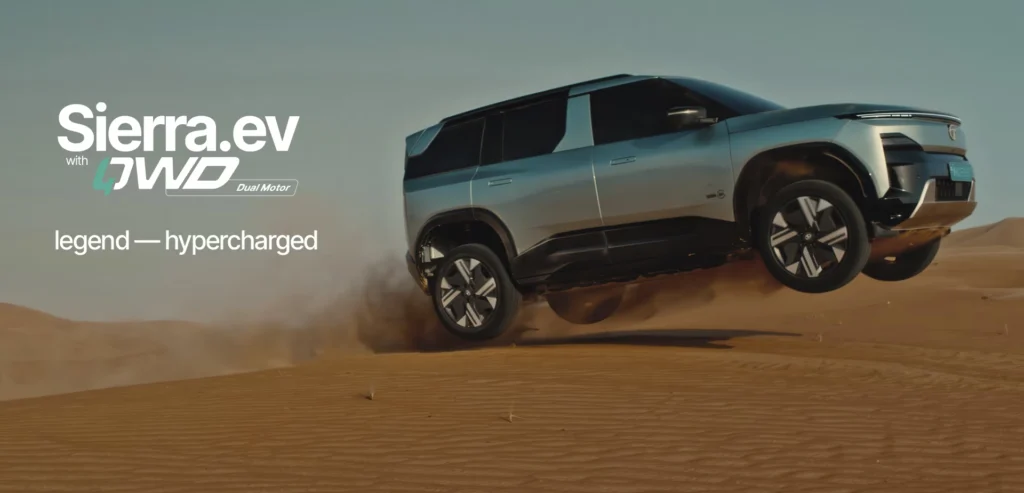
The Tata Sierra EV proves that smart engineering isn’t always reflected by bigger power figures. While the 63 kWh variant offers stronger peak performance, the 75 kWh version delivers what many buyers are likely to appreciate even more—a substantially longer driving range without sacrificing everyday drivability.
The specification sheet tells only half the story. Once you look beyond the peak power figures, the Sierra EV’s engineering philosophy becomes much easier to understand. For performance-focused drivers, the 63 kWh variant remains an excellent choice. But for most buyers, the 75 kWh Sierra EV stands out as the more practical and future-ready option. More importantly, the bigger battery won’t just deliver more kilometres—it will deliver greater peace of mind every time you head out on the road.