
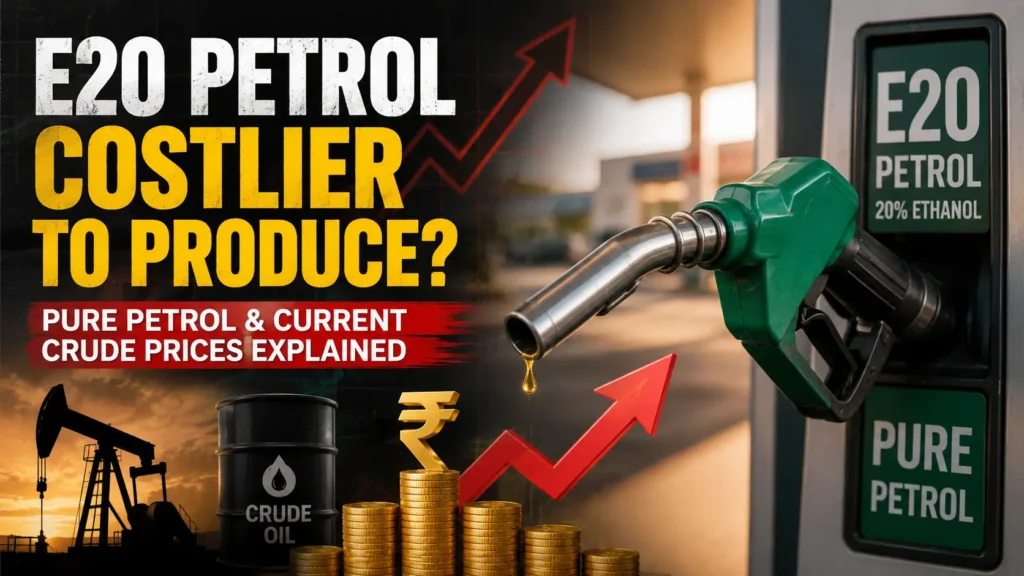
E20 Petrol Is Now Costlier to Produce Than Pure Petrol – Government Admits the Uncomfortable Truth
For years, the Indian government has championed ethanol blending as the silver bullet that would simultaneously reduce India’s dependence on imported crude oil, lower carbon emissions, boost farmer incomes, and — most importantly for the common man — bring down the price of petrol at the pump. Union Minister Nitin Gadkari famously claimed that ethanol blending could eventually bring petrol prices down to Rs 15 per litre. That promise now looks not just optimistic but almost fantastical, because the Petroleum and Natural Gas Ministry has officially acknowledged what many industry observers have been saying quietly for months — E20 petrol is currently costlier to produce than pure, unblended petrol at prevailing global crude oil prices.
This admission is significant because it fundamentally challenges the narrative that ethanol blending is always a win-win proposition. The reality, as the ministry’s statement makes clear, is far more nuanced. The economics of ethanol blending are not fixed — they swing dramatically depending on where global crude oil prices are trading. And right now, with Brent crude hovering around the $70 per barrel mark, the math simply does not work in ethanol’s favour.
The Numbers That Tell the Story
The government currently procures maize-based ethanol at Rs 71.86 per litre. This is the base cost before adding GST, transportation charges, and depot handling costs. Once you factor in these additional expenses, the actual cost of ethanol delivered to the blending facility is significantly higher than Rs 71.86.
Now compare this with the cost of producing pure petrol from crude oil. When international crude is trading at approximately $70 per barrel — which is roughly where it has been in recent months — the cost of refining a litre of petrol from crude oil is substantially lower than the cost of procuring ethanol. The ministry’s statement is unambiguous on this point: at $70 per barrel crude, E20 is costlier to produce than pure petrol.
This creates an awkward situation. The government is mandating that oil marketing companies blend 20 percent ethanol into petrol, but the ethanol component is actually more expensive than the petrol it is replacing. The additional cost has to be absorbed somewhere — either by the oil companies (reducing their margins), by the government (through subsidies), or by the consumer (through higher pump prices). In practice, it is likely a combination of all three, though the government has been reluctant to explicitly pass on the cost to consumers.
Also Read: TVS Jupiter 125 Real-World Review: The Most Practical 125cc Scooter with Minor Flaws?
Why Ethanol Costs Are Fixed While Petrol Costs Fluctuate
To understand why this situation has arisen, you need to understand the fundamental difference between how ethanol and petrol are priced.
Ethanol in India is produced primarily from sugarcane, maize (corn), and damaged food grains. Its production costs are determined by domestic agricultural factors — the cost of the crop, distillation expenses, labour, and government-regulated procurement prices that are designed to ensure farmers receive a fair return. These costs are relatively stable and insulated from global market fluctuations. Whether crude oil is at $50 or $150 per barrel, the cost of producing a litre of ethanol from maize remains roughly the same.
Petrol, on the other hand, is refined directly from crude oil, and its production cost is almost entirely determined by the international price of crude. When crude is cheap, petrol is cheap to produce. When crude is expensive, petrol becomes expensive. This direct linkage to global markets means that petrol production costs can swing wildly from month to month.
The problem arises when crude oil prices fall to levels where refining petrol becomes cheaper than procuring ethanol. At $70 per barrel, we are firmly in that territory. The government is essentially paying more for the ethanol component than it would cost to simply use pure petrol — which means the blending programme, at current prices, is adding to the cost of fuel rather than reducing it.
When Does Ethanol Become Cheaper?
The ministry’s statement provides a clear answer to this question. If crude oil prices rise to $120-130 per barrel — as they did during the West Asian conflict and various geopolitical crises — the economics reverse completely. At those elevated crude prices, refining petrol becomes extremely expensive, while ethanol production costs remain stable. In that scenario, blending 20 percent ethanol into petrol actually pulls the overall production cost down, making E20 cheaper than pure petrol.
This is exactly what happened during previous oil price spikes. The government used ethanol blending as a buffer to protect consumers from the full impact of rising global crude prices. When crude was at $120+ per barrel, the ethanol component was the cheaper ingredient in the blend, and its inclusion helped keep pump prices lower than they would have been with pure petrol.
The challenge is that crude oil prices are cyclical and unpredictable. The blending programme was designed for a world where crude was expected to remain expensive. In the current environment of relatively moderate crude prices, the programme’s economic rationale weakens — though its strategic and environmental benefits remain intact.
The Strategic Case Still Holds
While the immediate economics may not favour ethanol blending at current crude prices, the government’s broader strategic rationale for the programme remains valid. India imports over 85 percent of its crude oil requirements, making it extremely vulnerable to supply disruptions, geopolitical tensions, and price shocks. Every litre of ethanol blended into petrol is a litre of crude oil that India does not need to import, reducing the country’s foreign exchange outflow and improving energy security.
According to the ministry, the Ethanol Blended Petrol Programme has already delivered substantial benefits. It has saved more than Rs 1.97 lakh crore in foreign exchange, substituted nearly 316 lakh metric tonnes of crude oil imports, reduced approximately 952 lakh metric tonnes of carbon dioxide emissions, and transferred more than Rs 1.66 lakh crore directly to farmers through ethanol procurement.
These are not trivial numbers. The foreign exchange savings alone justify the programme from a macroeconomic perspective, even if the per-litre economics do not always work out in ethanol’s favour. And the farmer income support — Rs 1.66 lakh crore transferred directly to agricultural producers — has significant social and political value that goes beyond simple cost-per-litre calculations.

Also Read: VinFast’s Taxi Dream Hits Trouble Early: Drivers Start Complaining Just Days After Launch
What This Means for Consumers
For the average car owner filling up at the pump, the immediate impact of this revelation is limited. Petrol prices in India are determined by a complex formula that includes crude oil costs, refining margins, excise duty, VAT, dealer commissions, and various other factors. The ethanol blending cost is just one component of this formula, and its impact on the final pump price is relatively small in absolute terms.
However, the admission does put to rest any hopes of a significant petrol price reduction driven by ethanol blending — at least at current crude oil prices. The promise that blending would make fuel cheaper was always contingent on crude remaining expensive. In the current price environment, blending is a cost rather than a saving, and consumers should not expect any relief at the pump from this programme alone.
What consumers should be aware of is that E20 fuel has approximately 6-7 percent lower energy content than pure petrol, which can translate into a marginal reduction in fuel efficiency — typically in the range of 1-6 percent depending on the vehicle and driving conditions. The Petroleum Ministry has stated that this impact is minimal and can be mitigated with proper engine tuning, but it is a factor that cost-conscious buyers should keep in mind.
The Road Ahead — E30 Is Coming
Despite the current cost challenges, the government is not slowing down on its ethanol blending ambitions. In fact, it is accelerating them. In May 2026, the government notified fuel standards for E30 petrol — a blend containing 30 percent ethanol — signalling that India intends to push well beyond E20 in the coming years.
The logic behind this push is long-term and strategic rather than short-term and economic. The government is betting that crude oil prices will not remain at $70 forever. When the next price spike inevitably comes — whether driven by geopolitical conflict, OPEC production cuts, or supply disruptions — India wants to have a robust domestic ethanol infrastructure in place that can cushion the blow. Building that infrastructure takes years, and waiting until crude prices spike to start building it would be too late.
Additionally, the environmental benefits of ethanol blending — reduced carbon emissions, lower particulate matter, and cleaner combustion — align with India’s climate commitments and urban air quality goals. These benefits have value even when the per-litre economics do not favour ethanol.
The Bottom Line
The government’s admission that E20 is costlier to produce than pure petrol at current crude prices is a moment of refreshing honesty in a debate that has often been dominated by overly optimistic projections. It does not mean the ethanol blending programme is a failure — far from it. The programme has delivered real benefits in terms of energy security, farmer incomes, and emission reductions. But it does mean that the promise of cheaper petrol through blending was always conditional, and those conditions are not currently being met.
For car owners, the practical takeaway is simple — do not expect petrol prices to fall because of ethanol blending. The programme exists for strategic and environmental reasons, not to make your fuel bill smaller. And if crude oil prices rise sharply in the future, be grateful that the blending infrastructure exists to cushion the impact. That insurance policy has a cost, and right now, we are paying it.
FAQ
1. Is E20 petrol more expensive to produce than pure petrol?
Yes, at current crude oil prices of around $70 per barrel, E20 petrol is costlier to produce than pure petrol because the government procures ethanol at Rs 71.86 per litre (before GST and transport costs), which is higher than the cost of refining petrol from cheap crude.
2. At what crude oil price does ethanol blending become economical?
According to the Petroleum Ministry, if crude oil rises to $120-130 per barrel, ethanol becomes cheaper than petrol and blending reduces the overall fuel production cost.
3. How much has the ethanol blending programme saved India?
The programme has saved over Rs 1.97 lakh crore in foreign exchange, substituted 316 lakh metric tonnes of crude oil, reduced 952 lakh metric tonnes of CO2 emissions, and transferred Rs 1.66 lakh crore to farmers.
4. Does E20 petrol reduce fuel efficiency?
E20 has about 6-7% lower energy content than pure petrol, which can reduce fuel efficiency by 1-6% depending on the vehicle. The Petroleum Ministry says this impact is marginal and can be mitigated with engine tuning.
5. Is India planning to go beyond E20?
Yes, the government notified E30 petrol standards in May 2026, signalling plans to increase ethanol blending to 30% in the coming years.
For more such updates on latest cars, bikes and EVs stay connected to MotorMitra. #gaadiyonkismartguide