How an Oil Giant Just Built an EV with Half the Carbon Footprint of Today’s Electric Cars
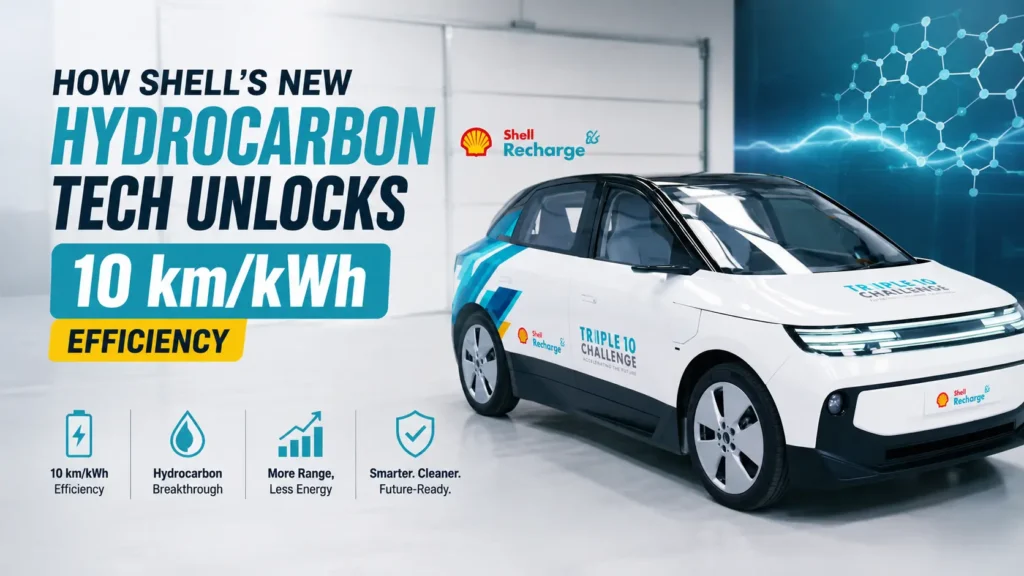
Shell has officially pulled the wraps off its “Triple 10 Challenge” electric vehicle concept. Instead of chasing massive battery metrics, this road-legal compact hatchback focuses entirely on radical thermal management, achieving a mind-boggling driving efficiency of 10 km/kWh, a sub-10-minute fast-charging cycle, and an absolute lifecycle carbon footprint of just 10 tonnes of $CO_2$—roughly half that of a standard modern EV.
The automotive industry’s default solution to EV range anxiety has become incredibly predictable: just slap a bigger battery into the floor pan. While this brute-force method successfully pushes driving ranges past the 500 km mark, it introduces a dark corporate secret. Massive battery packs drastically increase vehicle weight, drive up consumer costs, and create a colossal carbon footprint during the initial raw-material mining and manufacturing phases. Now, in a twist of absolute industrial irony, one of the world’s largest oil conglomerates has stepped forward to show global carmakers a vastly superior way forward.
Liquid-Immersion Thermal Management
The engineering breakthrough enabling these spectacular metrics isn’t a magical new battery chemistry. Instead, it is a revolutionary packaging system built around Shell Recharge dielectric fluid. In a conventional electric car (like a Tesla Model 3 or a Tata Nexon EV), the battery pack relies on an indirect cooling network. A mixture of water and glycol is piped through closed aluminum cooling plates running underneath or alongside the battery cells. This creates uneven temperature zones, slow heat dissipation, and localized internal hotspots.
Shell’s concept completely throws out cooling plates. Developed alongside British engineering powerhouse RML Group, the Triple 10’s compact 32 kWh usable battery pack fully immerses its cylindrical cells directly in a non-conductive, hydrocarbon-based dielectric liquid. Because every square millimeter of the cell is in direct contact with the cooling fluid, heat is absorbed with absolute uniformity. This eliminates internal hotspots entirely and allows the battery to sustain an intense, unthrottled 175 kW DC fast-charging rate across almost the entire charging cycle.
Also Read: €1.5 Billion Down the Drain: Why Volkswagen Just Canned Its Flagship Self-Driving Project
Efficiency
Because the liquid-immersion system regulates temperatures flawlessly, Shell’s engineering team managed to link the entire vehicle’s thermal architecture into one single, ultra-simplified cooling loop. The same fluid absorbs heat from the battery, flows directly through the electric motor, passes through the power electronics, and expels heat via a single radiator. This hyper-lean layout eliminates heavy secondary water pumps, complex electronic valves, and bulky multi-stage heat exchangers, cutting overall battery assembly weight and reducing production costs by an estimated 25 percent.
| EV Efficiency & Metric | Shell Triple 10 Concept | Tesla Model 3 (Standard RWD) |
| Battery Pack Capacity | Compact 32 kWh (Usable) | ~60 kWh LFP Pack |
| Real-World Energy Efficiency | 10 km/kWh (6.2 miles/kWh) | ~8 km/kWh (4.9 miles/kWh) |
| 10% to 80% Fast-Charging Time | 9 Minutes, 54 Seconds | ~25 Minutes |
| Total Lifecycle Carbon Footprint | ~10 Tonnes of $CO_2e$ | ~20 Tonnes of $CO_2e$ (Average) |
| Charging Power Retention | Sustains 175 kW flat out | Throttles down as heat rises |
By achieving an efficiency rate of 10 km per single kilowatt-hour of juice, the Triple 10 extracts over 30% more driving range out of the exact same amount of electricity compared to the industry’s most efficient sedans. Despite packaging a tiny 32 kWh battery (roughly half the size of a standard midsize EV), the car easily delivers a highly practical 210 to 220 miles (340+ km) of real-world driving range.
Built from the Circular Economy
To ensure the vehicle achieved its rigid target of just 10 tonnes of lifetime lifecycle emissions, Shell wrapped the ultra-efficient powertrain in a deeply sustainable structure:
- The Skeleton: The primary chassis is constructed out of high-strength, lightweight recycled aluminum structures.
- The Shell: The aerodynamic body panels, low-drag wheel hubcaps, and structural rims utilize recycled carbon fiber weaves.
- The Cabin: The interior upholstery leaves plastic synthetics behind, utilizing a highly durable, lightweight textile woven entirely from natural flax-derived fibers.
Also Read: Ferrari’s First EV Was Roasted Online—Then Sold Out in China Within Hours
Motor Mitra Verdict
Let’s be completely clear: Shell is not planning to set up a network of assembly lines to become a global mass-market car manufacturer. The Triple 10 Challenge is a highly sophisticated, rolling technological billboard designed to prove a profound point to legacy car brands: the race for heavier, resource-intensive 100 kWh batteries is a fundamentally flawed strategy. By proving that a lightweight, hyper-efficient car with a small 32 kWh pack can charge from 10% to 80% in 9 minutes and 54 seconds using a standard, widely available 175 kW DC charger, Shell has highlighted a smarter path forward.
The real commercial product here is their specialized Shell Recharge immersion fluid. As automotive giants scramble to build affordable, sub-$25,000 global EVs over the next few years, transitioning to immersion-cooled battery packs could be the exact holy grail required to drop manufacturing costs by 25%, halve carbon footprints, and permanently end range anxiety through true single-digit pit stops.
For more such updates on latest cars, bikes and EVs stay connected to MotorMitra. #gaadiyonkismartguide