To understand how paddle shifters interact with an Automated Manual Transmission (AMT), it helps to first demystify what an AMT actually is.
Unlike a traditional automatic (which uses a torque converter and planetary gears) or a Dual-Clutch Transmission (DCT), an AMT is mechanically identical to a standard manual transmission. It features a conventional dry clutch and a traditional gearbox layout. The only difference is that the human element—the clutch pedal and the gear stick—is replaced by an electro-hydraulic or electromechanical robot called an Actuator.
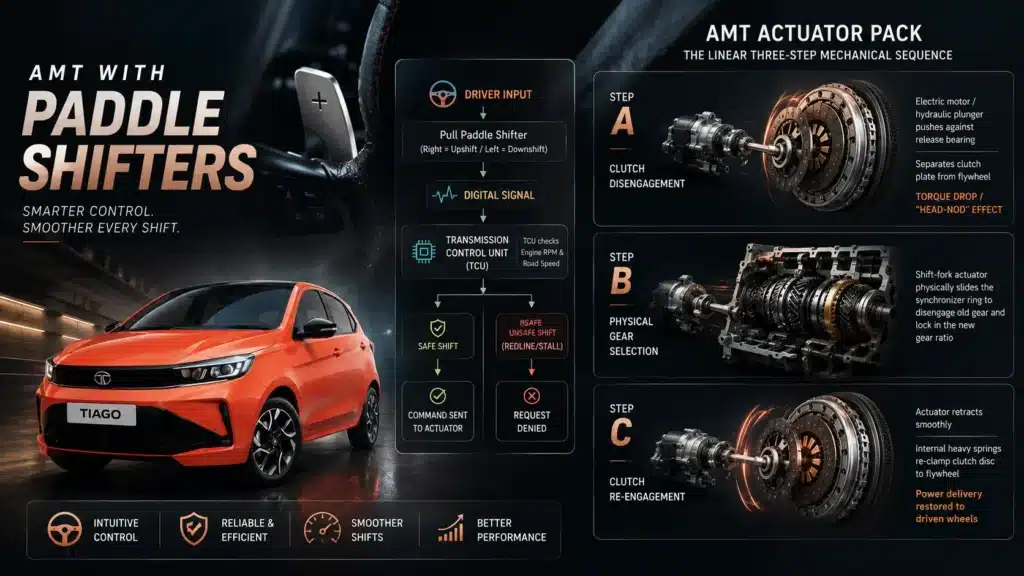
When you add paddle shifters to this mix, you are introducing an electronic bypass to the system’s default brain. Here is the step-by-step mechanical and electronic chain reaction that occurs when you pull a paddle:
Also Read: New Honda City vs Hyundai Verna 2026: Specs, Features & Mileage
1. The Electronic Signal (The Demand)
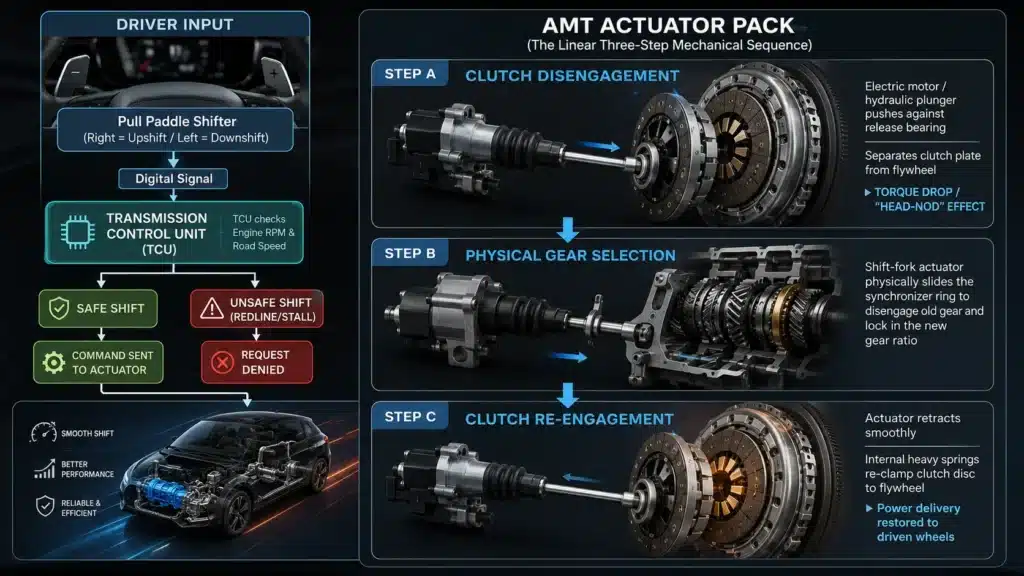
When the car is in “Manual” mode and you pull the right paddle (Upshift) or left paddle (Downshift), you are not mechanically moving any gears. The paddle is simply an electronic switch.
Pulling the paddle sends a digital request to the TCU (Transmission Control Unit).
2. The TCU Processing (The Logic)
Before executing your command, the TCU acts as a gatekeeper to protect the engine. It cross-checks the current engine RPM and road speed.
- If you ask for a downshift that would redline and damage the engine, the TCU denies the request.
- If the parameters are safe, the TCU instantly commands the AMT Actuator Pack to execute the shift sequence.
3. The Actuator Execution (The Mechanical Action)
This is where the physical magic happens. The actuator pack consists of small, powerful electric motors or hydraulic pumps bolted directly onto the casing of the manual gearbox. Upon receiving the signal from the TCU, the actuator executes a perfectly timed, three-step mechanical sequence:
[Pull Paddle] ➔ [TCU Approves] ➔ [Actuator Disengages Clutch] ➔ [Actuator Shifts Gear] ➔ [Actuator Re-engages Clutch]
Step A: Clutch Disengagement
An electric motor or hydraulic plunger physically pushes against the clutch release bearing, separating the clutch plate from the engine flywheel. This cuts off power delivery from the engine to the wheels, exactly like stepping on a clutch pedal.
Also Read: The Petrol-Electric Revolution: 3 New Honda Hybrids Built to Thrill
Step B: The Gear Selection
Simultaneously, a second set of actuators shifts the internal gear selector forks. If you pulled the right paddle, the actuator physically moves the shift fork to disengage the current gear ratio and slide the synchronizer ring onto the next higher gear gear wheel.
Step C: Clutch Re-engagement
The Core Challenge: Why AMTs Feel Slow
When you use paddle shifters in a high-end sports car with a Dual-Clutch Transmission (DCT), the shift feels instantaneous (often under 50 milliseconds). This is because a DCT pre-selects the next gear on a separate shaft; it just swaps clutches.
In an AMT, because it uses a single clutch and a standard manual layout, the mechanical sequence must happen linearly: Clutch Open $\rightarrow$ Shift Gear $\rightarrow$ Clutch Close.
During this window (which usually takes between 500 milliseconds to a full second in budget cars), there is a complete interruption of torque. This torque gap is what causes the infamous “head-nod” or torque-hole effect, where occupants lean forward momentarily because the car stops accelerating while the mechanical components shift inside the gearbox.
Also Read: Pulsar N160 vs Apache RTR 160 4V Comparison: Price, Specs, Mileage
Why Add Paddles to an AMT?
Despite the inherent slowness of the mechanism, paddle shifters drastically improve the driving experience of an AMT in two scenarios:
- Anticipating Overtakes: An AMT’s automatic brain takes time to realize you want to accelerate quickly, causing a delayed downshift. With a paddle, you can manually drop a gear before pulling out to overtake.
- Engine Braking: When driving down a steep hill, you can use the left paddle to force the actuator to downshift and hold a lower gear, using the engine’s compression to slow the vehicle rather than riding and overheating the brakes.
- Create a comparison table of shift speeds across AMT, CVT, Torque Converter, and DCT
- Explain the mechanical difference between electro-hydraulic and electromechanical AMT actuators
- Draft a troubleshooting guide for common mechanical failures in AMT systems