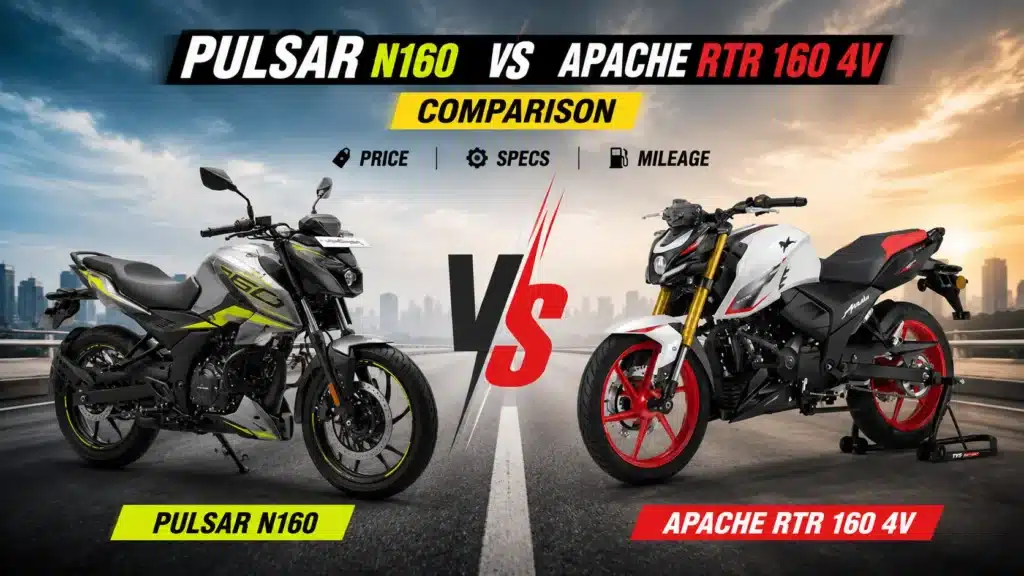
Streetfighter Scrimmage: Bajaj Pulsar N160 vs TVS Apache RTR 160 4V
The entry-level premium commuter space in India has evolved into a hyper-competitive battleground. Buyers shopping in the 160cc segment no longer settle for standard point-A-to-point-B commuters; they demand track-honed agility, cutting-edge technology, aggressive bodywork, and everyday usability.
For years, the TVS Apache RTR 160 4V comfortably sat on the throne, fending off challengers with its high-revving 4-valve engine and race-derived heritage. However, the arrival of the heavily refreshed Bajaj Pulsar N160 completely disrupted this status quo, introducing a premium big-bike character and a segment-first safety feature list. Let’s dive deep into this no-nonsense journalistic shootout to see which machine deserves your hard-earned money.
Also Read: Bajaj Pulsar N160 Single Seat With USD Forks Launched In India At ₹1.23 Lakh
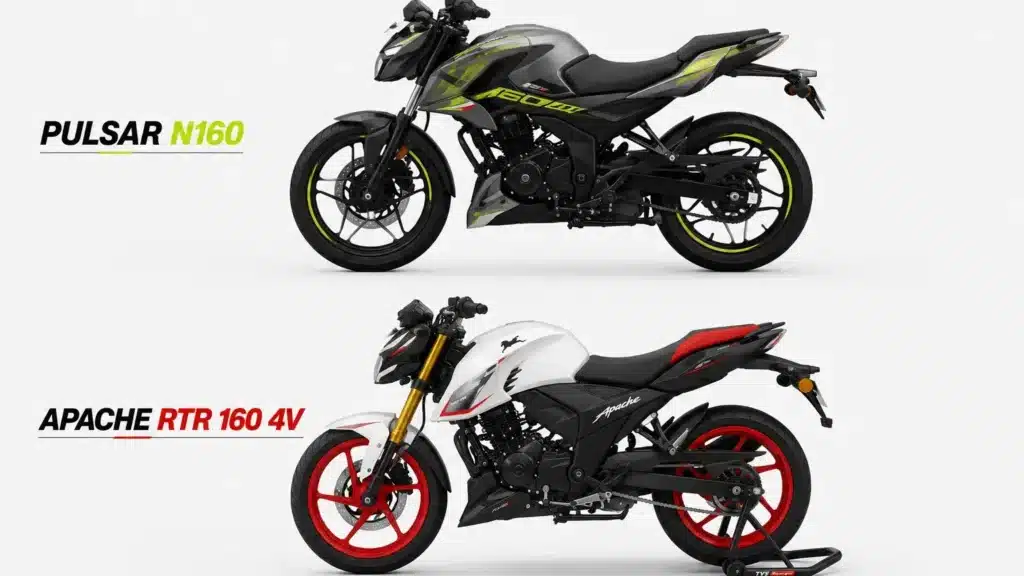
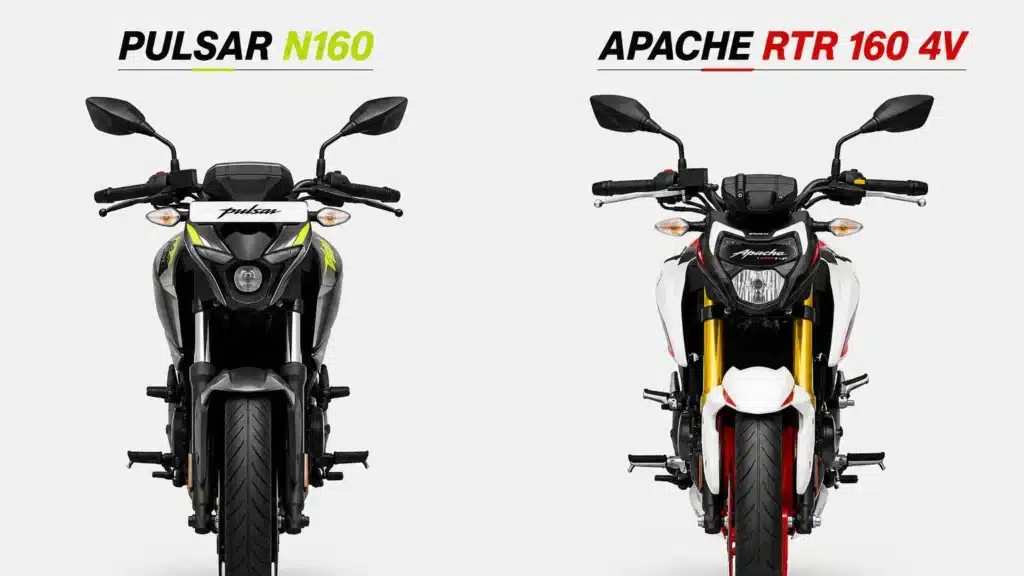
The Bajaj Pulsar N160 takes heavy inspiration from its bigger sibling, the N250. It relies on a dark, muscle-bound, and brooding streetfighter stance. The absolute highlight of its design is the sinister-looking bi-LED projector headlamp assembly flanked by sharp LED daytime running lights (DRLs), creating an incredibly aggressive face in rear-view mirrors. With its muscular fuel tank extensions, tight underbelly exhaust, and clean split-seat setup, the N160 carries a premium, cohesive look that values road presence and structural bulk.
The TVS Apache RTR 160 4V, on the other hand, wears its racing heritage on its sleeve. It is leaner, sharper, and features aggressive, sweeping graphics. The front face is characterized by TVS’s signature “fang” LED DRLs. The overall architecture feels much more athletic, giving off the impression of a nimble track-day tool even when it is parked at a traffic signal.
The real personality split occurs under the bodywork. While both use five-speed manual gearboxes, the way they deliver performance is fundamentally different.
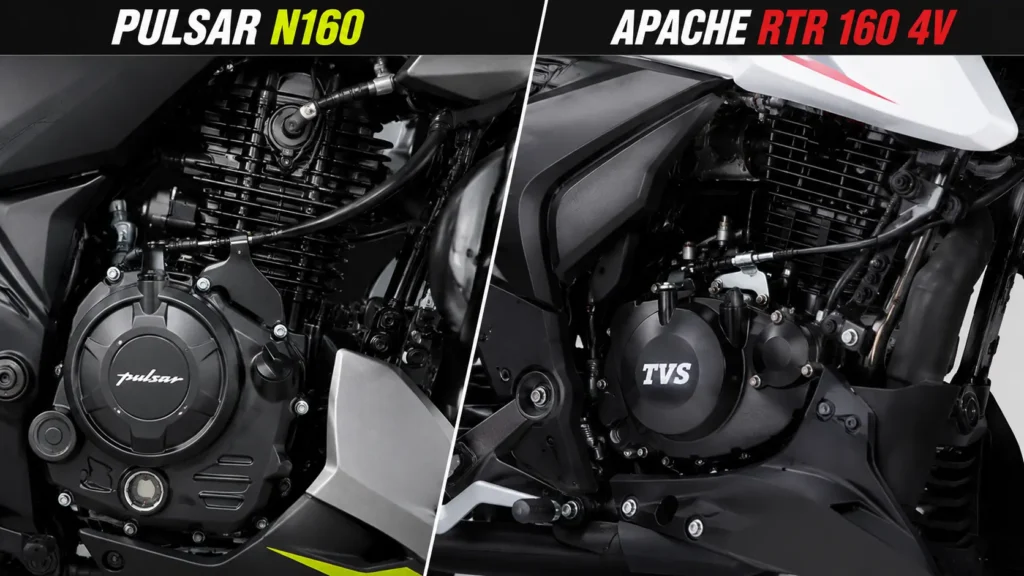
Pulsar N160 Engine
- 164.82cc, 2-Valve Single
- Focus: Mid-range grunt
- 16 PS / 14.65 Nm
Apache RTR 160 4V Engine
- 159.7cc, 4-Valve Single
- Focus: High-revving power
- 17.55 PS / 14.73 Nm
The Pulsar N160 relies on a marginally larger 164.82cc oil-cooled engine, but it runs on a more basic 2-valve SOHC architecture. Bajaj tuned this engine for effortless tractability. It pulls cleanly right from 1,500 rpm. In stop-and-go city traffic, you don’t need to dance through the gearbox; the torque is readily available right in the lower and middle sections of the tachometer.
Also read: Bajaj Avenger 220 Street Coming Soon –160 Street Discontinued, Big Shift for Buyers
The Apache RTR 160 4V hits back with a highly sophisticated 159.7cc, 4-valve oil-cooled setup. This extra pair of valves allows the engine to breathe much more freely at higher revs. While it feels slightly less eager than the Pulsar at very low RPMs, the moment the digital tacho crosses 6,000 rpm, the Apache surges forward with unmatched top-end urgency, comfortably leaving the Pulsar behind on wide-open highways.
Specifications Comparison Table
| Technical Metric | Bajaj Pulsar N160 | TVS Apache RTR 160 4V | Winner |
| Engine Displacement | 164.82 cc | 159.7 cc | Pulsar (Size) |
| Valve Configuration | 2-Valve, SOHC | 4-Valve, SOHC | Apache (Tech) |
| Cooling System | Air & Oil Cooled | Air & Oil Cooled | Tie |
| Maximum Power | 16 PS @ 8750 rpm | 17.55 PS @ 9250 rpm | Apache |
| Maximum Torque | 14.65 Nm @ 6750 rpm | 14.73 Nm @ 7500 rpm | Apache |
| Top Speed | 120 kmph | 114 kmph | Pulsar |
| Overall Mileage | ~45-50 kmpl | ~41-45 kmpl | Pulsar |
Ride, Handling, and Everyday Dynamics
When it comes to geometry, the bikes cater to completely different rider profiles.
Also Read: TVS Apache RTX 300 Real Highway Mileage Finally Revealed – Touring Range May Shock Buyers
The Pulsar N160 sets its rider up in an engaging yet comfortable streetfighter stance. The clubman handlebars sit low and slightly tapered, matched with rear-set footpegs. Combined with its substantial 37mm telescopic front forks (or premium Upside Down forks depending on the specific trim level chosen) and Nitrox rear monoshock, the ride quality is exceptionally balanced. It handles bad city tarmac and speed breakers with absolute composure without feeling overly soft when leaning into corners.
The Apache RTR 160 4V places the rider in an upright seating position with tall, wide handlebars. Paradoxically, its footpegs are mounted significantly higher up the frame. While this gives excellent cornering clearance for track environments, taller riders (over 6 feet) might find the rider triangle cramped on long commutes. Dynamically, the Apache’s chassis feels sharper and faster to transition from left to right, acting like a scalpel through dense urban congestion.
Braking and Feature Differences
| Feature Comparison | Bajaj Pulsar N160 | TVS Apache RTR 160 4V |
| Front Brake Size | 300 mm Disc | 270 mm Disc |
| Anti-Lock Braking (ABS) | Dual-Channel ABS (Standard) | Single or Dual-Channel (Variant dependent) |
| Riding Modes | Not Available | Urban, Rain, and Sport Modes |
| Connectivity | Digital Console with Bluetooth | SmartXonnect Bluetooth System |
| Low-Speed Traffic Tech | No | Glide Through Technology (GTT) |
| USB Charging Port | Yes | No |
Bajaj completely edges out TVS when it comes to raw mechanical safety, making dual-channel ABS a key highlight on the N160. The massive 300mm front rotor provides reassuring bite and prevents wheel lockup even in emergency braking over wet patches.
TVS, conversely, sweetens the deal with digital technology. The top-tier variants offer dedicated riding modes (Urban, Rain, Sport) that actively alter the power delivery curve and ABS sensitivity. It also features Glide Through Technology (GTT), which lets the bike crawl forward smoothly in traffic simply by releasing the clutch, completely eliminating throttle fatigue.
Both of these 160cc streetfighters are exceptionally polished products, meaning there is no clear loser.
Choose the Bajaj Pulsar N160 if you want an effortless, torquey, everyday commuter with mature big-bike riding manners. Its rock-solid mid-range engine performance, premium LED projector headlight, and safety-focused dual-channel ABS configuration make it a highly practical and secure urban cruiser.
Choose the TVS Apache RTR 160 4V if you are an automotive purist who loves high-revving performance, tech-heavy gadgetry, and sharp track-focused agility. If you enjoy extracting every ounce of top-end performance out of an engine and love playing with tech features like riding modes and navigation telemetry, the Apache continues to justify its legendary racing status.