
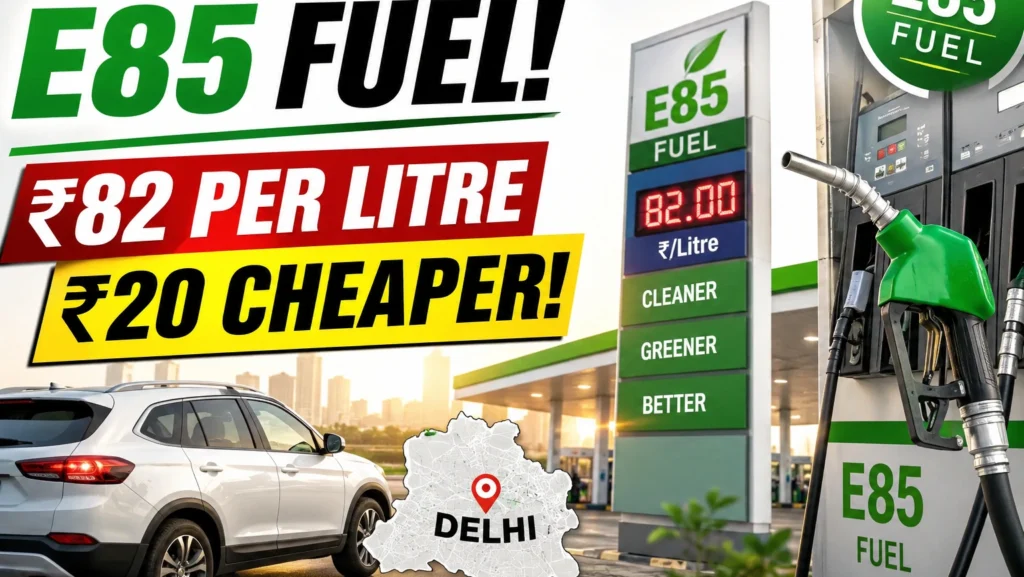
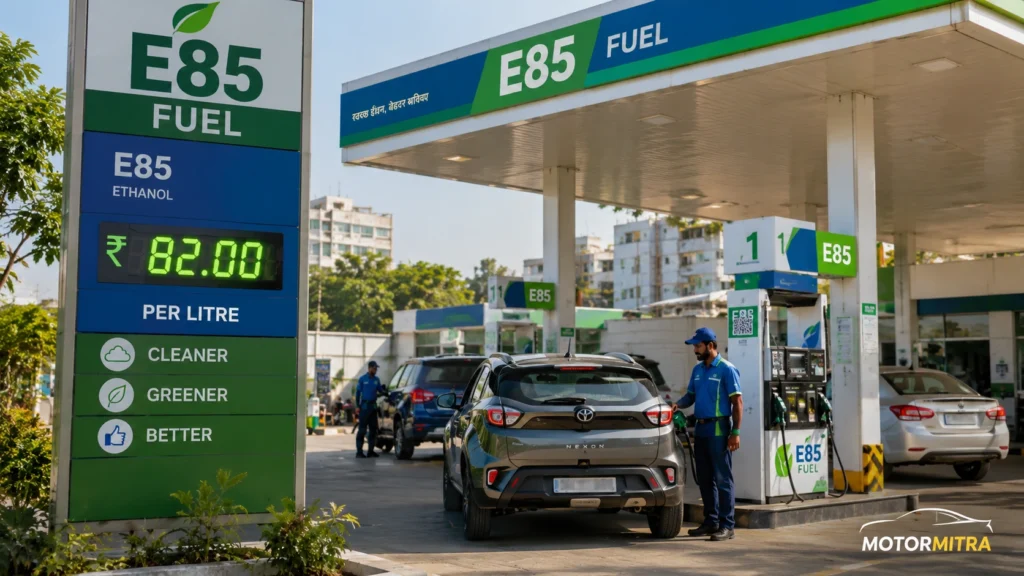
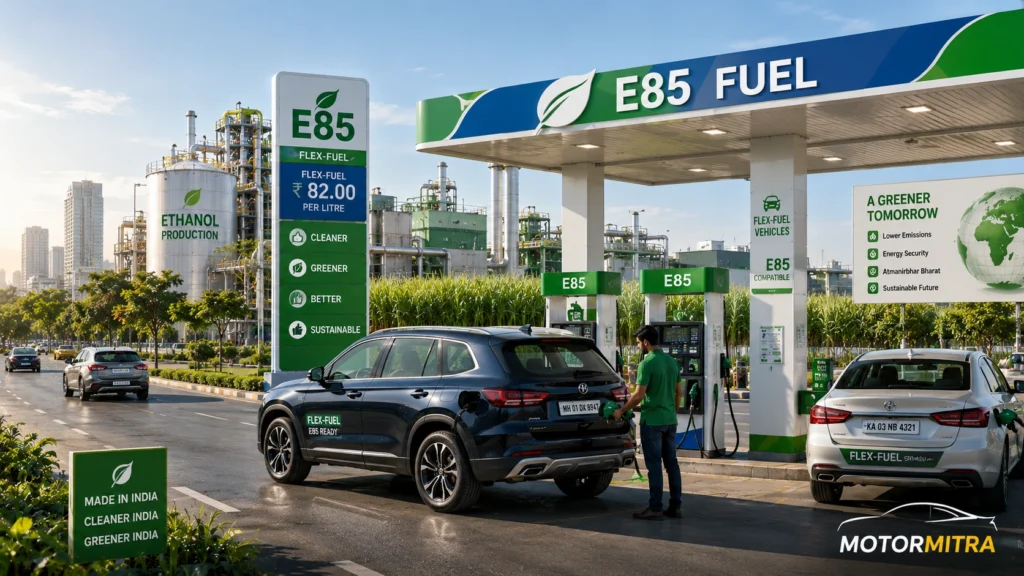
Fuel prices have become one of the biggest concerns for Indian vehicle owners over the last few years. Whether someone drives daily for work or frequently travels long distances, rising running costs can significantly impact overall ownership expenses. That is exactly why a new development in Delhi is attracting attention far beyond the capital. Delhi has received its first E85 fuel station, and while the technology behind it is important, the number grabbing headlines is the price itself. At around Rs 82 per litre, E85 fuel costs roughly Rs 20 less than regular petrol, immediately raising questions about whether this could become a meaningful alternative for Indian motorists.
For years, discussions around alternative fuels have largely revolved around CNG, electric vehicles and hybrid technology. E85 enters the conversation from a different angle. Instead of requiring buyers to move toward an entirely different vehicle category, it offers a potentially lower-cost fuel option for compatible flex-fuel vehicles. That distinction is important because it allows drivers to continue using familiar internal-combustion technology while benefiting from a different fuel strategy. As a result, Delhi’s first E85 fuel station could represent a much bigger shift than it initially appears.
Why This Matters
- Delhi has received its first E85 fuel station.
- E85 is priced at approximately Rs 82 per litre.
- The fuel costs around Rs 20 less than regular petrol.
- The move supports India’s growing flex-fuel ecosystem.
- Lower running costs could attract future flex-fuel vehicle buyers.
Also Read:- Maruti Suzuki Battles Fuel Price Volatility with India’s First Production-Spec E100 Wagon R
What Exactly Is E85 Fuel?
E85 is a fuel blend containing up to 85 percent ethanol and 15 percent petrol. It is specifically designed for flex-fuel vehicles that can safely operate on higher ethanol concentrations without requiring major modifications. While ethanol-blended fuels are already available in India at lower concentrations, E85 represents a significant step toward increasing ethanol usage across the transportation sector.
The concept itself is not entirely new. Countries such as Brazil and the United States have relied on higher ethanol blends for years, helping reduce dependence on conventional fossil fuels. India is now expanding its own ethanol strategy as part of broader efforts to reduce fuel imports, strengthen domestic agricultural supply chains and diversify mobility solutions. For consumers, however, the immediate attraction is much simpler. Lower fuel prices are easy to understand, and that alone is enough to generate significant interest.
| Ownership Impact | E85 Fuel | Petrol | Real-World Effect |
|---|---|---|---|
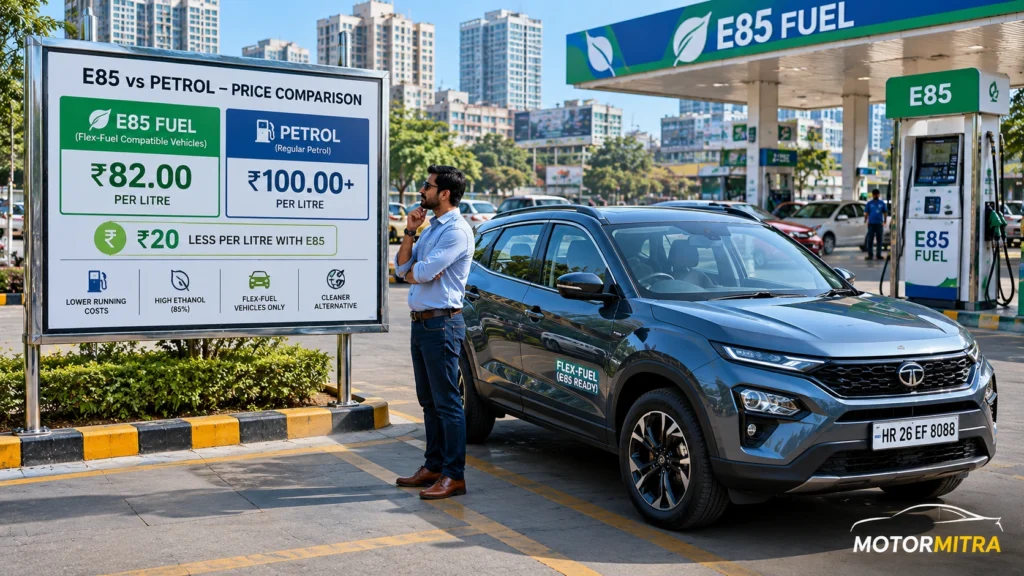
| Price Per Litre | Rs 82 | Rs 100+ | Around Rs 20 saving per litre |
| 50-Litre Fill-Up Cost | Lower | Higher | Roughly ₹1,000 difference per tank |
| Monthly Running Cost | Potentially lower | Higher | Better for frequent drivers |
| Fuel Composition | 85% Ethanol + 15% Petrol | Conventional petrol | Lower fossil fuel dependence |
| Vehicle Compatibility | Flex-fuel vehicles only | Most petrol vehicles | Biggest adoption barrier today |
| Availability | Limited stations | Nationwide network | Infrastructure expansion required |
| Government Support | Strong ethanol push | Existing ecosystem | More growth expected |
| Environmental Impact | Lower emissions potential | Higher fossil fuel usage | Supports cleaner mobility goals |
| Long-Term Potential | Growing rapidly | Mature fuel market | Future-focused alternative |
| Biggest Advantage | Lower running costs | Easy accessibility | Cost vs convenience trade-off |
| Annual Usage Impact | E85 Fuel | Petrol | Higher annual savings potential for frequent drivers |
But the real significance of E85 extends beyond simple fuel savings.
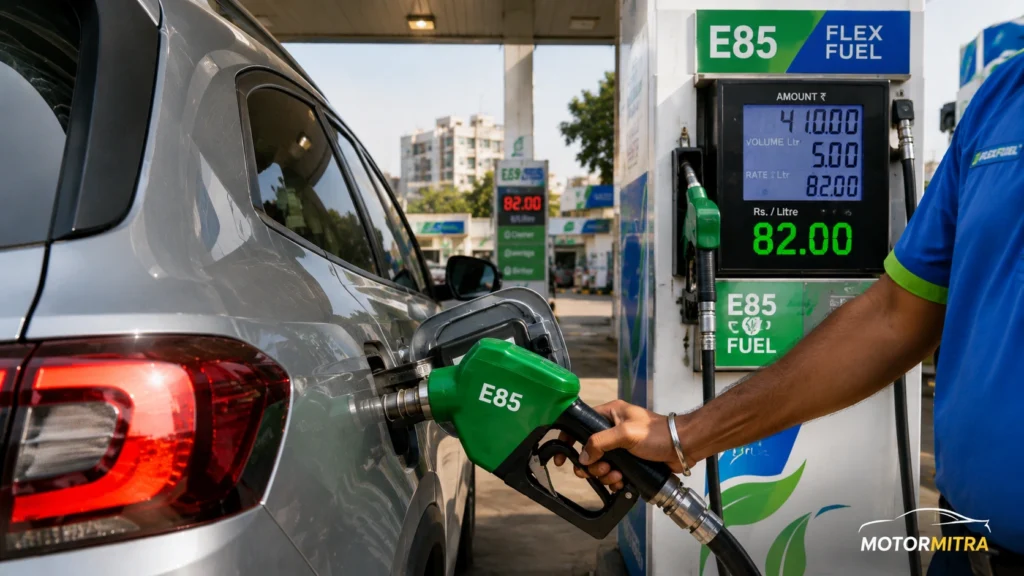
The bigger story is that this launch signals increasing confidence in flex-fuel mobility. While consumers naturally focus on the Rs 82 price tag, policymakers and manufacturers are paying attention to what it could mean for India’s long-term transportation strategy. That is where this development becomes particularly interesting.
How Much Could Drivers Actually Save?
The Rs 20 difference between E85 and petrol may not sound dramatic at first glance, but the numbers become more compelling when viewed through the lens of everyday vehicle ownership. A driver filling a 50-litre tank could theoretically save around Rs 1,000 compared with regular petrol prices. Over several fill-ups each month, those savings can add up quickly, especially for users who travel long distances or depend heavily on their vehicles for daily commuting.
That does not automatically mean every driver can take advantage of those savings immediately. Vehicle compatibility remains the biggest factor, and E85 is intended specifically for flex-fuel-compatible vehicles. Even so, the potential financial benefit helps explain why the fuel is attracting attention from both consumers and industry observers. At a time when buyers are increasingly focused on ownership costs, a Rs 20-per-litre advantage is difficult to ignore.
Also Read:- Hero MotoCorp Launches Flex-Fuel Splendor+ and HF Deluxe; Prices Start At Rs. 72,792
Should Vehicle Owners Care About E85 Right Now?
For existing petrol vehicle owners, the answer depends entirely on what they drive. Most conventional petrol vehicles are not engineered to operate on E85 fuel, meaning immediate adoption will not be possible for everyone. In the short term, the primary beneficiaries will be owners of flex-fuel-compatible vehicles capable of safely utilizing higher ethanol concentrations.
However, future buyers should pay close attention. Manufacturers have already begun exploring flex-fuel technologies, while government initiatives continue encouraging greater ethanol adoption. If vehicle availability expands alongside fuel infrastructure, E85 could become a much more relevant consideration during future purchase decisions. What appears to be a niche development today may eventually become an important part of India’s broader mobility landscape.
Why This Could Be Bigger Than Just A New Fuel Station
The opening of Delhi’s first E85 fuel station is not simply about offering a cheaper fuel option. It also reflects a larger shift toward exploring multiple pathways for reducing fuel-import dependence and supporting alternative energy solutions. While electric vehicles continue to gain momentum, the automotive industry increasingly recognizes that no single technology is likely to solve every challenge.
That is why E85 matters. It provides another route toward cleaner and potentially more affordable mobility without requiring a complete transition away from internal-combustion technology. The fuel complements existing solutions such as EVs, hybrids and CNG rather than competing directly against them. If more manufacturers embrace flex-fuel technology and additional stations are introduced across the country, E85 could become one of the most important alternative-fuel developments currently underway in India.
The Verdict That Matters Most
Delhi’s first E85 fuel station may appear like a small step today, but it introduces a fuel option that directly addresses one of the biggest concerns among vehicle owners: running costs. At approximately Rs 82 per litre, the pricing advantage alone is enough to spark curiosity, particularly at a time when affordability remains a major consideration for buyers.
Whether E85 becomes a mainstream success will ultimately depend on infrastructure growth, vehicle availability and consumer acceptance. However, one thing is already becoming clear. Petrol is no longer the only conversation when it comes to affordable mobility. If more stations follow and flex-fuel vehicles become increasingly common, today’s Rs 82 fuel launch could eventually be remembered as the moment E85 entered the mainstream automotive conversation in India.