Maruti Suzuki Debuts India’s First Flex-Fuel Passenger Vehicle
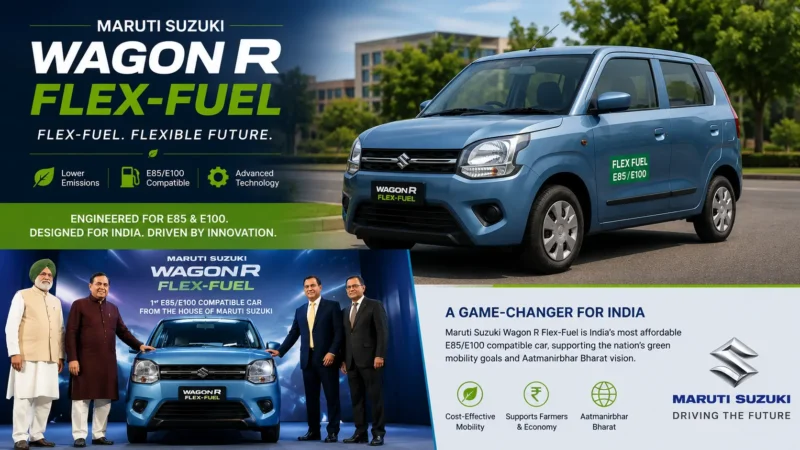
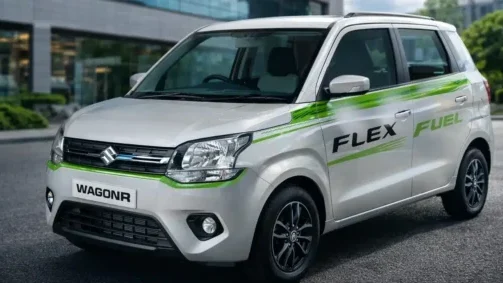
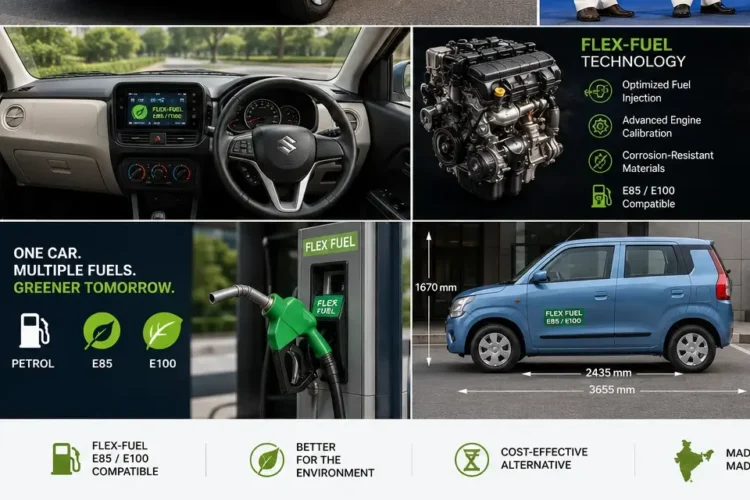
In a move closely coordinated with India’s expanding alternative fuel roadmap, Maruti Suzuki India Limited (MSIL) has officially debuted the country’s first mass-market flexible-fuel passenger vehicle (FFV). Unveiled at a high-profile industry event at Delhi’s Taj Palace on the eve of World Environment Day, the nation’s largest carmaker showcased a highly modified, production-ready prototype based on its iconic Wagon R hatchback platform.
The unveiling marks a major structural shift for Maruti Suzuki, which has historically relied heavily on compressed natural gas (CNG) to offset its standard petrol models. With Union Road Transport Minister Nitin Gadkari and Petroleum Minister Hardeep Singh Puri in attendance, the presentation underscores the political and macroeconomic momentum building behind high-blend ethanol commercialization.
The Engineering Reality
The centerpiece of Maruti Suzuki’s new flex-fuel powertrain is its ability to operate seamlessly on any fuel composition ranging from standard E20 (20% ethanol, 80% petrol) right up to E85 (85% ethanol, 15% petrol). Some industry insiders hint that future configurations are being bench-tested to accept up to E100 (100% pure ethanol) under updated government certification protocols.
However, adapting a high-volume internal combustion engine (ICE) to ingest high concentrations of ethanol introduces severe mechanical challenges. Ethanol possesses significantly different chemical characteristics than standard fossil fuels:
To eliminate these vulnerabilities, Maruti Suzuki’s R&D department had to completely overhaul the Wagon R’s fuel delivery system:
- Material Resilience: Standard rubber fuel lines, gaskets, and plastic connectors have been replaced with highly specialized, non-reactive compound materials capable of resisting chemical degradation.
- Corrosion Defense: The internal fuel tank, pump assembly, and fuel injectors have been reinforced with anti-corrosion coatings to combat water retention.
- Smart Powertrain Management: The vehicle relies on a heavily revised, multi-mapping Electronic Control Unit (ECU). The system utilizes an inline fuel composition sensor that reads the exact ethanol percentage in real-time, instantly adjusting injection timing, air-fuel ratios, and spark advance parameters to preserve everyday drivability.
The X-Factor: Pairing Flex-Fuel with Strong Hybrid Technology
Also Read: Honda Cars Posts Aggressive 31% YoY Sales Growth in May 2026: Elevate, Amaze, and New City Facelift
What differentiates Maruti Suzuki’s approach from global flex-fuel implementations—such as those seen in Brazil or the United States—is the intentional integration of Strong Hybrid Technology.
Because ethanol has roughly 33% lower energy density than pure petrol, vehicles running on high-blend ethanol traditionally suffer from a noticeable drop in fuel economy. Maruti Suzuki has cleverly neutralized this drawback by introducing an electric motor and a compact battery pack into the drivetrain.
This parallel setup permits energy recuperation during deceleration and provides an electronic torque assist during initial acceleration. By taking the load off the internal combustion engine during low-speed urban crawls, the hybrid architecture mitigates the typical fuel economy penalty associated with biofuels, presenting a unique dual-pathway approach to emission reductions.
Economic Impact
Maruti Suzuki’s choice of the Wagon R as the launch platform for this green tech is highly tactical. The tall-boy hatchback remains an undisputed volume driver in both urban and rural markets across India. By showcasing this technology on an affordable, accessible nameplate rather than a niche premium model, Maruti is sending a clear signal to the industry that it intends to democratize alternative fuel choices.
| Strategic Parameter | Industry and Economic Impact |
| Import Substitution | Directly targets India’s multi-trillion rupee crude oil import bill by shifting demand to local biofuels. |
| Agricultural Integration | Sourcing feedstock from domestic sugarcane molasses and surplus food grains channels automotive energy spending directly into the rural farming sector. |
| EV Complement | Serves as an immediate, practical parallel solution in regions where high-capacity public EV charging networks remain underdeveloped. |
“Vehicles with such flex-fuel engines are going to be introduced on a large scale soon,” stated Union Minister Nitin Gadkari during recent industry engagements, highlighting the government’s plans to help state-run oil marketing companies set up nearly 5,000 dedicated E100 dispensing stations over the next two years.
While the engineering validation is complete and complies with revised national vehicle testing standards, Maruti Suzuki executive leadership has indicated that a full-scale commercial rollout will follow a calculated, gradual trajectory.
The primary constraint remains the spotty, regional availability of high-blend fuels like E85 and E100 at the retail level. Outside of specialized pilot corridors, the current nationwide infrastructure is primarily optimized for E20 distribution.
Consequently, Maruti Suzuki plans to scale production volumes over a 5-to-10-year horizon, matching its manufacturing output with the expansion of the government’s retail biofuel network. While the prototype demonstrates complete technical readiness, the physical sight of mass flex-fuel hatchbacks in everyday multi-lane traffic will ultimately depend on the rollout speed of the country’s alternative energy infrastructure.