
Next-Gen Tata Tiago Facelift vs. Hyundai Grand i10 Nios (3-Cylinder vs. 4-Cylinder)
The budget-premium hatchback segment in India is witnessing a quiet but intense structural realignment. While the market continues its steady tilt toward compact crossovers, buyers navigating tight urban grids still rely on the absolute nimbleness of low-slung hatchbacks. For the longest time, the choice in this segment was simple: if you wanted a plush, feature-loaded city runabout with a super-smooth engine, you went to a Hyundai showroom for the Grand i10 Nios. If you wanted structural toughness and highway-smoothing ride manners, you knocked on Tata’s doors for the Tiago.
However, the commercial arrival of the Next-Gen Tata Tiago Facelift has disrupted this equation. By upgrading the vehicle with an aggressive premium front face, a revamped digital cabin, and an expanded safety kit, Tata has directly targeted the premium appeal of the Nios.
Can the upgraded Tiago shift the balance of power, or does the Grand i10 Nios remain the default premium hatchback standard? Let’s evaluate both platforms side by side.
1. Exterior Design
Both cars approach styling from entirely different visual angles, resulting in two very distinct road presences.
The updated Tata Tiago Facelift drops its older rounded front design for an upright nose and a flatter bonnet. The front layout is dominated by sharp rectangular double-barrel headlamps with a premium eyebrow-style LED DRL element along the top edge. The rear profile gets a major cosmetic lift with an updated faux full-width taillamp look that visually connects the two clusters across the tailgate, giving the car a wider stance on the road.
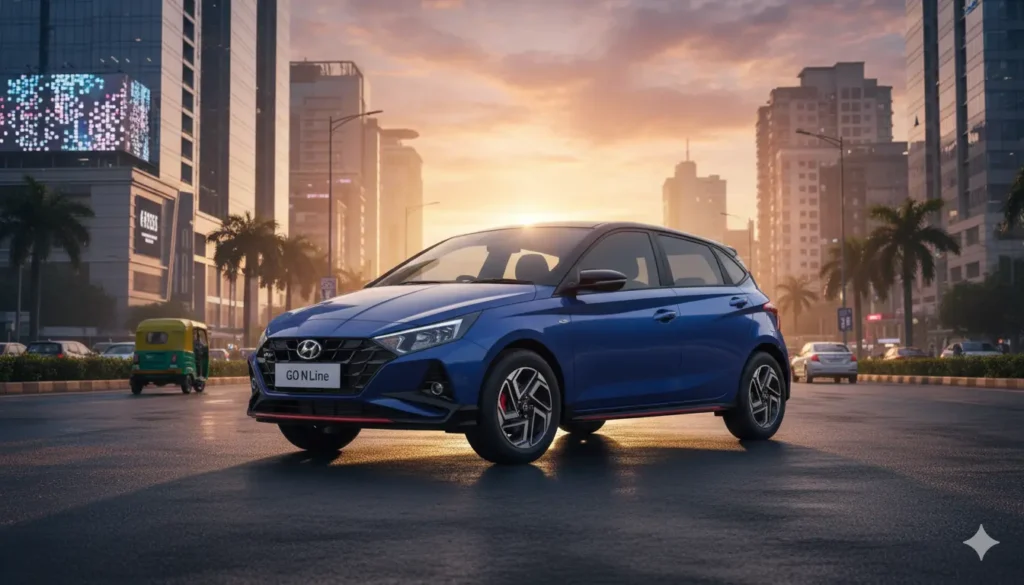
The Hyundai Grand i10 Nios relies on its clean, Euro-inspired urban styling. Its lower stance, massive black-painted front radiator grille, and neatly integrated tri-arrow LED DRL pods on the bumper corners give it an elegant, sophisticated look. The Nios feels visually sleeker, whereas the new Tiago leans toward a chiseled, more aggressive look.
2. Cabin Experience
Inside the cabin, the competition shifts to a battle between advanced digital technology and premium material execution.
Also Read: Next-Gen Tata Tiago vs Maruti Suzuki Swift: The Ultimate Hatchback Showdown in 2026
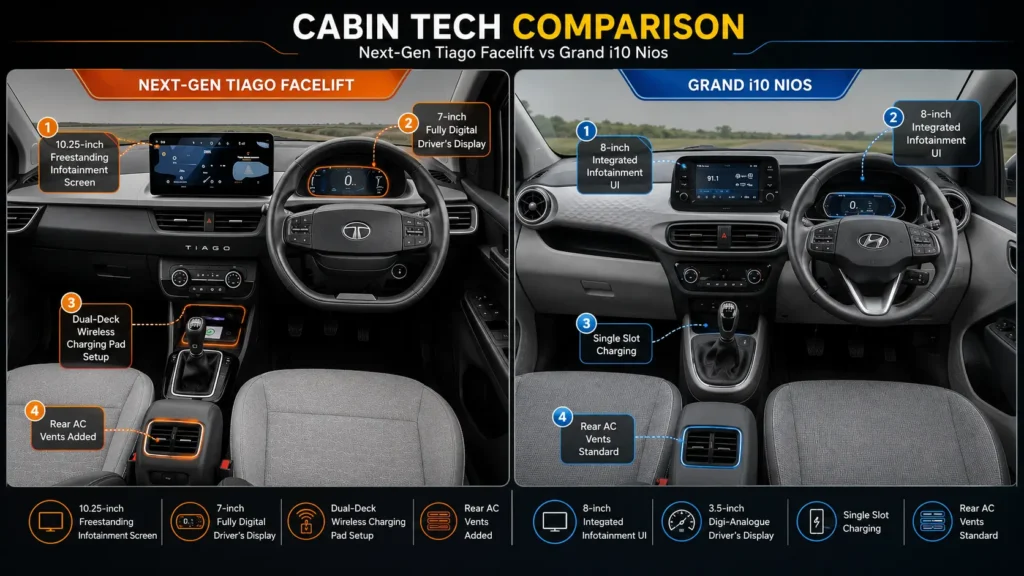
The next-gen Tata Tiago takes a massive leap forward in its interior presentation. It comes equipped with a large 10.25-inch freestanding touchscreen infotainment setup, paired with a fully digital driver display panel. Tata has also packed the car with modern features, including automatic climate control with newly integrated rear AC vents, a dual-deck wireless phone charger, and high-output dual Type-C fast-charging sockets.
The Hyundai Grand i10 Nios counters with its user interface and interior fit-and-finish. The dashboard uses a dual-tone grey layout with neat textured surfaces that feel built to last. While its 8-inch screen is physically smaller than the Tiago’s new display, Hyundai’s software handles Apple CarPlay and Android Auto with exceptional smoothness and zero lag. The Nios also scores points with its functional cabin layout, though its analog-digital gauges feel slightly less futuristic than the Tiago’s fully digital dashboard.
3. Powertrain: 3-Cylinder vs. 4-Cylinder Character
The defining mechanical difference between these two hatchbacks comes down to cylinder configuration, which fundamentally shapes how they feel on the road.
| Mechanical Parameter | Tata Tiago Facelift (1.2L Revotron) | Hyundai Grand i10 Nios (1.2L Kappa) |
| Engine Configuration | 3-Cylinder, Naturally Aspirated | 4-Cylinder, Naturally Aspirated |
| Engine Displacement | 1,199 cc | 1,197 cc |
| Peak Power Output | 86 PS @ 6,000 rpm | 83 PS @ 6,000 rpm |
| Peak Torque Output | 113 Nm @ 3,300 rpm | 113.8 Nm @ 4,000 rpm |
| Transmission Options | 5-Speed MT / 5-Speed AMT | 5-Speed MT / 5-Speed AMT |
| Refinement Standard | Moderate (Typical 3-Cylinder Thrum) | Excellent (Incredibly Silent Idle) |
The Tata Tiago’s 3-cylinder Revotron motor is a strong performer, pushing out a healthy 86 PS. It delivers excellent mid-range power, making highway cruising comfortable. However, being a 3-cylinder design, it lets out a noticeable mechanical thrum under heavy acceleration, and minor vibrations can be felt through the pedals at idle.
The Hyundai Grand i10 Nios runs on a highly refined 4-cylinder Kappa engine. This engine sets the benchmark for smoothness in its segment. At traffic lights, the engine is so silent you barely feel it running. Power delivery is perfectly linear, making it incredibly easy to drive smoothly in stop-and-go city traffic, and its AMT automatic transmission shifts with minimal shift-shock.
Also Read: India Launches E85 Fuel at Rs 82.12/Litre: 5 Critical Realities Every Car and Bike Owner Must Know
The Alternate Fuel Battle: Twin Cylinders vs. Dual CNG Packs
For buyers eyeing low running costs, the factory-fitted CNG variants present another interesting choice. Tata continues to offer great utility with its Twin-Cylinder technology, split-packaging the storage tanks under the luggage deck to save precious boot space. Additionally, the Tiago CNG AMT variant now gets steering-mounted paddle shifters for manual gear control. Hyundai has responded directly by introducing its own Dual-Cylinder CNG architecture in the Nios line, successfully resolving its older trunk space limitations to match Tata’s practicality.
4. Ride Quality, Suspension Balance, and Safety Architecture
When it comes to road manners and tackling bad patches, both manufacturers have tuned their chassis to deliver very different driving experiences.
The Tata Tiago uses a beautifully balanced suspension setup. It feels incredibly solid on the highway, absorbing deep potholes and sharp speed breakers with a muted, reassuring thump that keeps the cabin well-settled. It also carries a proven legacy of strong structural safety performance.
The Hyundai Grand i10 Nios is tuned primarily for effortless city driving. Its steering wheel is remarkably light, making parking and sharp u-turns in tight spaces a breeze. The ride is soft on smooth urban tarmac, though continuous rough roads can make the suspension behave a bit busy compared to the solid, planted feel of the Tiago.
Both cars now step up their safety game by offering 6 airbags as standard across their entire model lineups, along with Electronic Stability Control (ESC) and Hill Hold Control.
5. Pricing Framework and Market Position
The final decision for most buyers comes down to overall value and variant pricing:
- Next-Gen Tata Tiago Price Bracket: Rs. 4.69 Lakh to Rs. 8.55 Lakh (Ex-Showroom)
- Hyundai Grand i10 Nios Price Bracket: Rs. 5.60 Lakh to Rs. 8.04 Lakh (Ex-Showroom)
The next-gen Tiago starts at a highly competitive Rs. 4.69 lakh for its base Smart variant, making its entry point nearly Rs. 90,000 more accessible than the base Grand i10 Nios Era. However, as you climb up to the fully-loaded top variants, the pricing closes up significantly, making it a direct feature-for-feature budget battle.
Which Hatchback Earns Your Money?
Choose the Next-Gen Tata Tiago Facelift if…
You want a rugged, planted highway car packed with premium tech. With its larger 10.25-inch touchscreen, fully digital instrument cluster, unique dual wireless charging layout, and solid suspension manners, the updated Tiago offers a highly capable and feature-rich package, especially given its aggressive starting price.
Choose the Hyundai Grand i10 Nios if…
Your driving is centered almost entirely around dense urban commutes and you value mechanical refinement above all else. The ultra-smooth performance of its 4-cylinder engine, lighter steering controls, slick AMT automatic box, and superior cabin fit-and-finish make it an incredibly premium, stress-free city car to live with every day.