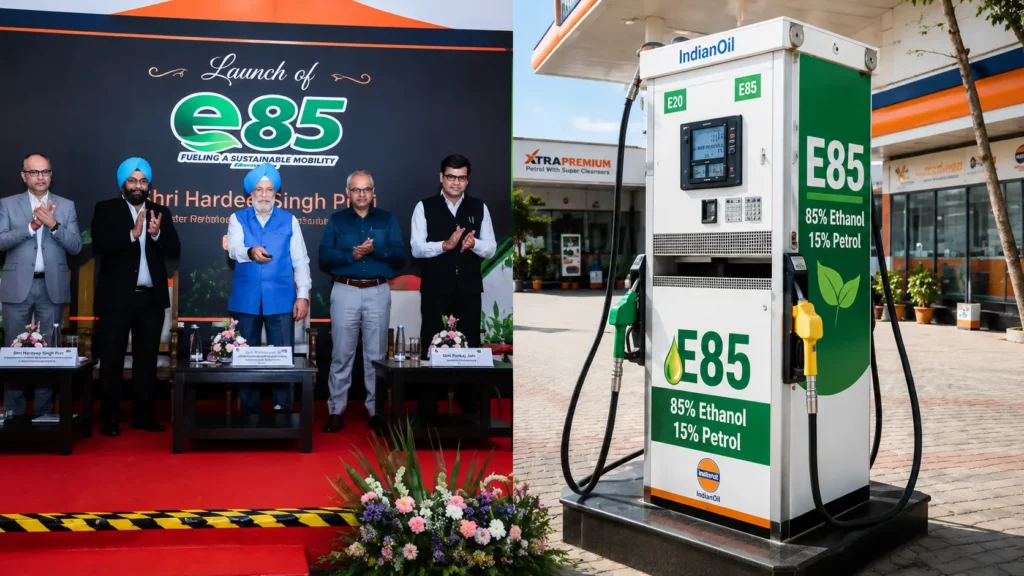
The economic anxiety surrounding fossil fuel prices in India has found a major policy distraction. Amid volatile crude supply lines that have pushed conventional fuel pricing past the psychological Rs 102/litre threshold in the national capital, Union Petroleum and Natural Gas Minister Hardeep Singh Puri has officially introduced E85 bio-ethanol fuel.
Inaugurated at a flagship Indian Oil Corporation (IOCL) outlet on Pusa Road, Delhi, the fuel is retailing at Rs 82.12 per litre. The price tag immediately stands out—offering an upfront discount of nearly Rs 20 per litre compared to standard E20 petrol.
However, behind the attractive pricing lies a complex mix of automotive engineering challenges, infrastructural limitations, and financial trade-offs. Here is a comprehensive, journalist-grade analysis of the five critical factors that define this high-ethanol rollout.
1. What Exactly is E85?
E85 is not simply a refined iteration of standard commercial petrol. It represents a highly concentrated biofuel blend consisting of 80% to 85% plant-based ethanol mixed with remaining 15% to 20% conventional fossil petrol.
Unlike regular E20 fuel, which is now the baseline across Indian pumps, E85 is molecularly different. Ethanol is derived domestically from agricultural feedstocks—primarily sugarcane molasses, surplus corn, and broken food grains. While the high concentration reduces dependency on overseas oil fields, it fundamentally alters how the fuel burns inside an internal combustion chamber.
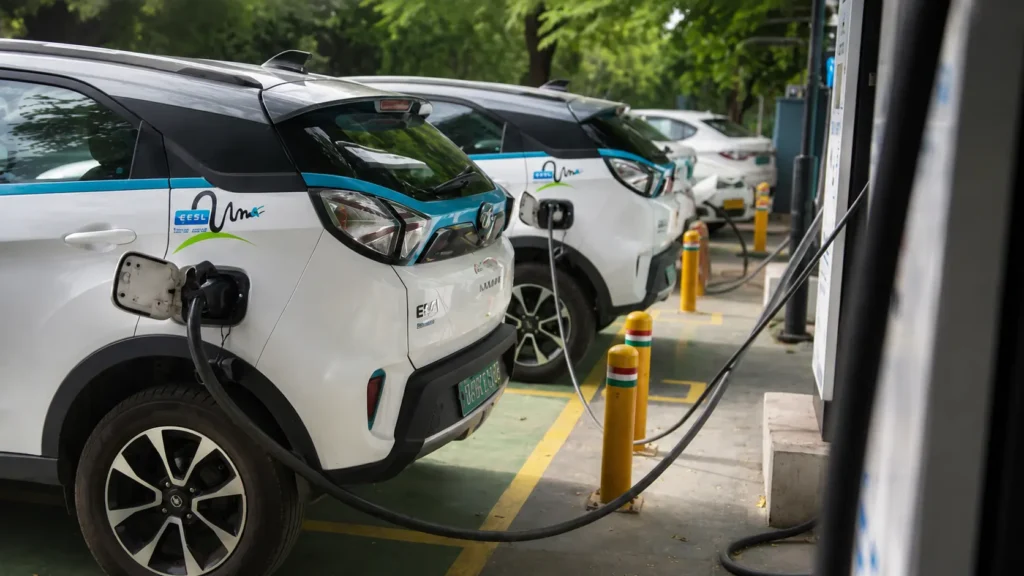
Also Read: Fuel Price Shock Drives Mass-Market EV Breakthrough 2026: Why Indian Car Buyers Are Abandoning ICE
2. Vehicle Compatibility: The Absolute Danger to Regular Engines
The most urgent warning for motorists is simple: You cannot pump E85 into a standard car or motorcycle. Even if your modern vehicle is fully certified for E20 petrol compliance, it is structurally unequipped to handle E85. Running this high-concentration blend in a conventional internal combustion engine (ICE) will result in immediate and long-term mechanical failures:
- Material Degradation: High alcohol concentrations act as a solvent, corroding standard aluminum fuel rails, melting plastic float sensors, and drying out rubber seals or gaskets within the fuel delivery tract.
- Severe Engine Knocking: Ethanol has a high Research Octane Number (RON 108), meaning it requires vastly different ignition timing and air-fuel ratios. Regular ECUs cannot compensate for this variance, leading to lean running conditions, overheating, and piston damage.
To safely burn E85, a vehicle must be a factory-certified Flexible-Fuel Vehicle (FFV). These machines feature inline optical fuel sensors, multi-mapped ECUs, and corrosion-resistant fuel injectors designed specifically to tolerate high-alcohol environments.
3. A Catch on the Real-World Wallet
While saving Rs 20 per litre at the dispenser seems like an immediate win for consumer savings, the underlying chemistry of biofuels changes the actual calculation.
| Fuel Performance Parameter | Standard E20 Petrol | New E85 Bio-Fuel |
| Retail Price (Delhi Bunk) | Rs 102.12 / Litre | Rs 82.12 / Litre |
| Research Octane Number (RON) | ~91 to 95 | ~108 (Superior Knock Resistance) |
| Energy Density (Calorific Value) | High Baseline | ~30% Lower than Petrol |
| Expected Mileage Impact | Standard Baseline | 25% to 30% Volumetric Drop |
Because ethanol carries roughly 30% less energy density per unit volume compared to pure fossil petrol, an engine must inject significantly more fuel to produce the same combustion power. In real-world driving conditions, a flex-fuel vehicle operating on E85 will experience a 25% to 30% drop in fuel economy (mileage).

Also Read: Suzuki Just Gave The Fronx A Stunning New Look And It’s Turning Heads Already
The Mathematical Reality: If a standard hatchback delivers 16 kmpl on E20 petrol, its efficiency will drop to roughly 11–12 kmpl when running on E85. Therefore, the Rs 20 upfront discount at the pump is largely offset by the vehicle consuming more litres to cover the exact same distance.
4. Objective: Forex Shields and Agricultural Boost
The fast-tracked implementation of the E85 framework is driven primarily by macro-economic factors rather than consumer demand. India currently imports 85–90% of its crude oil requirements, resulting in a massive annual foreign exchange drain.
The successful implementation of the E20 blending mandate has already saved the national exchequer over Rs 1.84 lakh crore in foreign exchange. By moving toward E85 networks, the Ministry of Petroleum and Natural Gas seeks to insulate the domestic economy from geopolitical conflicts in the Middle East. Furthermore, diverting industrial grain and sugarcane waste into the ethanol processing chain injects cash directly back into India’s rural farming sector.
5. Infrastructure: The 48-Outlet Pilot Network
The current commercial footprint of E85 remains highly localized. The fuel has been deployed across an initial pilot web of 48 public sector oil marketing outlets spread across major tier-1 metropolitan corridors.
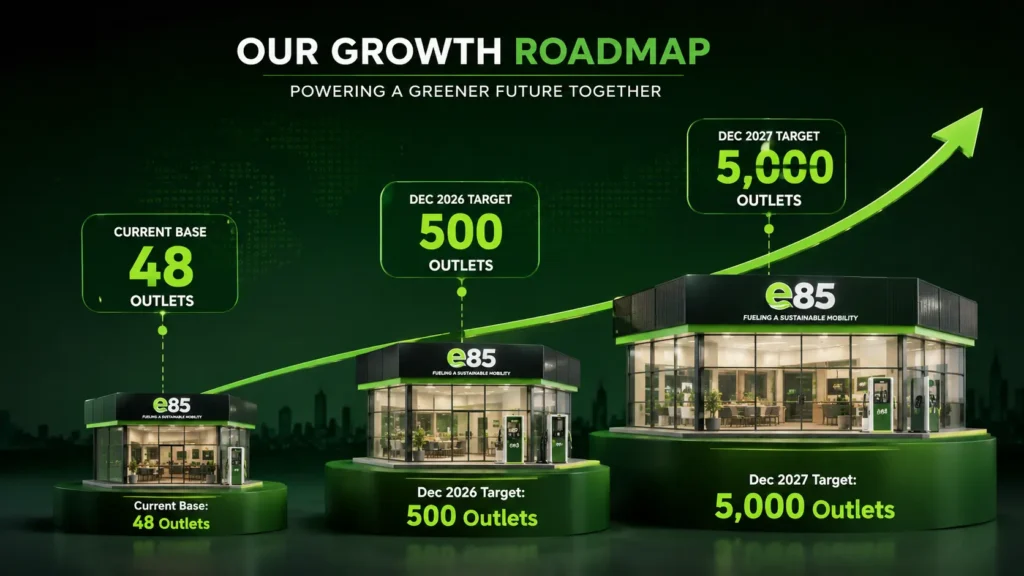
To address the chicken-and-egg problem of infrastructure preceding vehicle availability, Minister Hardeep Singh Puri announced an aggressive scaling timeline. The government aims to establish 500 dedicated E85 pumps by December 2026, with the network expanding to 5,000 operational stations by the end of 2027.
These dispensers are easily identified by distinct purple nozzle branding and clear ‘E85’ hazard signage to prevent accidental misfueling by regular vehicle owners.
A Policy Waiting for the Fleet
The launch of E85 at Rs 82.12/litre is a bold regulatory statement, but it arrives ahead of the vehicles that can actually use it. Currently, options are limited to showcased prototypes like the Maruti Suzuki Wagon R Flex-Fuel or recently launched premium commuter options like Hero’s specialized Splendor+ and HF Deluxe variants.
Until mass-market car manufacturers roll out fully homologated flex-fuel model lines at price parity, E85 will remain a crucial policy tool for energy independence rather than an immediate solution for the average motorist’s daily fuel bill.