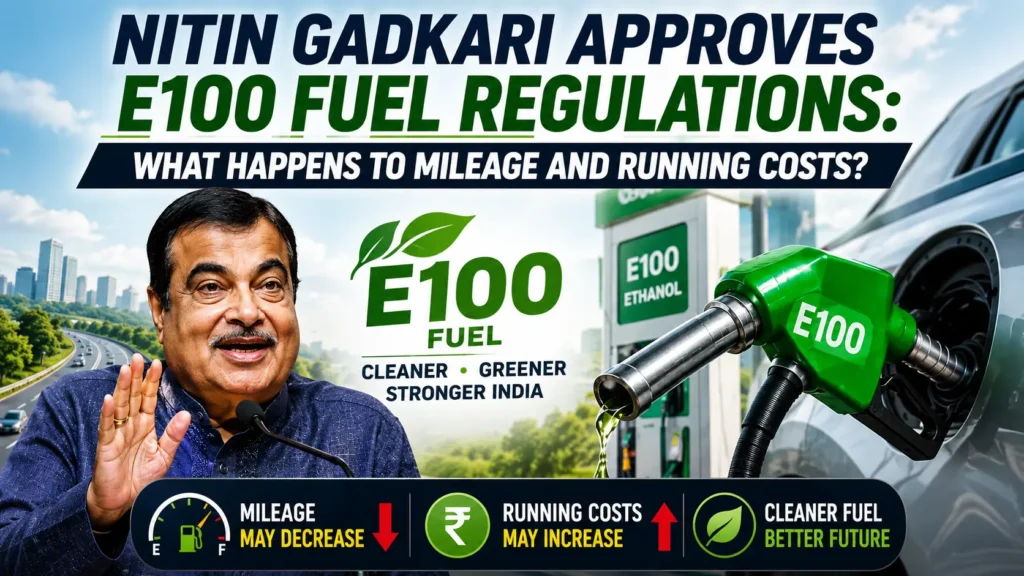
The Indian automotive landscape is undergoing a massive, multi-faceted transition. While electric vehicles (EVs) and CNG models continue to grab headlines, the Indian government is quietly but aggressively laying the groundwork for an entirely different kind of green revolution: alternative bio-fuels. In a landmark development for the country’s energy sector, Union Road Transport and Highways Minister Nitin Gadkari has officially signed off on the regulatory framework for E100 (100% Ethanol) fuel.
Speaking at an industry event in Nagpur, the Union Minister confirmed that the official file approving E100 fuel regulations has been legally cleared. This long-awaited regulatory green light effectively removes the legal hurdles for automakers, paving the way for the mass production and sale of vehicles engineered to run entirely on pure ethanol.
“People Used to Laugh at Me” – A Personal Victory for Gadkari
For years, Nitin Gadkari has been a relentless champion of indigenous, green fuels, often facing skepticism from both the industry and political peers. Reflecting on this journey after signing the approval, the minister shared a candid moment:
“When I first floated the idea of running India’s transport system on 100% ethanol, many people laughed at me. I faced severe criticism, even from close friends. But today, it has officially become a legal reality, and it will soon emerge as the most viable, clean alternative to conventional petrol.”
The government’s underlying strategy is driven by macroeconomic urgency. India currently spends a staggering Rs 22-lakh crore annually on importing crude oil. Transitioning a significant portion of the country’s fleet to ethanol would drastically cut this import bill while simultaneously boosting the rural economy. Because ethanol is derived from agricultural byproducts like sugarcane molasses, broken rice, and food grains, the money spent on fuel will directly benefit Indian farmers instead of foreign oil corporations.
Also Read: Car Owners Can Finally Stop Worrying: E20 Fuel Won’t Void Your Insurance
Maruti Suzuki WagonR Flex-Fuel Showcased; Major Brands Gear Up
The regulatory approval of E100 has immediately triggered action on the manufacturing front. Leading the mass-market charge, Maruti Suzuki has officially showcased the WagonR Bioflex, a flex-fuel prototype developed specifically for the Indian market, unveiled jointly by Union Petroleum Minister Hardeep Singh Puri and Nitin Gadkari.
The two-wheeler segment is moving just as fast. India’s largest two-wheeler manufacturer, Hero MotoCorp, has already demonstrated flex-fuel iterations of its highly popular Splendor+ and HF Deluxe commuters, proving that high-ethanol blending is viable for budget-conscious buyers.
Furthermore, Nitin Gadkari confirmed that the floodgates are about to open. Over the next one and a half to two months, major automotive giants—including Toyota, Suzuki, Hyundai, and MG—are scheduled to officially roll out their respective Flex-Fuel Vehicles (FFVs) capable of operating seamlessly on up to 100% ethanol blends.
Can You Pump E100 Into Your Current Car?
The short answer is no. Vehicle owners cannot simply pull up to an ethanol pump tomorrow and fill up their existing petrol or E20 (20% ethanol blend) vehicles.
Ethanol possesses chemical properties that differ drastically from standard fossil fuels. It is inherently hygroscopic (absorbs moisture) and corrosive to certain metals and rubber compounds. Therefore, true Flex-Fuel Vehicles require specific engineering upgrades directly from the factory:
- Corrosion-Resistant Components: Fuel lines, fuel tanks, seals, and gaskets must be manufactured using specialized polymers and stainless steel to prevent degradation over time.
- Advanced Engine Calibration: The Engine Control Unit (ECU) must be equipped with an ethanol-content sensor. This sensor instantly analyzes the exact ratio of the fuel mixture and automatically recalculates spark timing and fuel injection in real-time.
- Cold-Start Assistance: Pure ethanol has a lower vapor pressure than petrol, making vehicles harder to start in freezing temperatures. Manufacturers integrate specialized heating elements or auxiliary systems to counter this.
(Note: Commercially available E100 is typically not 100% chemically pure ethanol; it contains roughly 93-95% ethanol, with the remainder consisting of petrol and specialized denaturants to ensure optimum cold-starting and engine lubrication).

Also Read: Upcoming EVs in India 2026–2027: Top Electric Cars and SUVs Launching Soon
The Big Question: What Happens to Mileage and Running Costs?
For the average Indian consumer, the ultimate metric of any technology is its running cost. From a purely technical standpoint, ethanol has a lower energy density than petrol (roughly 30% less energy per liter). This means an engine running on E100 must burn more fuel to generate the same amount of power, resulting in a noticeable drop in fuel economy (km/l) compared to standard petrol.
However, the financial math still tips in favor of the consumer. The government plans to price ethanol significantly lower than heavily taxed fossil fuels. To sweeten the deal further, Nitin Gadkari has formally requested the Finance Ministry to slash the GST rates on flex-fuel vehicles and high-concentration ethanol blends (currently taxed at 18%). If approved, the lower cost per liter of fuel will comfortably offset the dip in mileage, resulting in a lower net cost-per-kilometer for the driver.
A Pragmatic Step Toward Green Mobility
The legal approval of E100 marks a pivotal turning point in India’s automotive roadmap. While electric vehicles are the definitive long-term goal, the massive infrastructure challenges of setting up widespread fast-charging networks mean full EV adoption will take time.
Flex-fuel technology offers a highly practical, immediate bridge. It utilizes existing internal combustion engine manufacturing lines and leverages a fueling infrastructure that can be adapted far more quickly. If the government can successfully manage fuel distribution and maintain an attractive price gap between petrol and ethanol, E100 could easily become the preferred choice for millions of Indian motorists looking to cut down their running costs and carbon footprint simultaneously.
For more such updates on latest cars, bikes and EVs stay connected to MotorMitra. #gaadiyonkismartguide