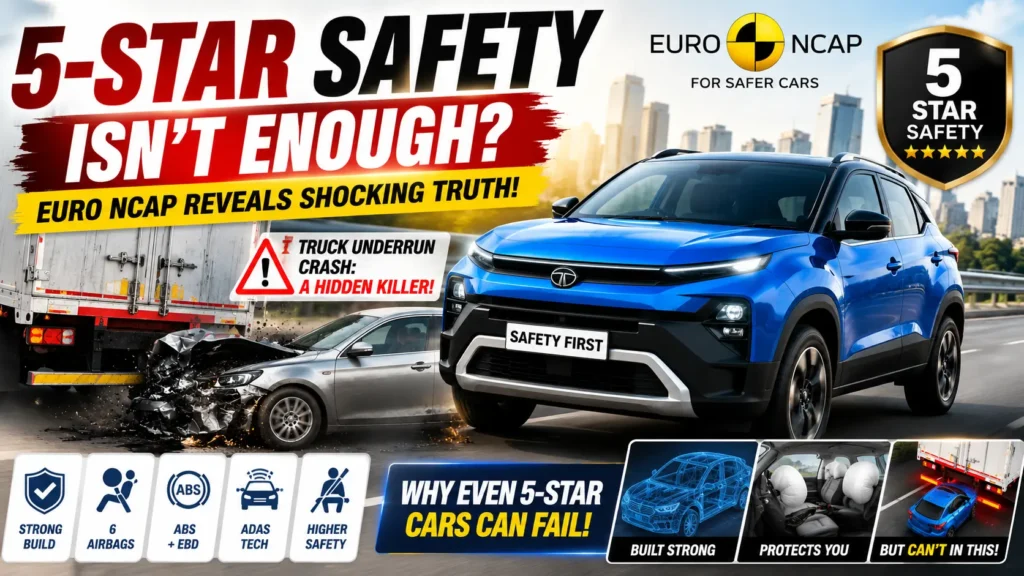
Millions of buyers trust a 5-Star Safety badge before signing the cheque for a new car. It has become one of the strongest indicators of occupant protection and crashworthiness. But what if even the safest car on the road can’t fully protect you in one specific type of crash? That’s exactly what the latest Euro NCAP study has revealed.
The organisation’s latest evaluation shows that while modern passenger cars have become safer than ever, truck rear underrun crashes remain one of the biggest challenges for road safety. The findings don’t question the value of 5-Star Safety ratings—instead, they highlight that passenger vehicle safety alone cannot eliminate every real-world risk. As cars become smarter and stronger, improving truck safety is now just as important for saving lives.
The study doesn’t question the credibility of 5-Star Safety ratings. Instead, it highlights a critical gap in road safety where passenger cars and heavy commercial vehicles interact during a crash. According to Euro NCAP, improving truck safety standards could play an equally important role in saving lives as developing safer passenger cars.
In Short
- Euro NCAP studied truck rear underrun crashes involving modern passenger cars.
- Even 5-Star Safety vehicles can suffer severe cabin intrusion if a trailer’s rear guard fails.
- Passenger vehicle safety has advanced rapidly, but commercial vehicle safety must evolve alongside it.
- Stronger truck underrun guards could significantly reduce fatalities in high-speed rear-end crashes.
Also Read:- Tata Punch Creates History! India’s Top 10 Best Selling Cars & SUVs in June 2026 Revealed
What Is A Truck Underrun Crash?
A truck underrun crash occurs when a passenger vehicle crashes into the rear of a truck or trailer and slides underneath it instead of being stopped by the truck’s rear impact protection system. Unlike a normal frontal collision, where a car’s crumple zones absorb most of the crash energy, an underrun crash allows the trailer to bypass these engineered safety structures. This can lead to severe intrusion into the passenger compartment, significantly increasing the risk of serious or fatal injuries.
Modern passenger cars are designed to perform exceptionally well in standard crash tests, but these tests assume that both vehicles involved in a collision interact as intended. When a trailer’s rear protection fails to prevent underrun, even the best-engineered passenger vehicle can lose much of its built-in crash protection.
Why Even 5-Star Safety Cars Lose Their Biggest Advantage In Truck Crashes
One of the biggest takeaways from the latest Euro NCAP evaluation is that the passenger car itself wasn’t necessarily the weakest link. During crash testing, modern vehicles equipped with advanced occupant protection systems generally performed as expected until the trailer’s rear protection system failed.
Once the vehicle slid underneath the trailer, its carefully engineered crumple zones could no longer absorb impact energy efficiently. Instead, the trailer structure reached areas of the passenger cabin that were never intended to withstand such forces. As a result, even advanced safety systems such as airbags, seatbelt pretensioners and reinforced passenger cells became less effective because the crash no longer followed the conditions they were designed for.
This demonstrates an important point that buyers often overlook. A 5-Star Safety rating reflects how well a vehicle performs within internationally recognised crash-testing procedures, but no passenger car can completely compensate for weaknesses in another vehicle’s safety design.
Why Crash Compatibility Matters More Than Ever
For decades, manufacturers have focused on making passenger cars safer through stronger body structures, better restraint systems and increasingly sophisticated driver assistance technologies. These improvements have dramatically reduced fatalities in conventional frontal and side-impact crashes.
However, Euro NCAP believes the next major leap in road safety depends on something equally important—crash compatibility. In simple terms, every vehicle sharing the road should be designed to work together during a collision rather than independently. If a heavy truck’s rear protection collapses during impact, even the safest passenger car cannot fully utilise its own safety systems.
This shift in thinking marks an important evolution in automotive safety. Future improvements won’t rely solely on building stronger cars but also on ensuring that commercial vehicles provide adequate protection during severe rear-end collisions.
How Different Safety Systems Perform During A Truck Underrun Crash
| Safety Factor | Standard Crash | Truck Underrun Crash | Euro NCAP Observation | Buyer Impact |
|---|---|---|---|---|
| Crumple Zone | Works effectively | Can be bypassed | Protection reduces significantly | Cabin intrusion risk increases |
| Airbags | Maximum effectiveness | Depends on cabin integrity | Cannot compensate for severe intrusion | Occupant injuries may increase |
| AEB | Can avoid many crashes | May miss certain trailers | Performance varies | Helpful but not foolproof |
| Truck Rear Guard | Not applicable | Critical safety component | Stronger guards improve crash outcome | Better survival chances |
| Overall Safety | Excellent | Shared responsibility | Passenger and truck safety must work together | Safer roads need both |

Also Read:- Finally, HUD & Dashcam! Kia Seltos GTX (O) & X-Line (O) Revealed with 5-Star BNCAP Safety!
Why Advanced Safety Technology Alone Can’t Prevent Every Crash
Today’s vehicles are equipped with increasingly advanced ADAS features capable of detecting vehicles, pedestrians and cyclists before a collision occurs. Automatic Emergency Braking has already proven its ability to reduce crash severity in many real-world situations.
However, the latest Euro NCAP evaluation found that some older-generation systems may not always recognise every trailer configuration or stationary heavy commercial vehicle under all conditions. While newer technologies continue to improve, electronic safety systems should always be viewed as an additional layer of protection rather than a replacement for strong structural safety.
This is precisely why Euro NCAP believes better truck underrun protection remains essential. Preventing a passenger vehicle from sliding underneath a trailer gives the car’s own safety systems the opportunity to perform exactly as engineers intended.
For most buyers, a 5-Star Safety rating has become the benchmark while comparing new vehicles. However, the latest Euro NCAP findings remind us that real-world safety depends on much more than crash test scores alone. Passenger cars, heavy trucks, road infrastructure and driver behaviour together determine how severe a collision becomes. This is why improving truck safety standards could have an impact almost equal to making passenger cars stronger.
What Does This Mean For Car Buyers?
For buyers, the latest findings shouldn’t create doubts about choosing a 5-Star Safety vehicle. In fact, crash-tested cars remain the safest choice available today and continue to offer significantly better occupant protection than lower-rated alternatives.
The real message from Euro NCAP is that road safety cannot depend on passenger vehicles alone. Safer trucks, stronger commercial vehicle regulations, improved highway infrastructure and responsible driving habits all contribute to reducing fatalities. Maintaining a safe following distance behind heavy commercial vehicles and avoiding unnecessary high-speed tailgating remain simple yet highly effective ways to minimise risk on highways. As governments and manufacturers continue improving vehicle safety standards, commercial vehicles will likely receive greater attention to ensure they match the impressive progress already achieved by modern passenger cars.
The latest Euro NCAP report should not discourage buyers from choosing a 5-Star Safety vehicle. Instead, it reinforces why crash safety must now extend beyond passenger cars. Manufacturers have already invested heavily in stronger vehicle structures and smarter driver assistance systems. The next major improvement in global road safety will come from ensuring heavy commercial vehicles are equally crash-compatible with modern passenger cars.

MotorMitra Verdict
The latest Euro NCAP findings don’t weaken the importance of 5-Star Safety ratings—they strengthen the case for making commercial vehicles safer. Passenger cars have evolved tremendously over the last decade, delivering outstanding protection in most crash scenarios. However, truck underrun collisions expose a safety gap that passenger car engineering alone cannot solve. Stronger trailer underrun guards, improved regulations and better crash compatibility could become the next major breakthrough in road safety.
For buyers, the advice remains unchanged: continue prioritising 5-Star Safety when purchasing your next vehicle, while recognising that safer highways depend on every vehicle being designed to protect not only its own occupants but everyone sharing the road. Road safety isn’t determined by the strongest vehicle in a crash—it’s determined by the weakest safety link involved.