
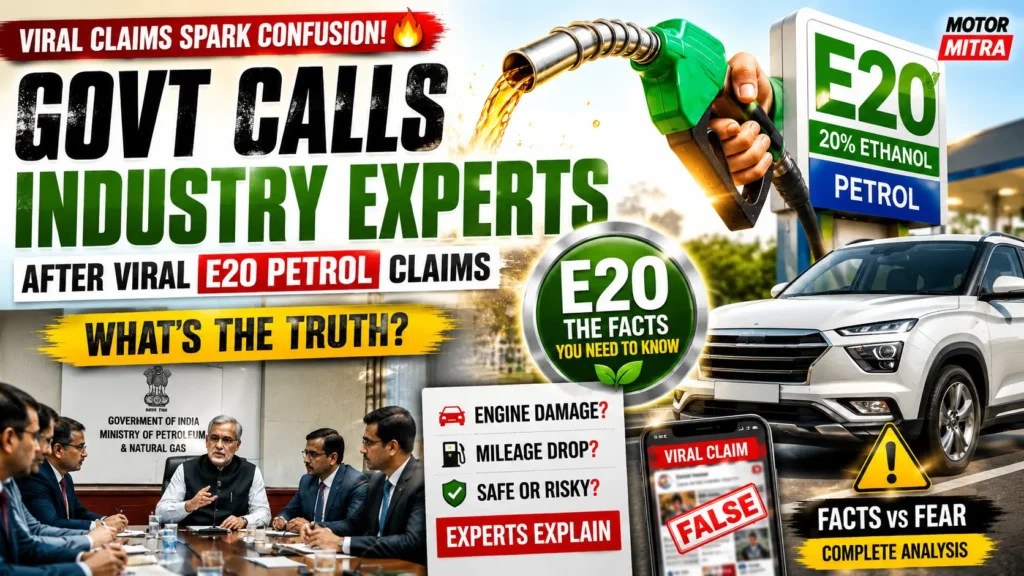
If you’ve recently filled your car or bike with E20 petrol, the viral claims circulating online may have already made you question whether you’ve made the wrong choice. Those allegations spread so rapidly that thousands of vehicle owners were left wondering whether they should stop using E20 fuel altogether. As confusion continued to grow across social media, the government stepped in and brought together automobile manufacturers and industry experts to separate facts from fear.
Instead of relying on rumours, the discussion focused on technical evidence, real-world testing and years of industry data. So, are the viral claims something every vehicle owner should worry about, or has the controversy grown far beyond the available evidence? Here’s what you need to know before drawing any conclusions.
At A Glance
- Government consulted automobile industry experts following viral E20 petrol claims.
- Manufacturers say years of testing have not found evidence of widespread engine damage in E20-compatible vehicles.
- A slight drop in fuel efficiency is expected because ethanol contains less energy than petrol.
- Experts urged owners to rely on verified technical information instead of unverified social media posts.
- The focus is on clearing public confusion, not changing the existing E20 fuel policy.
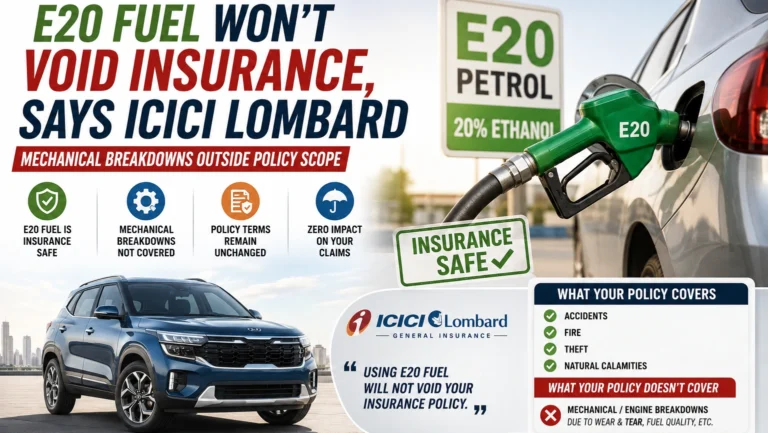
Also Read:- Car Owners Can Finally Stop Worrying: E20 Fuel Won’t Void Your Insurance
How Did A Viral Claim Turn Into A Nationwide Debate?
The controversy began when several social media posts alleged that E20 petrol was responsible for engine failures, reduced performance and rising maintenance costs. As these claims spread online, concern quickly reached millions of vehicle owners, especially those unsure whether their vehicles were designed to run on higher ethanol-blended fuel.
The debate intensified after comments linked to an ongoing legal discussion were widely interpreted in different ways across social media, adding further uncertainty. With speculation growing faster than verified information, the government invited automobile manufacturers and industry experts to present technical findings and explain what extensive testing has actually shown about E20 fuel.
What Industry Experts Actually Explained
Automobile manufacturers participating in the discussion stated that E20 petrol has undergone years of testing before being introduced on a wider scale. According to the industry’s assessment, there is no evidence of widespread engine damage in vehicles specifically designed or approved to operate on E20 fuel. Millions of compatible vehicles continue to use the fuel without any common pattern of ethanol-related mechanical failures emerging through regular service records.
Experts did, however, acknowledge one important point that many drivers may notice in everyday use. Because ethanol contains less energy than conventional petrol, vehicles running on E20 can experience a slight reduction in fuel economy. They stressed that this characteristic is well understood and should not be confused with claims suggesting that E20 itself causes widespread engine failures.
Viral Claims Vs What Experts Say
| Viral Claim | Expert Explanation | What Vehicle Owners Should Know |
|---|---|---|
| E20 damages every petrol engine | No widespread evidence has been found in compatible vehicles | E20-ready vehicles are expected to operate safely |
| Mileage drops drastically | A small reduction in fuel efficiency is normal | Ethanol naturally contains less energy than petrol |
| Older vehicles will immediately fail | Individual vehicles may vary based on condition and compatibility | Always follow your manufacturer’s fuel recommendation |
| Viral posts prove E20 is unsafe | Individual incidents require technical investigation | Individual incidents should not be treated as proof of a widespread problem. |
If years of testing don’t support the viral allegations, why has the controversy become so widespread? So, if experts remain confident about E20 petrol, why are so many vehicle owners still worried? Understanding that gap is the key to separating facts from fear—and making an informed decision.

Also Read:- India’s Next Fuel Step: E25 Talks Begin After E20—Should You Wait to Buy a Car?
Should You Really Be Worried About E20 Petrol?
After days of viral claims and heated online debates, one question continues to dominate conversations among vehicle owners—should you really be worried about using E20 petrol? Many motorists now want to know whether they should continue using E20 petrol or start avoiding it altogether. Based on the technical explanations shared during the discussions, experts believe there is little reason for panic if your vehicle is approved for E20 fuel. Modern E20-compatible cars and motorcycles have been developed and tested to operate with the higher ethanol blend.
While a slight reduction in fuel efficiency is a known characteristic because ethanol contains less energy than conventional petrol, that should not be mistaken for widespread engine damage. For owners of older vehicles, the safest approach remains checking the manufacturer’s fuel compatibility guidelines before making any decision.
Why The Government Chose Expert Review Instead Of Ignoring The Issue
Instead of allowing speculation to dominate the conversation, the government chose to seek technical answers from the people who understand E20 technology best—the automobile industry itself. By bringing together manufacturers and industry experts, the focus shifted from social media rumours to engineering evidence, long-term testing and real-world service experience. The objective wasn’t simply to respond to a viral controversy, but to reassure millions of vehicle owners with factual information. The episode also highlights how quickly misinformation can spread and why technical subjects should always be evaluated using verified data rather than online speculation.
MotorMitra Analysis
The E20 petrol debate is a reminder that viral content can shape public opinion far more quickly than verified technical information. At the same time, it also demonstrates why engineering evidence should always take priority over isolated claims shared on social media. A small reduction in mileage with E20 fuel has long been a known characteristic, but that alone should never be interpreted as proof of widespread mechanical problems. That’s exactly why verified engineering data should always carry more weight than viral social media narratives. For vehicle owners, understanding the difference between technical facts and online speculation is the key to making informed decisions.
The controversy surrounding E20 petrol has understandably raised questions, but the evidence discussed by industry experts does not support many of the alarming claims circulating online. For vehicles that are designed and approved to run on E20 fuel, the focus should remain on following the manufacturer’s recommendations rather than reacting to every viral post.
If your vehicle is approved for E20 petrol, trust verified technical guidance—not viral rumours. When it comes to your car, informed decisions will always be more valuable than fear-driven assumptions.