
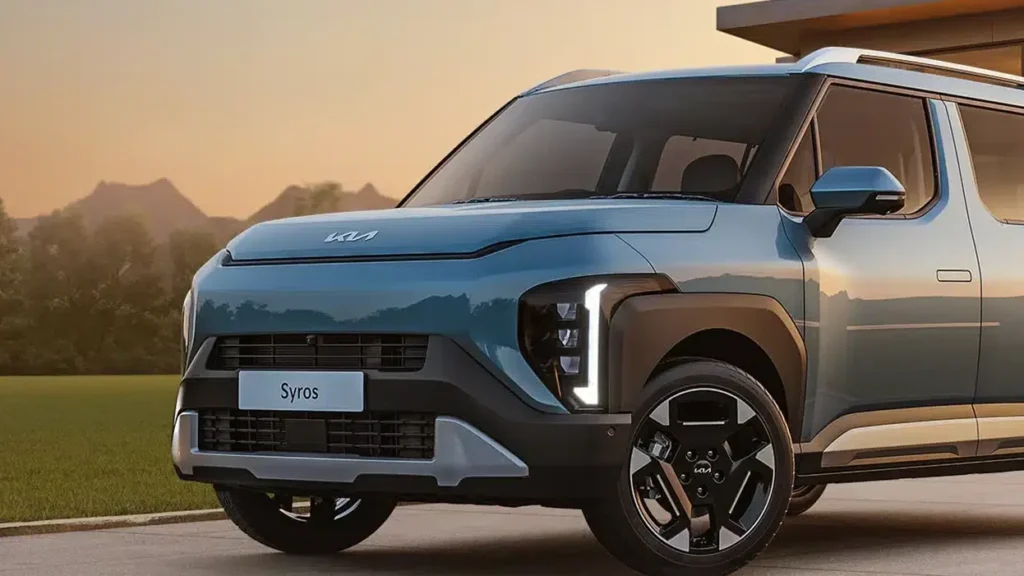
The Kia Syros EV has finally been caught without any camouflage on Indian roads, and the images confirm what many of us have been anticipating — this is going to be one seriously compelling electric SUV. Spotted in Bangalore during what appears to be an official television commercial shoot, the production-spec Syros EV has been photographed from multiple angles, revealing its exterior design in full detail. And the verdict is clear — Kia has retained the familiar boxy, bold design language of the ICE-powered Syros while making just enough changes to establish a distinct electric identity.
The timing of this undisguised sighting is no coincidence. Kia is expected to launch the Syros EV on July 23, 2026, which means the company is now in the final stages of pre-launch marketing activity. The fact that the vehicle was spotted during a TVC shoot confirms that the launch campaign is already underway, and dealers are likely to start accepting bookings very soon.
Design – Familiar Yet Distinctly Electric
The spotted images reveal that the Kia Syros EV preserves the upright stance, boxy silhouette, and tallboy proportions that have made the ICE-powered Syros such a distinctive presence on Indian roads. The design is heavily inspired by Kia’s “Opposites United” philosophy and draws clear visual connections to the larger EV9, giving it a family resemblance that strengthens Kia’s electric lineup identity.
The vehicle in the spy shots wears an Ivory Silver Matte shade with a contrasting gloss black roof panel, creating a striking two-tone effect. The front fascia features a closed-off panel replacing the traditional radiator grille — the most obvious visual indicator that this is a battery electric vehicle. The vertically mounted segmented headlamp units with integrated DRLs are retained from the ICE model, as are the body-coloured aero inserts, the pulled-up bumper design, and the thin air insert above the registration plate.
The unique sloping hood with the embossed Kia badging gives the front end a serious, purposeful look. The wide air dam below the registration plate area and the chunky black cladding around the lower body and wheel arches add to the rugged SUV character. The charging flap is positioned on the front left of the vehicle, making it convenient for most charging station layouts in India.
From the side, the Syros EV maintains the squared-off wheel arches, upright pillars, and the distinctive D-shaped design element on the lower body panel that has become a signature of the Syros design language. The blacked-out B-pillar creates a floating roof effect, while roof rails on top suggest practical luggage-carrying capability. The alloy wheels appear to be 17-inch units with a modern multi-spoke design in a dark finish.
The rear profile shows vertical LED tail lamps with a distinctive graphic pattern, a clean squared-off tailgate design, and no visible exhaust pipes — confirming the fully electric powertrain. The green number plate visible in the images is the mandatory registration for battery electric vehicles in India, further confirming the vehicle’s identity.
Also Read: Kia Syros MY26 Update: Prices Cut, 3 New Trims Added, Styling Tweaked
Battery and Range – Two Options for Different Needs
According to dealer sources and multiple reports, the Kia Syros EV will offer two battery pack options, both shared with the Kia Carens Clavis EV platform. The standard-range version will feature a 42 kWh battery pack, while the long-range version will come equipped with a larger 51.4 kWh battery pack.
The range figures are where things get truly exciting. Being smaller and lighter than the Carens Clavis EV, the Syros EV is expected to extract more efficiency from the same battery packs. The 42 kWh battery is expected to deliver a claimed range of up to 443 km on the Indian Driving Cycle, while the larger 51.4 kWh battery could push that figure to an impressive 520 km. If these numbers hold true in the real world — even with the typical 20-25 percent reduction from claimed figures — the Syros EV would offer genuine real-world range of 330-400 km, which is more than enough for daily commuting and occasional intercity trips without range anxiety.
These range figures, if accurate, would make the Syros EV one of the longest-range electric SUVs in its segment, potentially surpassing the Tata Nexon EV and giving the Hyundai Creta Electric serious competition. The combination of a sub-4-metre footprint with 500+ km claimed range is a proposition that no other manufacturer currently offers in India at this price point.
Platform and Powertrain
The Kia Syros EV is built on the Hyundai-Kia K1 platform, which has been engineered to support both internal combustion and electric powertrains. This shared platform approach allows Kia to offer the electric version at a competitive price point by leveraging economies of scale from the ICE model’s production infrastructure.
While specific motor output figures have not been officially confirmed, we can expect the Syros EV to offer performance that is at least on par with its segment rivals. Electric motors deliver instant torque, which means the Syros EV should feel significantly quicker off the line compared to its petrol and diesel siblings. The single-motor, front-wheel-drive layout is expected to be the standard configuration for the Indian market.
Interior and Features
The Syros EV is expected to carry forward the premium cabin of the standard ICE model, which means buyers can look forward to a feature-rich interior that punches well above its price point. Expected features include dual 12.3-inch displays — one for the digital instrument cluster and one for the touchscreen infotainment system — creating a wide-screen visual experience that looks premium and modern.
Other expected features include a panoramic sunroof, ventilated front and rear seats (a segment-first for an electric SUV at this price point), wireless phone charging, wireless Android Auto and Apple CarPlay, a 360-degree camera system, automatic climate control, connected car technology with over-the-air updates, and a comprehensive ADAS (Advanced Driver Assistance Systems) suite with Level 2 autonomous driving capabilities.
The Syros EV is also expected to come with Kia’s lifetime battery warranty — a confidence-inspiring proposition that addresses one of the biggest concerns potential EV buyers have about long-term ownership costs. This warranty essentially guarantees that the most expensive component of the vehicle is covered for as long as you own it, making the total cost of ownership calculation significantly more favourable compared to ICE vehicles.
Expected Pricing and Competition
The Kia Syros EV is expected to be priced between Rs 14 lakh and Rs 20 lakh (ex-showroom), which would position it as one of the most affordable electric SUVs in India with this level of range and features. The base variant with the 42 kWh battery is likely to start around Rs 14-15 lakh, while the top-spec long-range variant with the 51.4 kWh battery could go up to Rs 19-20 lakh.
At this price point, the Syros EV will compete directly with the Tata Nexon EV (which starts at around Rs 14.49 lakh), the MG ZS EV, and the upcoming Hyundai Creta Electric. However, the Syros EV’s combination of superior range, Kia’s build quality reputation, a comprehensive feature list, and the lifetime battery warranty could give it a significant edge over its rivals.
The sub-4-metre length also means the Syros EV benefits from lower GST rates compared to vehicles that exceed 4 metres, which helps Kia price it more aggressively. This size advantage, combined with the boxy design that maximises interior space within the compact footprint, makes the Syros EV a practical choice for urban buyers who need a vehicle that is easy to park and manoeuvre in city traffic while still offering enough space for a family of four or five.
Also Read: Kia Syros HTK (EX) Launched At Rs 9.89 L– New Value For Money Variant
Launch Timeline
Based on the undisguised sighting during a TVC shoot and multiple reports from dealer sources, the Kia Syros EV is expected to launch on July 23, 2026. This would make it one of the most significant EV launches of the year in India, and it comes at a time when the electric vehicle market is seeing accelerating growth driven by improving charging infrastructure, falling battery costs, and increasing consumer awareness.
Kia has also teased the Sorento Hybrid alongside the Syros EV, suggesting that the company is making a major push into electrified powertrains in India. The teaser video alternates between “HEV” and “BEV” under the tagline “The future is knocking,” confirming that both vehicles are part of Kia’s broader electrification strategy for the Indian market.
What the Spy Shots Tell Us
The fact that the Syros EV was spotted completely undisguised — not wearing even a hint of camouflage — during a professional TVC shoot tells us several things. First, the vehicle’s design is finalised and production-ready. Second, Kia is confident enough in the product to show it publicly before the official launch. And third, the marketing machinery is already in full swing, which means the launch date is imminent and unlikely to be delayed.
The images also confirm that Kia has not made dramatic changes to differentiate the EV from the ICE model. This is a deliberate strategy — buyers who love the Syros design but want an electric powertrain can now get exactly that without compromising on the look they fell in love with. The closed-off front grille and the absence of exhaust pipes are the primary visual differentiators, along with the green number plate that proudly announces its zero-emission credentials.
The Bottom Line
The Kia Syros EV is shaping up to be a game-changer in the Indian electric vehicle market. With up to 520 km claimed range, two battery options, a feature-loaded interior with dual 12.3-inch screens and ventilated seats, a lifetime battery warranty, and expected pricing starting from Rs 14 lakh, it ticks virtually every box that a potential EV buyer could ask for. The familiar, bold design of the ICE Syros translates beautifully to the electric version, and the sub-4-metre footprint makes it practical for Indian cities.
If Kia delivers on the promise shown by these spy shots and the leaked specifications, the Syros EV could very well become the electric SUV that finally convinces mainstream Indian buyers to make the switch from petrol and diesel. July 23 cannot come soon enough.
FAQ
1. When will the Kia Syros EV launch in India?
The Kia Syros EV is expected to launch on July 23, 2026. It has been spotted undisguised during a TVC shoot in Bangalore, confirming that the launch is imminent.
2. What are the battery options in the Kia Syros EV?
The Syros EV will offer two battery options — a 42 kWh standard-range battery and a 51.4 kWh long-range battery, both shared with the Kia Carens Clavis EV.
3. What is the range of the Kia Syros EV?
The 42 kWh battery offers a claimed range of up to 443 km, while the 51.4 kWh battery could deliver up to 520 km on the Indian Driving Cycle.
4. What is the expected price of the Kia Syros EV?
The Kia Syros EV is expected to be priced between Rs 14 lakh and Rs 20 lakh (ex-showroom), making it one of the most affordable long-range electric SUVs in India.
5. Does the Kia Syros EV come with a lifetime battery warranty?
Yes, the Kia Syros EV is expected to come with a lifetime battery warranty, covering the most expensive component of the vehicle for as long as you own it.
6. What are the rivals of the Kia Syros EV?
The Kia Syros EV will compete with the Tata Nexon EV, MG ZS EV, Hyundai Creta Electric, and other electric SUVs in the Rs 14-20 lakh segment.
For more such updates on latest cars, bikes and EVs stay connected to MotorMitra. #gaadiyonkismartguide