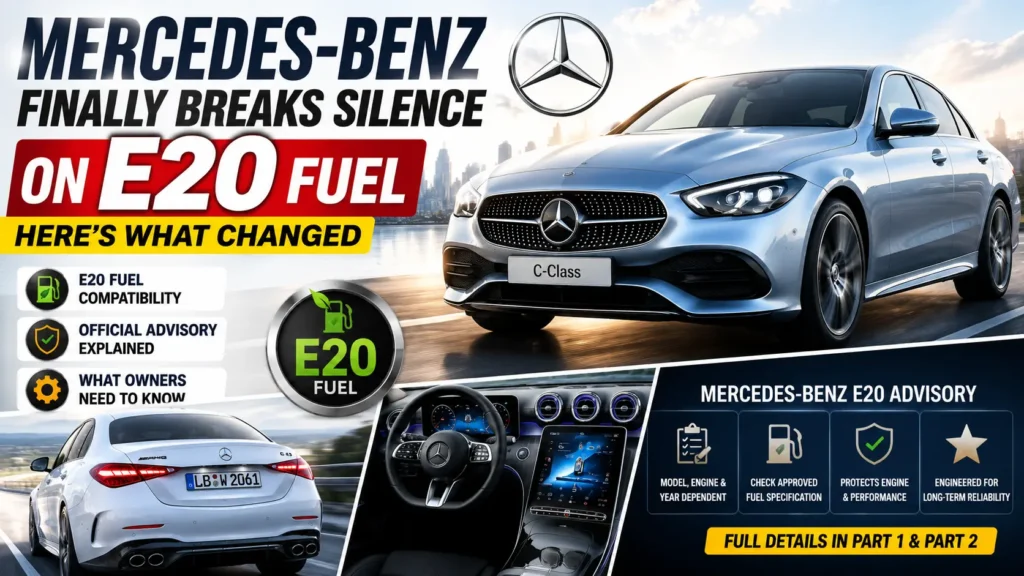
The transition to cleaner fuels is gathering pace across India, and E20 petrol is gradually becoming the standard fuel option at more filling stations. While many recently launched vehicles have already been engineered to support higher ethanol blends, luxury car owners have continued to ask one important question: Is my Mercedes-Benz compatible with E20 petrol? Mercedes-Benz India has now released fresh guidance on E20 fuel compatibility, giving owners greater clarity about which vehicles are suitable for the higher ethanol blend and which models may require a different fuel specification. If you already own a Mercedes-Benz or are planning to buy one, understanding this latest advisory could help you make the right decision every time you refuel.
What Is E20 Petrol And Why Is It Becoming More Common?
E20 petrol is a blend containing 20% ethanol and 80% petrol. The Indian government is promoting this fuel as part of its long-term strategy to reduce crude oil imports while lowering overall vehicle emissions. As the nationwide rollout continues, E20 petrol is becoming increasingly available across fuel stations, making it an important consideration for both existing and future vehicle owners.
Although many newly developed vehicles have been engineered with E20 compatibility in mind, luxury vehicles use highly sophisticated engines, fuel delivery systems and emission-control technologies that require extensive validation before a new fuel specification can be officially approved. This is precisely why Mercedes-Benz has issued detailed model-specific guidance instead of making a single recommendation for every vehicle in its lineup.
Also Read:- Bought A BMW Recently? There’s A New Fuel Rule Your Car Won’t Be Ready For E30
Mercedes-Benz Clarifies E20 Fuel Compatibility
According to the latest advisory, E20 compatibility depends on the specific Mercedes-Benz model, engine configuration and production year. While several newer vehicles have already been designed to support E20 petrol, certain older models may continue to require lower ethanol blends based on their original engineering specifications.
Rather than making assumptions based on a vehicle’s age or engine size, Mercedes-Benz recommends that owners verify the approved fuel specification for their exact model before using E20 petrol. Following the manufacturer’s recommendation helps protect engine components, maintain expected performance and support long-term reliability throughout the ownership experience.
Why Fuel Compatibility Matters For Luxury Vehicles
Luxury vehicles are engineered with extremely precise mechanical and electronic systems. Components such as fuel injectors, pumps, seals, sensors and emission-control equipment are calibrated to operate with specific fuel characteristics. Using a fuel blend that has not been approved for a particular model could affect efficiency, long-term durability or the overall performance of these systems.
Mercedes-Benz’s advisory should therefore be viewed as a preventive recommendation rather than a cause for concern. By following the approved fuel specifications, owners can continue to enjoy the performance, refinement and long-term reliability that define the Mercedes-Benz ownership experience.
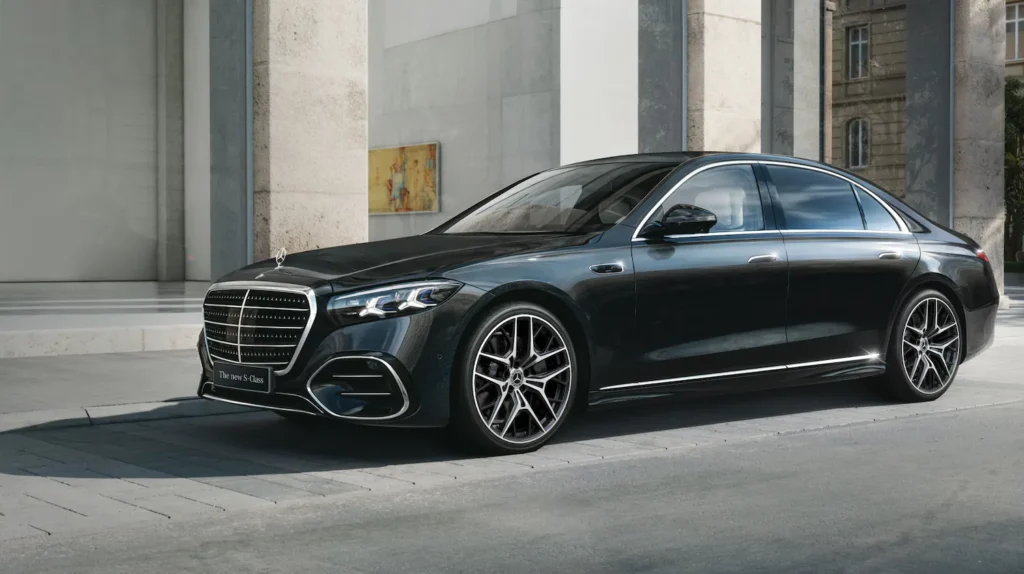
Mercedes-Benz E20 Compatibility At A Glance
| Category | Mercedes-Benz Advisory | Owner Benefit | Why It Matters |
|---|---|---|---|
| Fuel Type | E20 Petrol (20% Ethanol) | Better understanding of approved fuel | Helps avoid incorrect refuelling |
| Compatibility | Model, engine & production year dependent | Clear model-specific guidance | Prevents confusion |
| Recommendation | Verify approved fuel specification before using E20 | Safer long-term ownership | Protects engine and fuel system |
| Purpose | Official E20 Compatibility Advisory | Manufacturer-backed information | Greater confidence for owners |
Mercedes-Benz’s latest advisory provides much-needed clarity for owners as E20 petrol becomes more widely available across India. However, understanding whether your vehicle is compatible is only one part of the story. What does this advisory actually mean for existing owners, prospective buyers and long-term vehicle maintenance?
Also Read:- BMW X6 M60i Launched At ₹1.77 Crore: 0 to 100 in Just 4.3 sec
What Does The E20 Advisory Mean For Mercedes-Benz Owners?
The biggest takeaway from Mercedes-Benz’s latest E20 advisory isn’t the fuel itself—it’s the importance of knowing exactly what your specific vehicle has been engineered to use. That’s what makes this update especially relevant for both existing owners and prospective buyers. As E20 petrol becomes increasingly common across India, many drivers may assume that every modern luxury vehicle is automatically compatible with the higher ethanol blend. Mercedes-Benz has made it clear that the decision depends on the exact model, engine configuration and production year. In other words, checking the approved fuel specification is no longer just good practice—it has become an important part of protecting your vehicle’s long-term reliability, efficiency and performance.
Should Existing And Future Buyers Be Concerned?
For most Mercedes-Benz owners, there is no reason for unnecessary concern. The advisory has been issued to provide clarity rather than create uncertainty. Owners of compatible vehicles can continue using the approved fuel specification with confidence, while those driving older models simply need to verify whether E20 petrol has been officially approved for their specific vehicle. Instead of applying one rule to every model, Mercedes-Benz has adopted a model-specific approach that reflects the precise engineering standards behind each vehicle. This careful approach not only helps preserve engine durability and fuel-system integrity but also reduces the likelihood of avoidable maintenance issues over the years.
The advisory is equally valuable for prospective buyers. As cleaner fuels become more widely available, fuel compatibility is becoming another important factor to consider alongside performance, technology, comfort and safety. A premium ownership experience is defined not only by luxury features but also by following the manufacturer’s recommended operating guidelines throughout the vehicle’s life. Understanding fuel compatibility today can help owners avoid unnecessary uncertainty in the future.
MotorMitra Analysis
The Mercedes-Benz India E20 compatibility advisory reflects a much broader transformation taking place across the automotive industry. As governments encourage cleaner fuels and manufacturers adapt to evolving environmental standards, fuel compatibility is becoming an increasingly important aspect of vehicle ownership. Rather than issuing a universal approval for every vehicle, Mercedes-Benz has adopted an engineering-first approach that prioritises long-term reliability over convenience. For premium automobiles, where precision engineering directly influences performance, efficiency and durability, manufacturer-approved guidance remains the safest and most responsible path for owners.
The latest Mercedes-Benz E20 advisory should not be viewed as a warning against cleaner fuels—it should be seen as a reminder that premium vehicles deliver their best performance when operated according to the specifications for which they were engineered. By providing model-specific guidance instead of a one-size-fits-all recommendation, Mercedes-Benz is helping owners make informed decisions while protecting the long-term reliability, efficiency and refinement of their vehicles.
The future of premium motoring won’t depend only on cleaner fuels—it will also depend on how carefully owners follow the engineering recommendations behind them. That’s exactly why Mercedes-Benz’s latest E20 advisory matters, not just for today’s vehicles, but for the future of responsible luxury car ownership as well.