
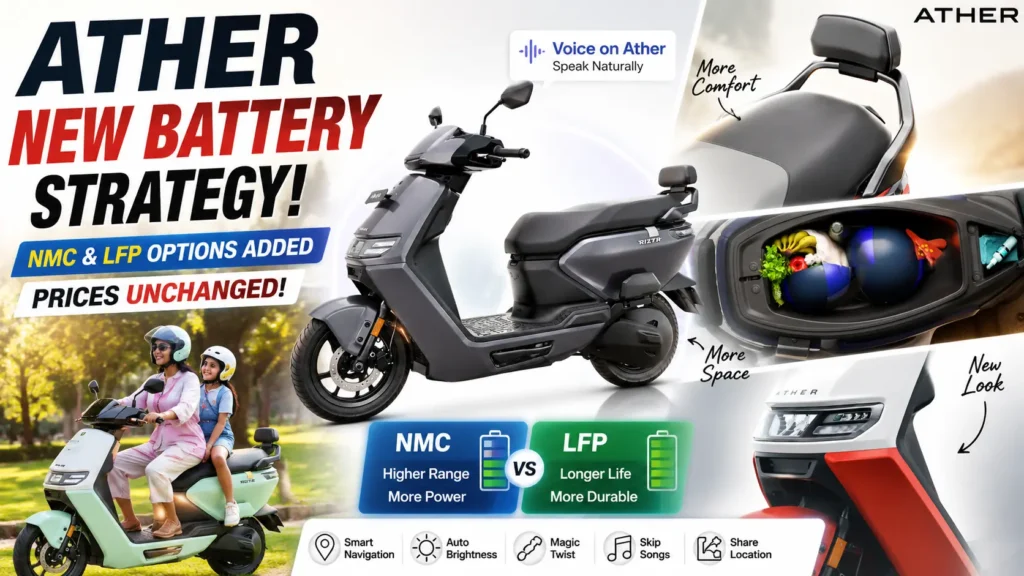
Planning to buy an Ather electric scooter? The company’s latest battery portfolio update could be more important than the launch of a new model. Instead of introducing an all-new scooter, Ather has refreshed its battery strategy by bringing updated battery configurations featuring NMC (Nickel Manganese Cobalt) and LFP (Lithium Iron Phosphate) chemistries across its portfolio. Alongside these changes, the company has also revised battery options for selected variants while keeping prices unchanged, making this an important development for both new and existing EV buyers.
Rather than focusing only on performance upgrades, Ather’s latest move reflects a broader effort to offer battery choices that better align with different riding requirements. Whether a customer prioritises longer range, long-term durability or everyday commuting efficiency, the updated battery portfolio aims to make it easier to choose a scooter that matches individual usage patterns without adding to the purchase cost.
What Has Changed In Ather’s Battery Strategy?
With this update, Ather has reorganised its battery portfolio by offering both NMC and LFP battery technologies across different variants. Instead of relying on a single battery chemistry throughout the lineup, the company is positioning different battery options to better address varying customer needs and riding conditions.
Also Read:- Hero Vida VX2 Plus 4.4kWh Launched in India at Rs 1.44 Lakh – 187 km Range Changes the Game
Ather has also introduced revised battery configurations for selected models as part of this portfolio update. While the exact battery technology and capacity differ depending on the variant, the overall strategy appears to simplify the product lineup and provide buyers with clearer choices based on their expected usage rather than offering multiple overlapping configurations.
Why Has Ather Introduced Two Battery Technologies?
Electric scooter buyers don’t all have the same priorities. Some riders need maximum range for longer daily travel, while others value long-term reliability, thermal stability and lower maintenance over several years of ownership. By offering both NMC and LFP battery options, Ather is expanding its portfolio to cater to these different expectations instead of relying on a single battery solution.
This approach also allows buyers to compare battery technologies based on real-world usage rather than focusing only on specifications. As electric mobility continues to evolve, providing battery options suited to different ownership requirements could make the buying decision more practical and transparent.
NMC Vs LFP: What’s The Difference?
Although both battery technologies are designed to power electric scooters efficiently, each offers a different balance of performance and long-term usability.
| Battery Type | Key Strength | Ideal Buyer |
|---|---|---|
| NMC | Higher energy density with the potential for longer riding range | Riders who frequently travel longer distances |
| LFP | Better thermal stability, longer service life and improved durability | Daily commuters prioritising long-term ownership value |
Rather than replacing one battery chemistry with another, Ather’s updated portfolio gives buyers the flexibility to choose the battery technology that best suits their riding habits and ownership expectations.
Why This Update Matters For Buyers
Battery technology plays a major role in determining an electric scooter’s overall ownership experience, influencing factors such as riding range, charging behaviour, durability and long-term reliability. By expanding its battery portfolio, Ather is giving prospective buyers more flexibility to select a scooter that better matches their individual requirements.
Another key highlight is that the updated battery strategy has been introduced without changing the ex-showroom prices of the affected variants. As a result, buyers can focus on selecting the battery configuration that best suits their usage instead of worrying about an immediate increase in purchase cost.
To better understand the direction of Ather’s updated battery portfolio, here’s a simplified overview of how the two battery technologies are positioned.
Ather’s Updated Battery Portfolio At A Glance
| Battery Technology | Primary Focus | Best Suited For |
|---|---|---|
| LFP | Long-term durability, thermal stability and extended battery life | Daily city commuting |
| NMC | Higher energy density and the potential for longer riding range | Riders covering longer daily distances |
| Variant-Specific Configurations | Battery choice based on model and intended usage | Buyers with different riding requirements |
Battery technology, capacity and variant availability may vary across Ather’s product lineup based on the company’s official specifications.
These updates mark an important step in Ather’s evolving battery strategy. However, understanding how these changes translate into everyday riding experience is equally important. In the next section, we’ll look at what the revised battery configurations mean in real-world usage, which battery technology is better suited for different riders and what buyers should consider before making their purchase decision.

Also Read:- Keeway Hypevolt-R Launched in India at Rs 1.99 Lakh: Price, Range, Features, and Everything You Need to Know
What Do These Battery Changes Mean In Everyday Riding?
On paper, battery chemistry may seem like a technical specification, but its real importance becomes clear during everyday ownership. Factors such as daily riding distance, charging habits, weather conditions and long-term reliability all influence how an electric scooter performs over time. That’s where Ather’s updated battery strategy becomes relevant.
Instead of offering a single battery solution for every rider, Ather is now providing different battery technologies across its portfolio to better match varying usage patterns. This allows buyers to look beyond claimed range figures and choose a scooter based on how they actually ride every day.
Which Battery Technology Is Right For You?
There isn’t a single battery technology that’s universally better—the right choice depends entirely on your riding requirements.
If most of your travel involves city commutes, office runs and predictable charging schedules, an LFP-based variant could be a sensible option because of its focus on long-term durability, thermal stability and dependable everyday performance.
However, riders who frequently cover longer distances or prefer maximising riding range may find an NMC-based variant better suited to their needs, thanks to its higher energy density.
Before making a purchase decision, buyers should also consider their average daily distance, access to charging infrastructure, expected ownership period and the specific features offered with each scooter variant.
Why Keeping Prices Unchanged Matters
Technology upgrades often lead to higher prices, especially in the premium electric scooter segment. That’s why Ather’s decision to introduce updated battery configurations without changing the prices of the affected lineup is significant.
Instead of paying extra simply because the battery strategy has evolved, buyers can continue comparing scooters based on their actual requirements. This makes the updated portfolio more attractive for customers who were already considering an Ather scooter while also reducing uncertainty during the buying process.

Quick Buying Guide
| Buyer Profile | Recommended Approach | Why It Makes Sense |
|---|---|---|
| Daily City Commuter | Choose an LFP-based variant | Better suited for consistent daily usage and long-term durability |
| Mixed City & Weekend Rider | Compare both battery options based on your average daily distance | Helps balance range, practicality and ownership needs |
| Frequent Long-Distance Rider | Consider an NMC-based variant | Higher energy density may be better suited for extended riding |
| First-Time EV Buyer | Evaluate battery type alongside warranty, service network and ownership costs | A complete ownership experience depends on more than battery chemistry alone |
MotorMitra Analysis
Rather than grabbing attention with an all-new scooter launch, Ather has focused on improving one of the most important aspects of electric vehicle ownership—the battery. As buyers become more informed about battery technology, introducing both NMC and LFP options reflects a practical product strategy rather than a cosmetic update.
Equally noteworthy is the company’s decision to keep prices unchanged despite refreshing its battery portfolio. By offering greater flexibility without immediately increasing costs, Ather is making it easier for customers to choose a scooter that better aligns with their real-world riding needs. In an increasingly competitive EV market, this measured approach could prove more valuable than simply adding new features or launching another variant.
The biggest takeaway from Ather’s latest portfolio update isn’t just the introduction of two battery technologies—it’s the fact that battery choice is now becoming as important as the scooter itself. Buyers no longer need to focus only on range figures or performance claims; understanding which battery technology best suits their riding style can have a meaningful impact on long-term ownership.
For prospective buyers, this update is worth paying close attention to. If the revised battery portfolio aligns with your daily usage, charging habits and ownership expectations, Ather’s latest battery strategy shows that meaningful product updates don’t always require a new scooter. Sometimes, giving buyers better choices can make an even bigger difference to the overall ownership experience.