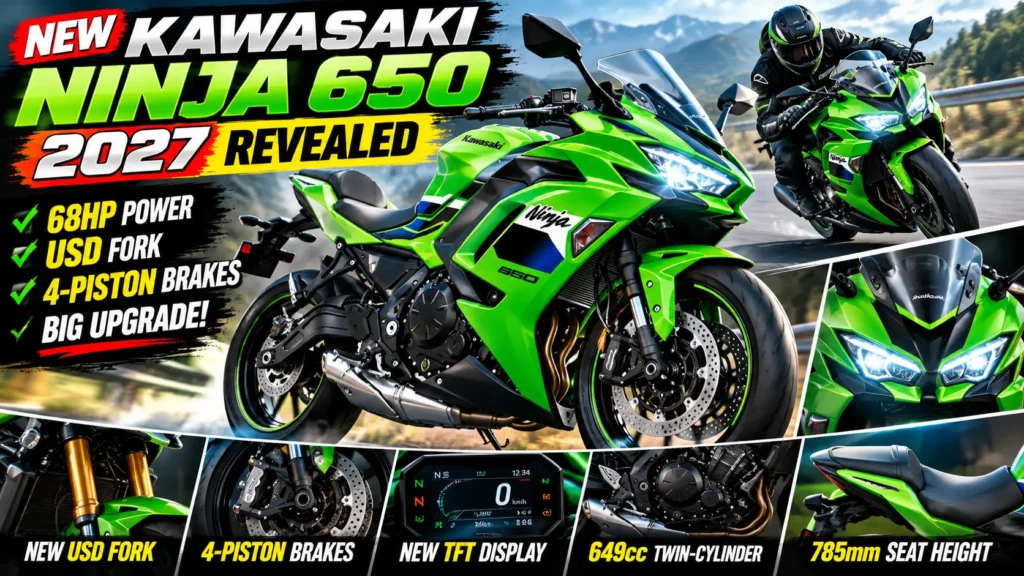
The Kawasaki Ninja 650 2027 has officially been revealed, bringing a major set of updates to one of Kawasaki’s most popular middleweight sportbikes. Instead of limiting the new model to cosmetic changes, Kawasaki has upgraded the suspension, braking hardware, electronics and rider ergonomics while retaining the familiar 649cc parallel-twin engine. The result is a Ninja 650 that looks familiar but gets several important mechanical and technology improvements.
The biggest highlight is the new 37mm Showa SFF-BP inverted front fork, which replaces the conventional telescopic fork used previously. The motorcycle also gets radial-mounted 4-piston front brake calipers, an updated 4.3-inch TFT display, expanded smartphone connectivity with navigation and voice-command functions, and a lower 785mm seat height. These changes make the 2027 model considerably more interesting for riders looking for a practical motorcycle with stronger sportbike hardware.
Kawasaki Ninja 650 2027: Major Updates Explained
The most significant mechanical change is at the front of the motorcycle. Kawasaki has replaced the previous conventional telescopic fork with a 37mm Showa SFF-BP (Separate Function Fork – Big Piston) inverted fork. This setup is designed to provide improved front-end control, better stability and a more controlled response during braking and cornering. The rear suspension continues to use Kawasaki’s horizontal back-link monoshock, but its spring rate has also been revised to complement the updated front-end setup.
The braking system has received an equally important upgrade. The previous axial-mounted 2-piston front calipers have been replaced by radial-mounted opposed 4-piston calipers, working with twin 300mm front discs. This is one of the most substantial hardware changes on the 2027 Ninja 650 and should give riders a sharper initial response and better control when braking aggressively, while the rear continues with a single disc brake setup.
| Specification | 2027 Kawasaki Ninja 650 | Previous Model | Key Difference |
|---|---|---|---|
| Engine | 649cc Parallel Twin | 649cc Parallel Twin | Same proven engine platform |
| Power | 68PS @ 8,000rpm | 68hp-class output | Similar performance character |
| Torque | 64Nm @ 6,700rpm | 62.1Nm India-spec | Higher international-spec figure |
| Front Fork | 37mm Showa SFF-BP USD | Conventional telescopic | Major suspension upgrade |
| Front Brakes | Radial 4-Piston | Axial 2-Piston | More advanced braking hardware |
| Front Discs | Twin 300mm | Twin 300mm | Disc size retained |
| Rear Suspension | Horizontal Back-Link | Horizontal Back-Link | Revised spring setting |
| Instrument Console | 4.3-inch Colour TFT | 4.3-inch Colour TFT | Updated display layout |
| Connectivity | Navigation + Voice Functions | Smartphone Connectivity | Expanded functionality |
| Seat Height | 785mm | 790mm | 5mm lower |
| Fuel Tank | 15 litres | 15 litres | Unchanged |
| Kerb Weight | 194kg* | Market dependent | International specification |
*International specification.
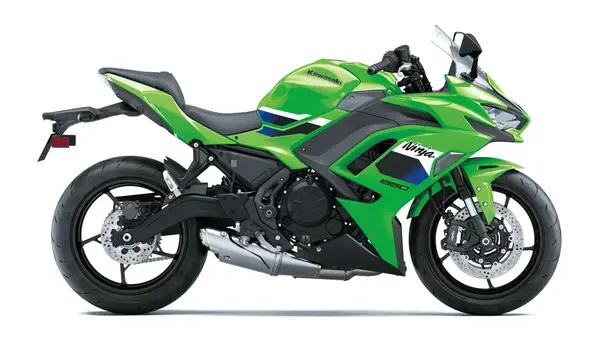
649cc Engine Continues With 68PS Power
Kawasaki has retained the familiar 649cc liquid-cooled parallel-twin engine for the 2027 Ninja 650. The engine continues with a six-speed gearbox and the same everyday-friendly character that has made the Ninja 650 popular among riders who want performance without the extreme riding position of a supersport motorcycle.
For the international 2027 model, Kawasaki lists 68PS at 8,000rpm and 64Nm at 6,700rpm. The engine therefore remains familiar rather than being completely redesigned, with Kawasaki instead focusing its development effort on improving the chassis, braking system, rider interface and overall usability.
This approach also keeps the Ninja 650 positioned as a motorcycle that can work equally well for daily commuting and weekend rides. The updated suspension and brakes should allow riders to make better use of the available engine performance when riding through corners or braking harder, while the parallel-twin configuration continues to offer a more accessible character than a high-revving supersport engine.
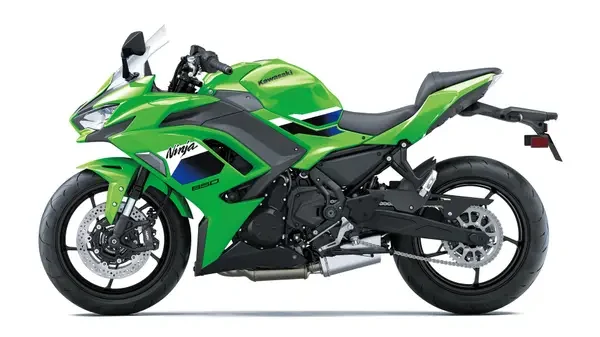
New USD Fork & 4-Piston Radial Brakes
The new Showa 37mm SFF-BP USD fork is arguably the biggest mechanical upgrade on the 2027 Ninja 650. The inverted design and Big Piston technology are intended to improve damping behaviour and front-end control, particularly during braking and corner entry. For riders upgrading from the previous Ninja 650, this is one of the changes most likely to be noticeable during real-world riding.
Kawasaki has also significantly upgraded the front braking hardware. The new radial-mounted 4-piston calipers replace the older axial-mounted 2-piston units, while the twin 300mm semi-floating front discs remain. The combination gives the Ninja 650 a considerably more sophisticated front braking package and brings its hardware closer to what riders expect from a modern middleweight performance motorcycle.
Also Read:- New Hayabusa Special Edition 2026: ₹19.90 Lakh, 190PS Power & Big Updates!
New TFT Display, Navigation & Connectivity
The 2027 Ninja 650 continues with a 4.3-inch colour TFT instrument panel, but Kawasaki has revised the display layout to provide a more modern cockpit experience. The updated screen works with Kawasaki’s smartphone connectivity system, giving riders access to additional information and connected functions through a compatible smartphone.
One of the most useful additions is expanded connectivity with navigation and voice-command functions. This makes the Ninja 650 more practical for longer rides, where navigation information can be accessed without relying entirely on a separate device. However, individual connected features can vary by market, so the final availability of every function will depend on the specification offered in each country.
Lower 785mm Seat Height & Everyday Practicality
Kawasaki has reduced the seat height from 790mm to 785mm on the 2027 international model. Although the difference is only 5mm, a lower seat can make the motorcycle easier to manage during low-speed manoeuvres, traffic stops and parking, particularly for riders who are sensitive to seat height.
The Ninja 650 retains a 15-litre fuel tank and a 17-inch wheel setup with a 120/70 front tyre and 160/60 rear tyre. The international specification lists a kerb weight of approximately 194kg, keeping the motorcycle within the familiar middleweight category. Its ergonomics continue to focus on a balance between sporty riding and everyday usability rather than an extreme supersport-style riding position.
Sporty Ninja Design With New Colour Options
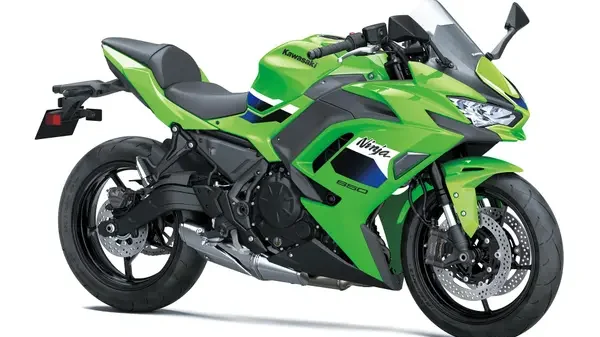
Kawasaki has retained the familiar Ninja design language rather than completely redesigning the motorcycle. The sharp front fairing, sporty proportions and aggressive stance remain, while the revised front-end components and wider front fender give the 2027 model a slightly more premium appearance.
For international markets, Kawasaki has announced three colour combinations: Lime Green, Metallic Flat Spark Black/Metallic Carbon Gray, and Metallic Matte Graphenesteel Gray/Metallic Spark Black. Colour availability can vary between countries, so Indian buyers will need to wait for Kawasaki India’s final specification before assuming that all three options will be offered locally.
Quick Shifter Available as an Accessory
The 2027 Ninja 650 also gets support for Kawasaki’s Quick Shifter, but there is an important distinction. The quick shifter is offered as an accessory, rather than being standard equipment on every version of the motorcycle. Where available, it allows clutchless upshifts during acceleration and can make spirited riding smoother and quicker.
The motorcycle continues to use an assist-and-slipper clutch as part of its standard setup. This means buyers who want the additional quick-shifting functionality can consider the accessory option depending on market availability and the final equipment list.
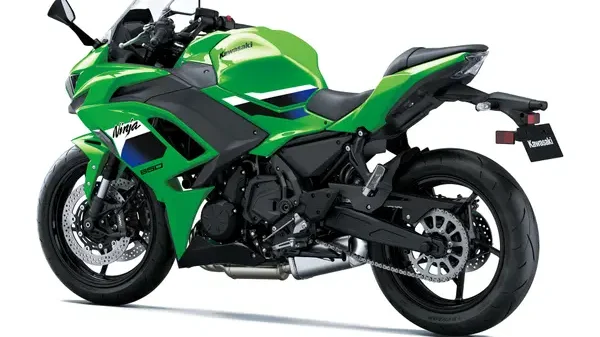
2027 Kawasaki Ninja 650 Mileage, Price & India Launch
Kawasaki has not published a definitive real-world mileage figure for the 2027 Ninja 650. Fuel economy will naturally depend on traffic conditions, riding style, speed, road conditions and maintenance, so an unverified mileage number should not be treated as an official figure. Buyers should therefore wait for India-specific testing and ownership data before expecting a particular mileage figure.
In India, the current 2026 Kawasaki Ninja 650 is priced at ₹7.91 lakh ex-showroom. The 2027 model’s India launch date and final India price have not yet been officially announced. Therefore, the ₹7.91 lakh figure should be treated only as the current-model reference price and not as the price of the upcoming 2027 version.
| India Buyer Detail | Current Information | 2027 Status | What It Means |
|---|---|---|---|
| Current Price | ₹7.91 lakh ex-showroom | Not announced | 2027 price may differ |
| India Launch | 2026 model available | Date not announced | Official confirmation awaited |
| Engine | 649cc Parallel Twin | Platform continues | Final India specification awaited |
| Power | 68hp-class | 68PS international spec | India figure to be confirmed |
| Front Fork | Conventional Telescopic | 37mm Showa SFF-BP USD | Major upgrade |
| Front Brakes | 2-Piston Axial | 4-Piston Radial | Major upgrade |
| Seat Height | 790mm | 785mm international | 5mm reduction |
| TFT | 4.3-inch | Updated 4.3-inch layout | Improved cockpit |
| Mileage | Riding-condition dependent | No official figure | Avoid unverified claims |
The 2027 Kawasaki Ninja 650 is therefore a substantial model-year update rather than a simple cosmetic refresh. Kawasaki has kept the proven 649cc parallel-twin engine and familiar Ninja identity, while upgrading the components that have the biggest effect on the riding experience. The new USD fork and radial 4-piston brakes are the headline mechanical changes, while the updated TFT, smartphone connectivity and lower seat height improve everyday usability.
For Indian buyers, the most important details still pending are the official India launch date, India-specific specifications, colour options and final price. Until Kawasaki announces those details, the international 2027 specifications provide the clearest picture of what has changed. With its combination of familiar engine performance, upgraded chassis hardware and modern electronics, the new Ninja 650 enters 2027 with a significantly more advanced specification while keeping the practical character that defines the model.