
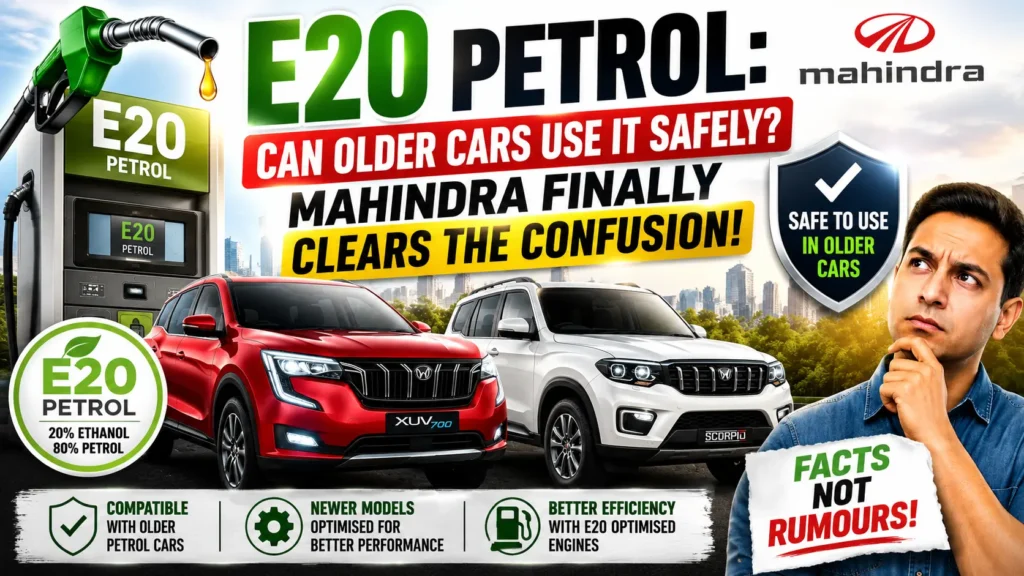
If you own an older petrol car, chances are the recent E20 petrol controversy has already made you question your next fuel stop. Viral claims and conflicting opinions have left thousands of vehicle owners wondering whether using E20 petrol could affect engine reliability or long-term performance. To address those concerns, Mahindra has issued an important clarification that separates facts from fear. According to the company, older Mahindra petrol vehicles can safely run on E20 petrol, while its newer-generation models have been specifically engineered to make even better use of the higher ethanol blend.
That distinction is more important than it appears because fuel compatibility and fuel optimisation are two completely different concepts. For existing owners, this clarification offers reassurance, while for new buyers, it explains why modern petrol engines are increasingly being designed with E20 fuel in mind.
At A Glance
- Older Mahindra petrol vehicles can safely use E20 petrol.
- Newer-generation models are specifically optimised for E20 fuel.
- Safe compatibility doesn’t always mean identical performance.
- Minor differences in mileage and driving refinement are expected.
- Mahindra’s clarification helps separate facts from viral misconceptions.
Also Read:- Govt Calls Industry Experts After Viral E20 Petrol Claims Spark Confusion
What Has Mahindra Actually Said?
The biggest takeaway from Mahindra’s clarification is surprisingly simple—being compatible with E20 fuel and being optimised for E20 fuel are two very different things. According to the company, older petrol-powered Mahindra vehicles can safely operate on E20 petrol without evidence of widespread engine-related concerns. However, newer models have been developed with revised engine calibration, fuel mapping and supporting components that enable them to utilise the higher ethanol blend more efficiently. In simple terms, owners of older vehicles don’t need to panic about using E20, while buyers of newer models can expect better optimisation, improved efficiency and a more refined driving experience.
Why Are Newer Models Better Optimised?
That’s because newer petrol engines have been developed with E20 petrol in mind from the earliest stages of engineering. Improvements in engine calibration, fuel delivery and combustion management help these vehicles make better use of the higher ethanol content, delivering smoother performance and more consistent efficiency across a wide range of driving conditions. Older vehicles, although fully compatible, were originally designed around lower ethanol blends and therefore may not unlock the same level of optimisation. That doesn’t make them unsafe—it simply means newer engines have been fine-tuned to extract the maximum potential from E20 fuel.
E20 Compatibility Explained
| Topic | Older Petrol Cars | Newer E20-Optimised Cars |
|---|---|---|
| E20 Compatibility | Safe to use | Fully compatible |
| Engine Calibration | Earlier-generation tuning | Specifically optimised for E20 |
| Performance | Safe to drive, but may not be as finely optimised as newer models | Engine calibrated to maximise E20 performance |
| Fuel Efficiency | Slight variation is possible | Better optimised for E20 fuel |
| What It Means For Owners | Continue using E20 with confidence | Enjoy better efficiency, refinement and optimisation |
If older petrol cars can already use E20 safely, what exactly do buyers gain by choosing an E20-optimised petrol engine? The answer isn’t just about compatibility—it also involves long-term efficiency, improved refinement and the future direction of petrol engine technology. And that’s exactly where the real story begins.
Also Read:- Car Owners Can Finally Stop Worrying: E20 Fuel Won’t Void Your Insurance
Is An E20-Optimised Petrol Engine Worth Choosing?
This is where the confusion finally begins to clear. While millions of existing vehicle owners simply want to know whether E20 petrol is safe for their cars, new buyers have a different question—is an E20-optimised petrol engine actually worth choosing? The answer lies in understanding the difference between compatibility and optimisation. An engine that’s designed specifically for E20 fuel isn’t just capable of using it safely; it’s engineered to make better use of the higher ethanol blend through refined calibration, fuel management and combustion tuning. While older compatible vehicles continue to operate safely on E20 petrol, newer E20-optimised models are more likely to deliver smoother performance, improved drivability and more consistent efficiency over the long term.
Should Older Petrol Car Owners Be Worried?
For the vast majority of existing owners, the answer is no. Mahindra’s clarification reinforces that older compatible petrol vehicles do not suddenly become unsafe simply because E20 petrol is now more widely available. If your vehicle is approved to run on E20 fuel and has been maintained according to the manufacturer’s recommendations, there is little reason to change your refuelling habits based on viral social media claims alone.
However, buyers planning to purchase a brand-new petrol vehicle can benefit from choosing a model that’s been specifically engineered for E20 fuel. While the difference may not always be dramatic in everyday driving, better optimisation contributes to smoother refinement, more consistent performance and an ownership experience that’s better prepared for evolving fuel standards.
MotorMitra Analysis
Mahindra’s clarification highlights one important lesson that many vehicle owners often overlook—compatibility should never be confused with optimisation. The recent E20 debate has created unnecessary concern because these two terms are frequently treated as if they mean the same thing. In reality, an older compatible vehicle can continue operating safely, while a newer E20-optimised engine simply extracts more from the fuel through improved engineering. Rather than replacing older vehicles overnight, E20 optimisation represents the natural evolution of petrol engine technology as fuel standards continue to evolve. That’s exactly why understanding this difference is becoming increasingly important for both existing owners and future car buyers.

Mahindra’s clarification should reassure thousands of existing petrol car owners who were left uncertain by recent discussions surrounding E20 petrol. Older compatible vehicles remain safe to use with E20 fuel, while newer-generation models have been developed to deliver better refinement, improved efficiency and more effective optimisation.
If your existing petrol car is E20-compatible, there’s little reason to worry. And if you’re planning to buy a new vehicle, choosing an E20-optimised engine simply means investing in technology that’s better prepared for the future. Ultimately, informed decisions based on verified technical guidance will always be far more valuable than conclusions driven by viral opinions.