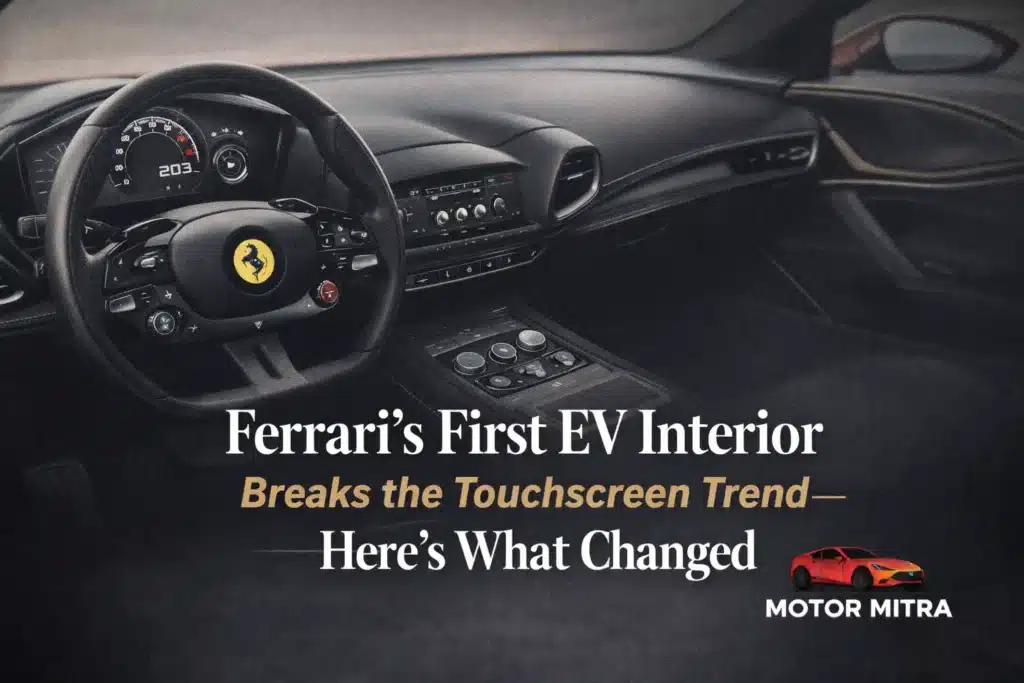
For years, electric cars have followed the same interior formula: bigger screens, fewer buttons, and software replacing physical controls. Ferrari has just taken a very different path. With the interior of its Ferrari Luce EV now revealed, the company is sending a clear signal — touchscreens will not define Ferrari’s electric future.
Instead, Ferrari has doubled down on something many brands have quietly abandoned: physical dials, buttons, and driver-focused controls. For buyers watching how performance brands adapt to Ferrari Luce EV, this is not a small design choice. It’s a philosophical one.
🔍 Why This Matters
- Most EV interiors are moving toward screen-dominated layouts
- Ferrari has chosen physical controls for its Ferrari Luce EV electric car
- This decision reshapes how luxury performance EVs may evolve
Why Ferrari Is Going Against the Touchscreen Wave
In the Ferrari Luce EV space, minimalism usually means digital dominance. Climate, drive modes, steering functions — everything lives inside software menus. Ferrari’s interior design for its Ferrari Luce EV pushes back against that logic.
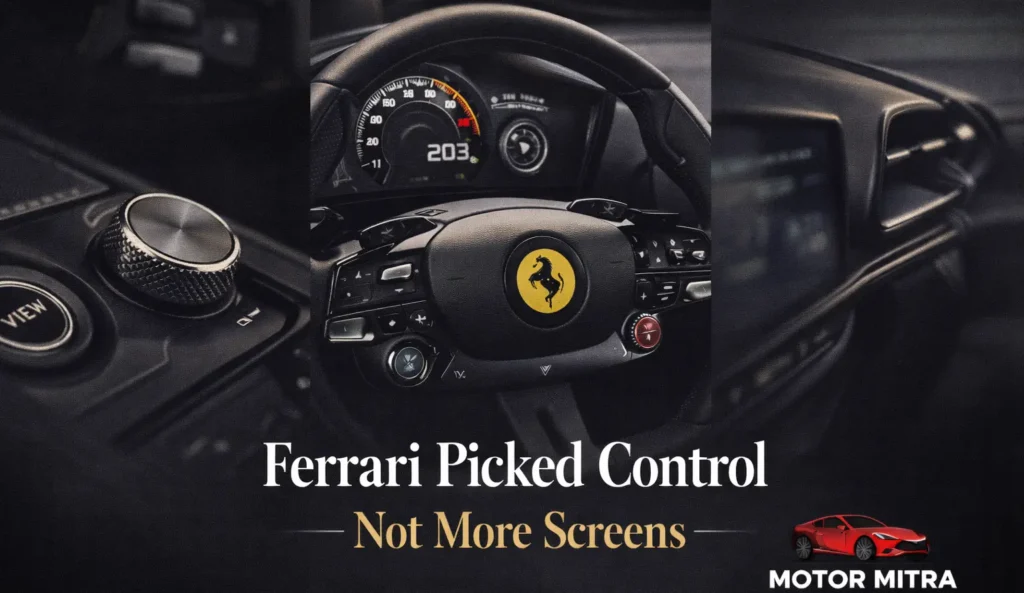
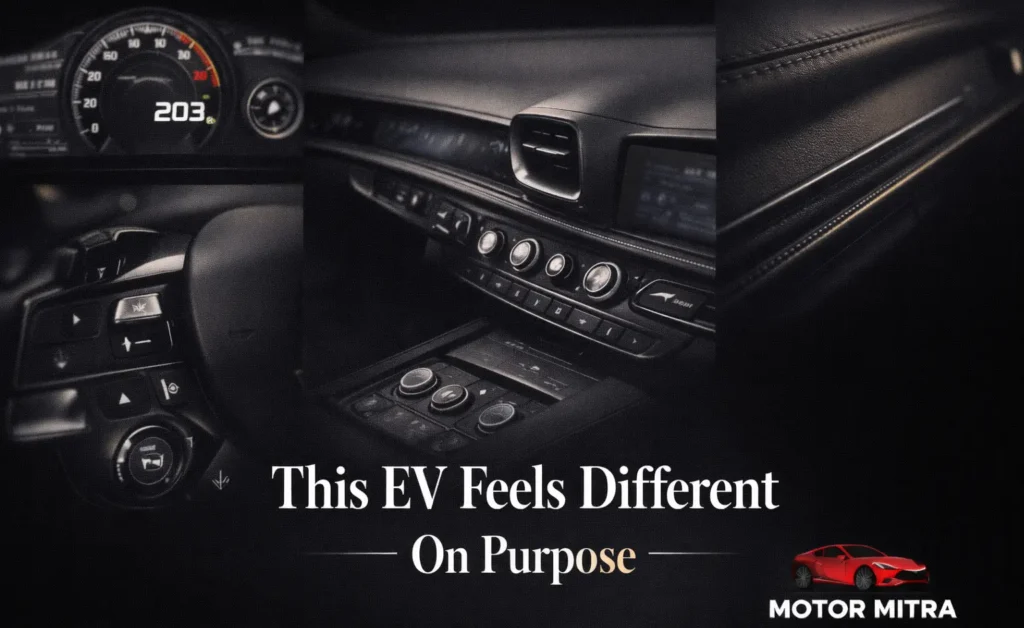
The cabin focuses on tactile interaction. Physical dials and buttons sit where drivers naturally expect them. Gauges provide information without forcing the driver to look away or tap through layers of menus. The layout prioritises muscle memory over digital discovery.
For Ferrari, this isn’t nostalgia. It’s performance logic. At high speeds or under load, touchscreens slow reaction time. Buttons don’t.
Also Read:- Breaking: Alpina Breaks Free from BMW – Officially a Standalone Brand in Historic 2026 Split!
What the Interior Actually Changes
Ferrari Luce EV interior does not reject technology — it rebalances it. Screens still exist, but they are no longer the centrepiece. Instead, the driver’s environment feels closer to Ferrari’s combustion-era cockpits than to a typical EV lounge.
Key changes include:
- Physical dials for critical functions instead of touchscreen sliders
- Dedicated buttons and switches placed for intuitive reach
- Clear, gauge-based information delivery that reduces distraction
- A minimalist layout that avoids visual clutter without relying on giant displays
This approach signals that Ferrari sees the interior as a driving tool, not a tech showcase.
Minimalism Without the “Tablet-on-a-Dash” Look
Many EV interiors claim minimalism, but rely on one massive screen to replace everything else. Ferrari Luce EVs interpretation is different. The cabin looks restrained, clean, and focused — but not empty.
Surfaces are purposeful. Controls exist because they serve a function. There is little excess, but also little ambiguity. Drivers don’t have to guess where to tap or swipe. They know.
This distinction matters because Ferrari’s buyers expect involvement, not automation. An EV can be quiet, but a Ferrari still needs to feel alive.
Why This Matters for Ferrari Loyalists
One of the biggest fears among Ferrari enthusiasts has been emotional dilution. EVs risk removing sound, vibration, and mechanical theatre. The Ferrari Luce EV interior becomes even more important as a result.
By retaining physical interaction, Ferrari is protecting the sense of control and connection that defines its Ferrari Luce EV brand. The Ferrari Luce EV interior becomes a replacement for some of the feedback lost when an engine disappears.
For loyalists, this design choice is reassurance: Ferrari understands what makes its cars feel special, even when the powertrain changes.
Also Read:- Red Bull RB17 Hypercar Unleashed: Adrian Newey’s 1,200hp Final F1 Masterpiece Hits Production!
A Quiet Critique of the Wider EV Industry
Ferrari’s interior is also a subtle critique of where the industry has gone. Touchscreen-heavy cabins prioritise cost savings, software updates, and showroom wow factor. They don’t always prioritise driving.
By going the opposite way, Ferrari is implicitly saying that performance brands should not copy mass-market EV logic. What works for tech-focused electric sedans does not automatically work for driver-focused cars.
This could influence other high-performance brands that are struggling to balance EV efficiency with emotional engagement.
How This Fits Ferrari’s EV Strategy
Ferrari has been cautious about entering the EV space. Its first electric model is not positioned as a tech experiment, but as a fully-fledged Ferrari that happens to be electric.
The interior reinforces that positioning. Instead of reimagining Ferrari as a digital brand, the company has adapted electric technology to Ferrari values — not the other way around.
That decision reduces risk. Buyers aren’t asked to accept a radically unfamiliar Ferrari experience. They’re asked to accept a familiar one, powered differently.
Will This Influence Other Luxury EV Interiors
It’s unlikely that mass-market EVs will reverse course. Screens are cheaper, simpler, and easier to update. But in the luxury and performance space, Ferrari’s move could start a rethink.
Buyers paying a premium expect more than a tablet. They expect craftsmanship, tactility, and intention. Ferrari’s interior shows that minimalism and physical controls can coexist — and may actually enhance the driving experience.
What This Really Signals
Ferrari’s first EV interior is not about rejecting technology. It’s about choosing where technology belongs. Software supports the drive, but does not dominate it. Controls exist to be used, not admired.
In a market rushing toward digital sameness, Ferrari has chosen differentiation through restraint.
That choice won’t matter to everyone. But for drivers who care about engagement, it could make Ferrari’s first EV feel more authentic than many expected.
Sometimes the most disruptive move isn’t adding more screens — it’s knowing when not to.
For more such updates and latest news on cars and bikes stay connected to motormitra.in
Thank you ..
auto.motormitra
Latest Auto News and Trends

Also Read:- 4 नई SUVs दिसंबर 2025 में लॉन्च होंगी — Maruti, Tata और Kia की बड़ी तैयारी शुरू
ऐसी ही और ताज़ा खबरों और अपडेट्स के लिए जुड़े रहें Auto.MotorMitra के साथ।
धन्यवाद!
Times Mitra
Latest bytes of news.

Also Read:- Google Invests $40 Billion in Texas to Build New AI Data Centers
For more such updates and latest news on cars and bikes stay connected to times.motormitra.in
Thank you ..