
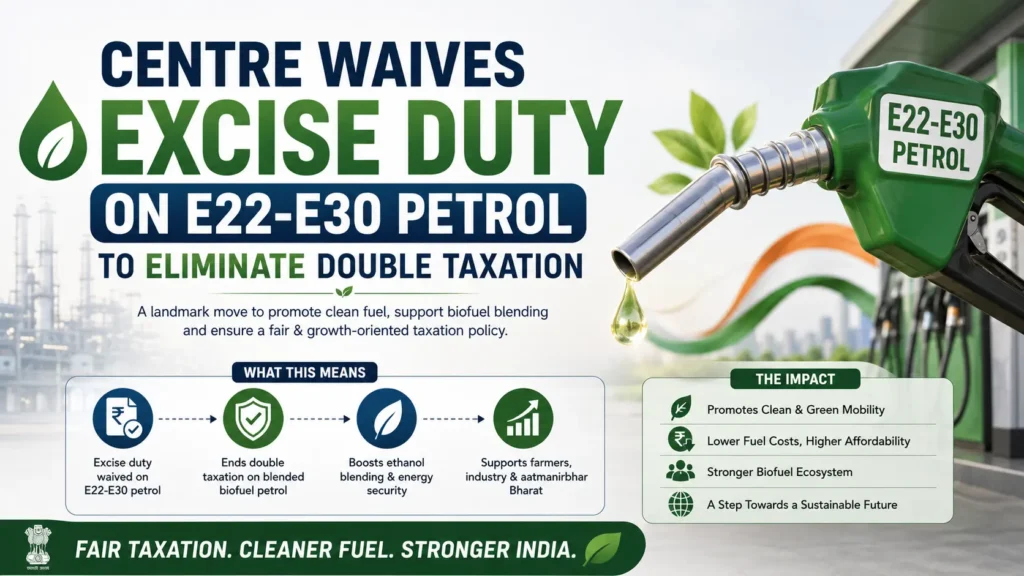
Following the successful national implementation of the 20% ethanol-blended petrol (E20) target, the Ministry of Finance has officially extended its long-term alternative energy roadmap. Through a series of gazette notifications issued by the Central Board of Indirect Taxes and Customs (CBIC), the government has granted a nil rate of central excise duty, special additional excise duty, and Road and Infrastructure Cess to higher ethanol-blended petrol grades, specifically covering E22, E25, E27, and E30 variants.
This decisive move comes closely on the heels of the Bureau of Indian Standards (BIS) notifying the official fuel-quality specifications for these exact higher blends under the IS 19850:2025 framework. Together, these dual developments establish the formal regulatory and fiscal architecture required for the next phase of India’s Ethanol Blended Petrol (EBP) programme.
1. Why This Exemption Was Vital
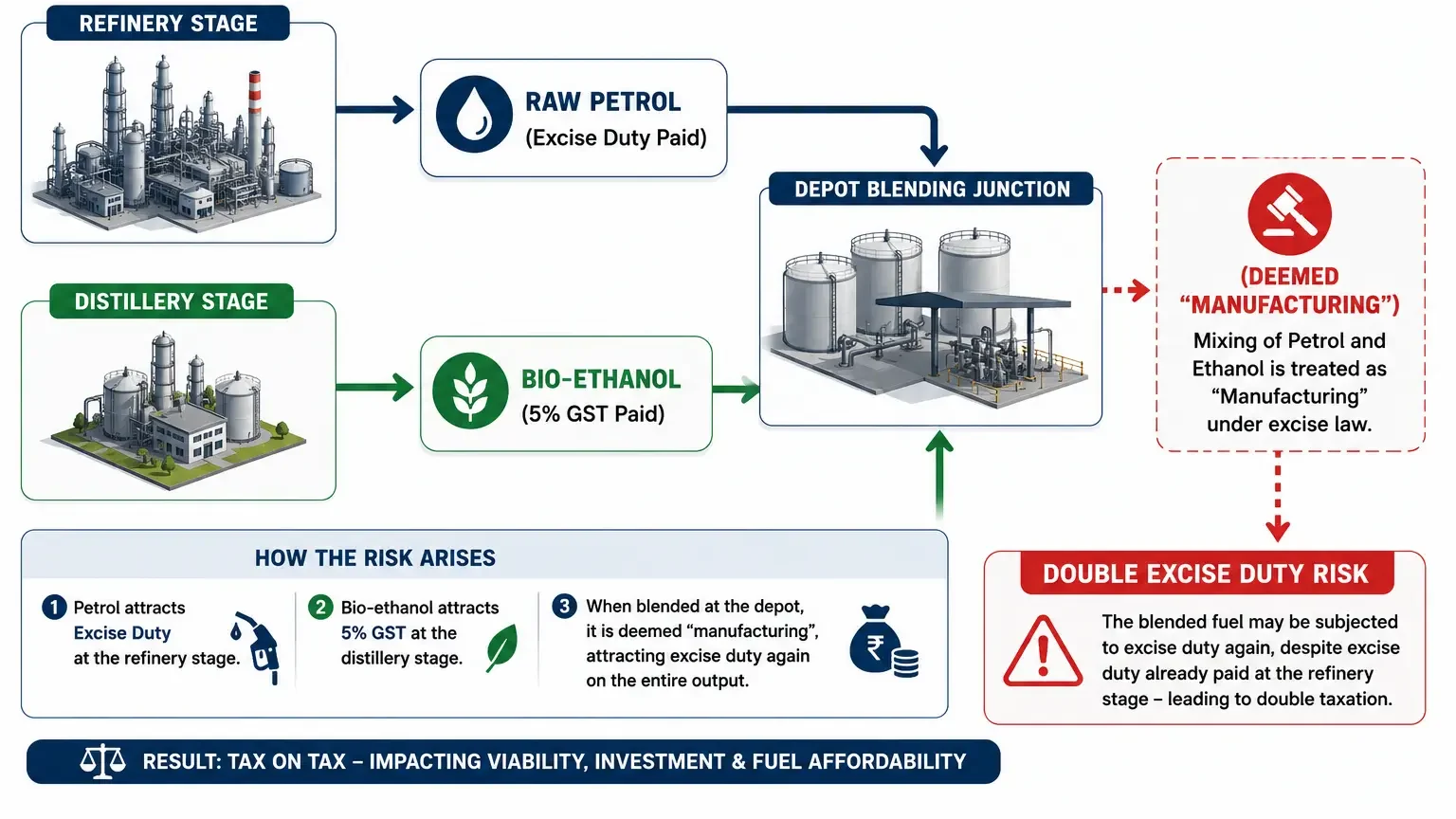
The primary driving force behind this tax notification is a technicality within India’s indirect tax laws. In the domestic fuel supply chain, raw motor spirit (conventional petrol) is subjected to heavy central excise duties at the refinery stage. On the other hand, plant-based anhydrous ethanol attracts Goods and Services Tax (GST) at a concessional rate of 5%.
Also Read: Tata Sierra EV Debut Confirmed: Why Premium SUV Buyers Must Wait For June 30
Under Indian Excise Law, the physical act of blending ethanol into petrol at oil marketing company (OMC) storage depots is technically classified as a manufacturing activity. Without a specific tax exemption, the resulting blended fuel variant (such as E25 or E30) would legally attract excise duty a second time on its full volumetric quantity. This new notification simply removes that legal complication, ensuring that taxes are not charged twice on the final consumer-facing product.
2. Composition Breakdown of the Newly Exempted Blends
The Department of Revenue has clearly mapped out the precise chemical and volumetric parameters for each newly exempted category to ensure uniform fuel manufacturing standards across the country:
| Fuel Grade Designation | Conventional Petrol Content (By Volume) | Bio-Ethanol Blending Ratio (By Volume) | Conforming BIS Standard |
| E22 Petrol Variant | 78% Motor Spirit | 22% Plant-Derived Ethanol | IS 19850 Architecture |
| E25 Petrol Variant | 75% Motor Spirit | 25% Plant-Derived Ethanol | IS 19850 Architecture |
| E27 Petrol Variant | 73% Motor Spirit | 27% Plant-Derived Ethanol | IS 19850 Architecture |
| E30 Petrol Variant | 70% Motor Spirit | 30% Plant-Derived Ethanol | IS 19850 Architecture |
3. Higher Blends Aren’t Coming Just Yet
While ethanol producers and sugar mills have openly welcomed this tax update, the Ministry of Petroleum and Natural Gas has issued a strong clarification for everyday car and bike owners: this notification does not mean E22 or E30 fuels will start appearing at local retail stations anytime soon.
Joint Secretary of the Petroleum Ministry, Sujata Sharma, explicitly noted that this update is simply a preliminary administrative requirement. Widespread deployment will require extensive real-world fleet validation and consultations with vehicle manufacturers.
Currently, more than 95% of the passenger vehicles and two-wheelers moving on Indian roads are engineered to handle a maximum threshold of E20 petrol. Pumping E25 or E30 fuel into an uncalibrated engine can cause severe corrosion in standard fuel lines, degrade rubber gaskets, and lead to poor engine performance over time.

4. Utilizing Surplus Ethanol and Saving Forex
The strategic push behind this policy is deeply tied to domestic energy security. Data shows that since the expansion of the blending targets starting around 2014-15, the EBP programme has achieved substantial macro-economic savings for the country:
- Foreign Exchange Savings: Over Rs 1.84 Lakh Crore saved in foreign exchange by directly reducing crude oil import bills.
- Crude Oil Substitution: Replaced roughly 30.2 Million Metric Tonnes of imported fossil oil with clean, domestically grown alternatives.
- Agricultural Boost: Generated over Rs 1.58 Lakh Crore in gross earnings for local farmers and rural distillation units.
Interestingly, India’s aggregate biofuel distillation capacity has already scaled up past 1,000 crore litres annually, meaning supply actually exceeds the requirements of the current E20 program. Moving toward E25 as the default next-step national blend could easily create an additional demand of 300 crore litres of ethanol per year, safely absorbing this surplus production.
Motor Mitra Verdict
The central excise duty exemption on E22-E30 fuels is not a retail discount for today’s driver, but rather a critical policy foundation for tomorrow’s transport network. It removes the tax hurdles well in advance, giving automakers a clear and stable tax environment to design and mass-produce affordable Flex-Fuel Vehicles (FFVs).
Combined with the ongoing pilot launch of high-concentration E85 fuel networks at a Rs 20 discount in metropolitan hubs, India is successfully building a robust, multi-tier alternative fuel ecosystem designed to keep the country moving, regardless of global crude market volatility.