
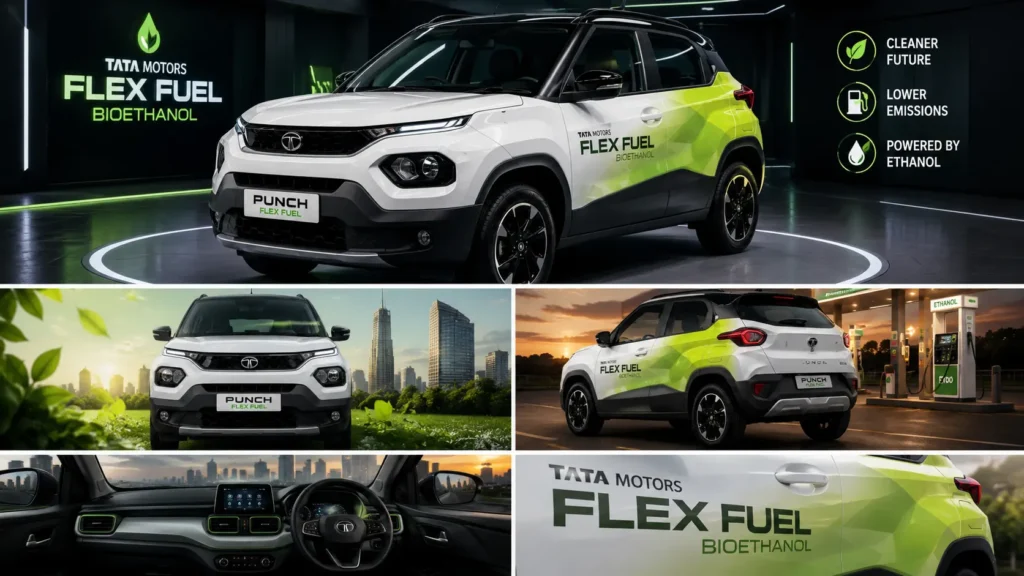
Tata Motors Preparing First Flex-Fuel Car for India, Punch Could Lead the Lineup
Tata Motors is preparing to enter India’s growing flex-fuel vehicle segment as the company plans to launch its first flex-fuel passenger vehicle by the end of 2026 or early 2027. The move comes amid the Indian government’s aggressive push toward higher ethanol blending in fuels and reduced dependence on imported crude oil. Reports strongly suggest that the Tata Punch Flex Fuel could become the brand’s first flex-fuel model for the Indian market. Tata Motors had already showcased the Punch Flex Fuel concept at the Bharat Mobility Expo 2025, giving a clear indication of the company’s future direction in alternative fuel technology.
The showcased Punch Flex Fuel was capable of running on ethanol blends ranging from E20 up to E100, making it one of the most advanced flex-fuel concepts displayed by an Indian manufacturer. The compact SUV used the familiar 1.2-litre naturally aspirated petrol engine but received several modifications to support higher ethanol compatibility. According to reports, Tata Motors updated the ECU software, fuel injection system, and exhaust after-treatment setup to allow the engine to automatically adapt to varying ethanol blends. This would enable the vehicle to run efficiently on different fuel mixtures depending on availability.

Also Read: Tata Sales March 2026 Revealed – Punch, Nexon Lead but This One Car Surprises Everyone
Tata Motors Passenger Vehicles Managing Director and CEO Shailesh Chandra recently confirmed that the company is technologically ready for flex-fuel products and expects at least one model to be market-ready by the end of this year or early next year. The development aligns closely with the Indian government’s broader ethanol strategy. India has already achieved nationwide E20 fuel availability ahead of schedule, and policymakers are now preparing regulations for higher blends such as E85 and E100.
Flex-fuel vehicles are designed to operate on petrol blended with varying levels of ethanol. Ethanol is considered a cleaner-burning fuel because it is produced from plant-based agricultural sources like sugarcane and corn. The government believes higher ethanol adoption could help reduce fuel imports, lower emissions, and strengthen India’s energy security. For Tata Motors, flex-fuel technology represents another important pillar in its broader alternative mobility strategy. While the company has heavily focused on EVs in recent years through models like the Nexon EV, Punch EV, Tiago EV, and Curvv EV, it now appears ready to diversify further into hybrid and flex-fuel technologies as well.
The Punch has emerged as the strongest candidate for Tata’s first flex-fuel vehicle because the SUV already enjoys strong popularity in India’s compact SUV segment. The model is currently available with petrol, CNG, and electric powertrain options, making flex-fuel technology a natural next addition to the lineup. The compact SUV’s relatively affordable pricing and mass-market positioning could also help Tata introduce flex-fuel technology to a much broader audience. If launched aggressively, the Punch Flex Fuel could become one of India’s first mainstream flex-fuel SUVs.

Also Read: BYD Atto 1 Price in India – 380KM Range EV That Could Beat Tata Punch EV
Industry reports indicate that multiple Indian manufacturers are now accelerating flex-fuel development ahead of upcoming CAFE 3 regulations expected in 2027. These new efficiency norms may provide flex-fuel vehicles regulatory advantages similar to electrified powertrains. This has pushed companies like Maruti Suzuki, Hyundai, Mahindra, Toyota, and Tata Motors to intensify work on ethanol-compatible vehicles. Tata’s decision to move toward flex-fuel technology therefore reflects a much larger transformation taking place across the Indian automotive industry.
One major advantage of flex-fuel vehicles is that they do not require major charging infrastructure like EVs. Buyers can continue using traditional fuel stations while benefiting from cleaner fuel alternatives and potentially lower fuel costs. However, flex-fuel vehicles also face challenges. Higher ethanol blends can sometimes result in reduced fuel efficiency compared to regular petrol. Manufacturers therefore need to optimize engines carefully to balance performance, drivability, and efficiency.
Despite these challenges, the Indian government continues supporting ethanol adoption aggressively. The country aims to significantly increase ethanol blending percentages over the next few years, creating a strong long-term opportunity for flex-fuel vehicles. Tata Motors appears well-positioned to capitalize on this shift because of its experience across multiple alternative fuel technologies including EVs, CNG, and commercial flex-fuel vehicles. Apart from the Punch, future Tata flex-fuel technology could eventually expand to additional SUVs and passenger vehicles depending on market response and government policy support.
The next few years are therefore expected to become extremely important for India’s flex-fuel vehicle market. While EVs continue growing steadily, flex-fuel technology may emerge as another major pathway toward cleaner mobility in the country. If Tata Motors successfully launches the Punch Flex Fuel by 2026–2027, it could become one of the first mainstream Indian automakers to bring advanced ethanol-compatible SUVs to mass-market buyers.
Stay tuned to MotorMitra for more exclusive deep dives into the world of Indian automotive excellence!