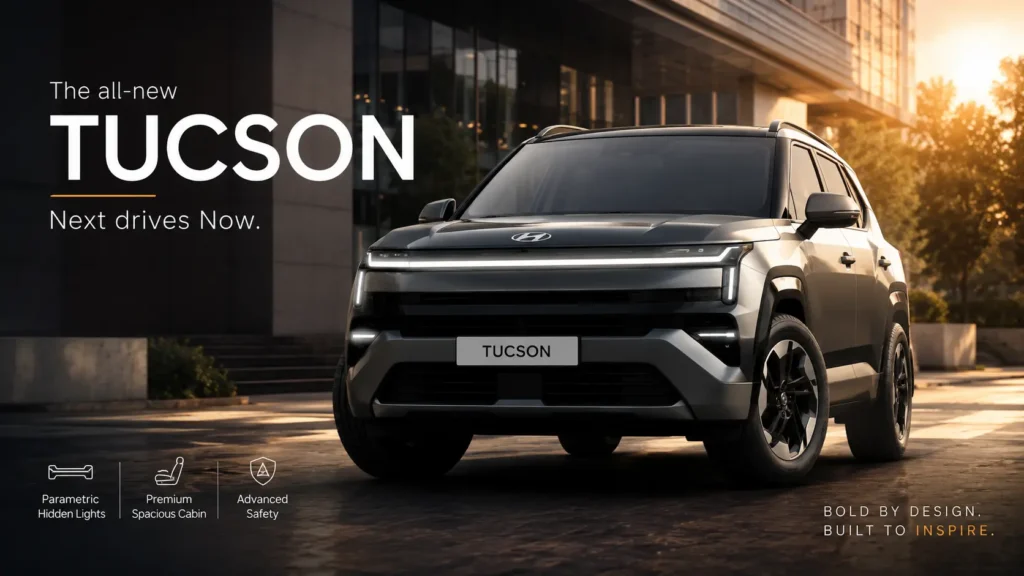
Hyundai has pulled the covers off the fifth-generation Tucson — and it looks nothing like the one it replaces. Gone are the flowing parametric lines and the jewel-like grille. In their place sits a squared-off, upright, unapologetically boxy SUV that looks like it was designed with a ruler and a purpose. The 2027 Hyundai Tucson is bigger in every direction, packed with new tech, and built to take on the Toyota RAV4, Honda CR-V, and everything else in the mid-size SUV space.
The new Tucson was revealed on 19 August 2026 and is set to go on sale in South Korea later this year, with global markets — including potentially India — expected to follow in 2027.
Design — The Curves Are Dead
Let’s address the elephant in the room. The fourth-gen Tucson was polarising — people either loved its sharp, angular design or found it too busy. Hyundai has clearly listened to the latter camp. The 2027 Tucson adopts what Hyundai calls its “Art of Steel” design language, and the result is a radical departure from everything the Tucson has been for the past five years.
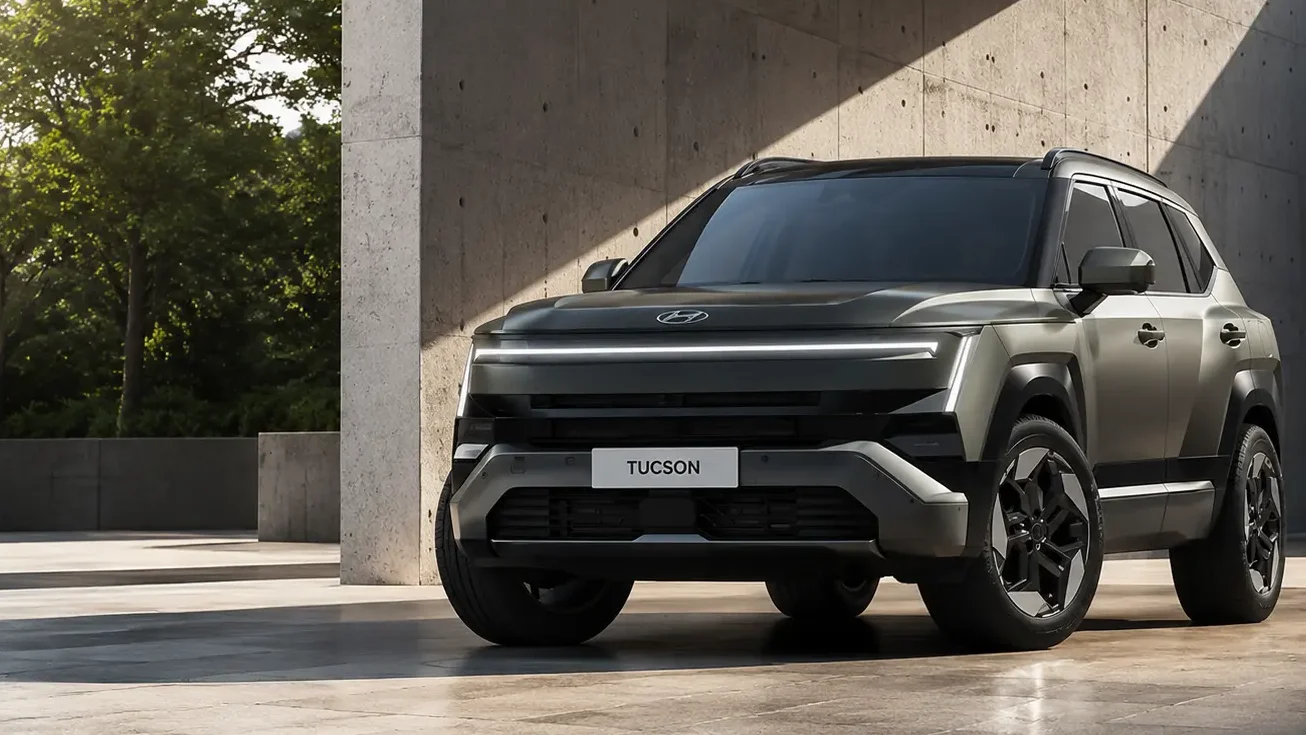
The front end is flat, upright, and dominated by a full-width LED light bar that stretches across the entire face of the SUV. Below it, vertically stacked LED strips flank the grille, while a pair of boxy headlamps sit lower on the bumper. The overall effect is imposing — this thing looks wider, taller, and more planted than before, even standing still.
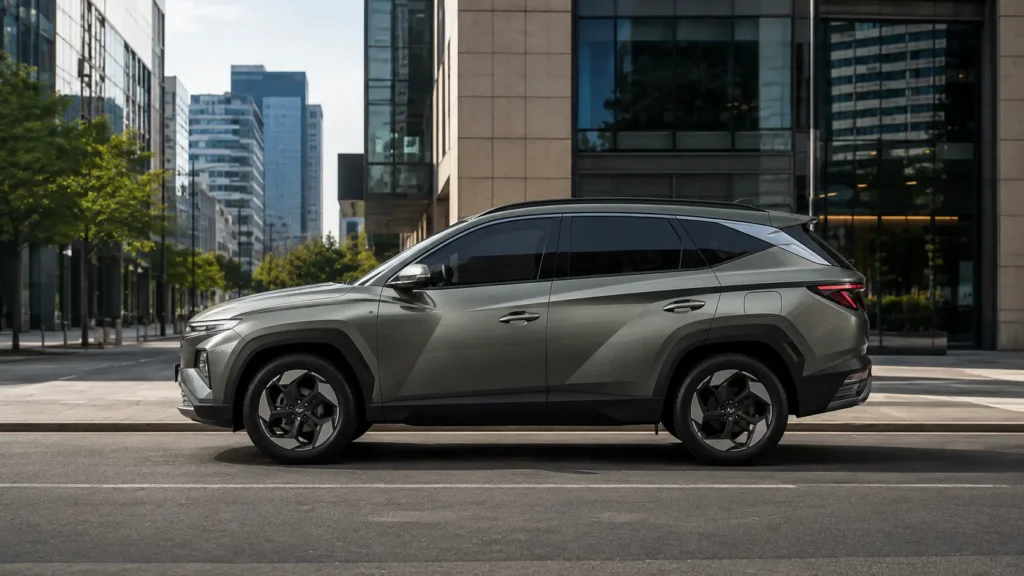
From the side, the Tucson has a more upright greenhouse, larger quarter glass panels, and a roofline that doesn’t taper as aggressively as before. The wheel arches are squared off, the shoulder line is high and flat, and the proportions scream ruggedness without resorting to fake off-road cladding.
At the rear, a matching full-width LED light bar ties the design together. The tailgate is more vertical, the bumper is heavily sculpted, and the overall stance is wide and confident. It’s a look that says “I belong on a mountain trail” just as convincingly as it says “I own this parking lot.”
Read Also:https://motormitra.in/chery-exeed-lepas-fulwin-patents-india/
Dimensions — Bigger in Every Way
The numbers confirm what your eyes already tell you. The 2027 Tucson has grown in every dimension:
- Length: 4,700mm (+60mm over outgoing model)
- Width: 1,905mm (+40mm)
- Height: 1,685mm (+20mm)
- Wheelbase: 2,785mm (+30mm)
That extra 30mm in the wheelbase translates directly to more legroom for rear-seat passengers. Hyundai has also increased rear-seat headroom by 29mm thanks to the taller roofline, and the rear doors now open to 83 degrees — up from 73 degrees on the outgoing model. Getting kids in car seats or loading bulky items just got significantly easier.
This is no longer a compact SUV trying to punch above its weight. The 2027 Tucson is firmly mid-size territory, and its dimensions put it right in the crosshairs of the Toyota RAV4, Mazda CX-5, and even some models a segment above.
Interior — Clean, Modern, and Refreshingly Physical
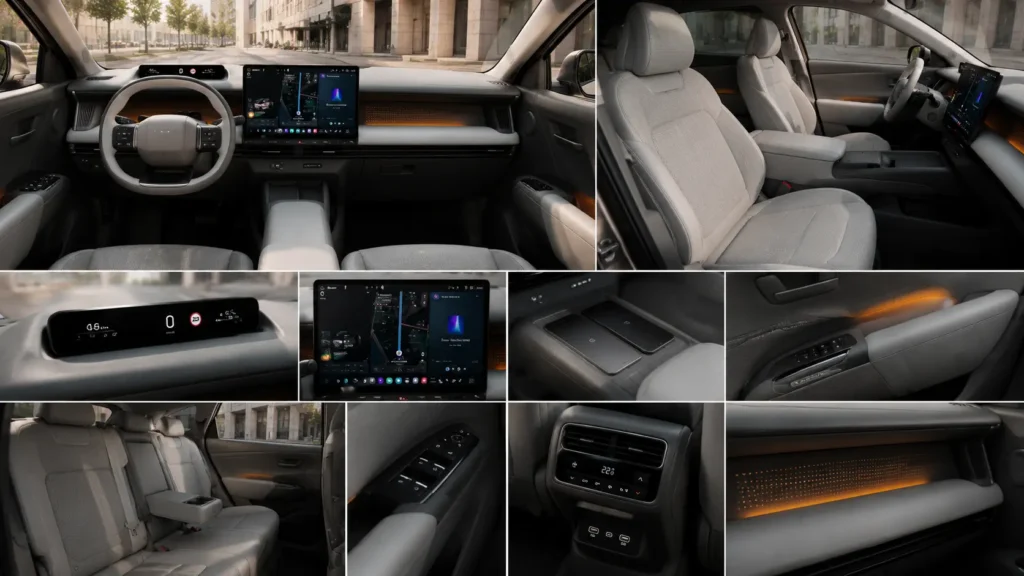
The cabin is where the biggest generational leap happens. Hyundai has ditched the dual 12.3-inch screen setup of the outgoing Tucson in favour of a completely new layout centred around its Pleos Connect infotainment system.
The dashboard is dominated by a large central touchscreen — reports suggest it could be as large as 14.6 to 17 inches — positioned high on the dash for easy visibility. Below it sits a row of physical controls for climate and key functions. This is a deliberate choice by Hyundai, and a welcome one. In an era where every manufacturer is burying basic controls behind touchscreen menus, Hyundai has kept buttons and knobs where they belong — within easy reach while driving.
The driver gets a slim, horizontal instrument display that sits prominently ahead of the steering wheel. The steering wheel itself is a new two-spoke design, giving the cabin a more modern, minimalist feel.
Other interior highlights include:
- Ambient lighting throughout the cabin
- Perforated leather upholstery
- Wood-effect trim inserts
- Dual wireless charging pads
- Redesigned centre console
- Flat-bottom steering wheel
- Improved material quality across touchpoints
The overall vibe is premium without being pretentious. It feels like a cabin designed for people who actually drive their cars, not for Instagram photoshoots.
XRT Variant — For Those Who Want More Ruggedness
For the first time, the Tucson gets a dedicated XRT (eXtreme Road Trip) variant. This isn’t just a cosmetic package — it’s a distinct trim aimed at buyers who want their SUV to look like it can handle more than school runs and mall parking.
The XRT gets:
- Unique front and rear bumper designs with integrated skid plates
- Black body cladding around the wheel arches and lower body
- Exclusive alloy wheel design
- Rugged exterior accents
- Differentiated interior trim
Think of it as Hyundai’s answer to the Toyota RAV4 Adventure or the Subaru Outback Wilderness — an SUV that looks trail-ready without needing a separate off-road variant.
Pleos Connect — Hyundai’s Next-Gen Infotainment
The Pleos Connect system is Hyundai’s newest infotainment platform, and the Tucson is one of the first vehicles to get it. While full details haven’t been revealed yet, here’s what we know:
- Large central touchscreen (likely 14.6–17 inches)
- Over-the-air (OTA) update capability
- Integrated connected car services
- Improved voice recognition
- Seamless smartphone integration
- Navigation with real-time traffic
This system is expected to become the backbone of Hyundai’s infotainment strategy going forward, and its influence will likely trickle down to models like the next-generation Creta and Venue in India.
Powertrain — Still Under Wraps
Here’s the one area where Hyundai is keeping its cards close. The company has not officially revealed powertrain details for the 2027 Tucson. However, based on the outgoing model’s lineup and industry expectations, the new Tucson is likely to offer:
- 1.6-litre T-GDi turbo-petrol (likely with mild-hybrid 48V tech)
- 1.6-litre T-GDi Hybrid (HEV) — combining turbo-petrol with an electric motor for ~230 PS
- 1.6-litre T-GDi Plug-in Hybrid (PHEV) — ~265 PS with electric-only range
- 2.0-litre diesel — for markets that still demand oil-burners (including India)
Both front-wheel drive and all-wheel drive configurations are expected, with transmission options likely including a 7-speed DCT and a 6-speed automatic depending on the powertrain.
Hyundai is expected to confirm full specifications closer to the Korean market launch later this year.
India Launch — Will It Come?
This is the big question. Hyundai discontinued the fourth-gen Tucson in India in November 2025 due to poor sales. The SUV struggled against more affordable competition and never found its footing in a market dominated by sub-₹20 lakh SUVs.
However, the new-generation Tucson’s larger dimensions, bolder design, and potential hybrid powertrain could give Hyundai a reason to bring it back. If priced competitively — in the ₹29–36 lakh range — and offered with a strong hybrid option, the 2027 Tucson could carve out a niche among buyers looking for something more premium than a Creta but less expensive than a full-size luxury SUV.
Hyundai India has not confirmed the new Tucson for the Indian market yet. But given the brand’s push towards premiumisation and the growing appetite for hybrid SUVs in India, a 2027 or early 2028 launch isn’t out of the question.
Rivals
- Toyota RAV4
- Honda CR-V
- Mazda CX-5
- Kia Sportage
- Volkswagen Tiguan
- Jeep Compass (in India)
- Citroen C5 Aircross
Verdict
The 2027 Hyundai Tucson is a statement of intent. It’s bigger, bolder, and more technologically advanced than anything Hyundai has put in this segment before. The boxy design will divide opinion — but that’s exactly what good design should do. It takes a stand. And in a sea of soft, rounded crossovers that all look the same, the new Tucson stands out like a clenched fist.
Whether it comes to India or not, this is the SUV that resets expectations for what a mid-size crossover should look, feel, and deliver. Hyundai isn’t playing safe anymore — and that’s exactly what this segment needed.
FAQs — 2027 Hyundai Tucson.
Q1. When will the 2027 Hyundai Tucson launch?
The 2027 Hyundai Tucson will go on sale in South Korea later in 2026. Global markets, including Europe, North America, and potentially India, are expected to get the new Tucson in 2027.
Q2. What is the expected price of the 2027 Hyundai Tucson in India?
While Hyundai hasn’t confirmed India pricing, the new Tucson is expected to fall in the ₹29–36 lakh (ex-showroom) range if launched, based on the outgoing model’s positioning and the added tech and size.
Q3. How big is the new 2027 Hyundai Tucson?
The 2027 Tucson measures 4,700mm in length, 1,905mm in width, and 1,685mm in height, with a wheelbase of 2,785mm. It’s 60mm longer, 40mm wider, and 20mm taller than the model it replaces.
Q4. What is the Hyundai Pleos Connect system?
Pleos Connect is Hyundai’s next-generation infotainment platform debuting in the 2027 Tucson. It features a large central touchscreen (up to 17 inches), OTA updates, connected car services, and improved voice recognition. It replaces the dual 12.3-inch screen setup of the previous model.
Q5. What is the Hyundai Tucson XRT variant?
The XRT (eXtreme Road Trip) is a new rugged variant of the Tucson featuring skid plates, black body cladding, exclusive alloy wheels, and a more adventure-oriented design. It’s aimed at buyers who want outdoor-lifestyle aesthetics without going full off-road.
Q6. What engine options will the 2027 Tucson get?
Hyundai hasn’t officially confirmed powertrains yet, but the new Tucson is expected to offer a 1.6-litre turbo-petrol (with mild-hybrid), a 1.6-litre full hybrid (HEV), a plug-in hybrid (PHEV), and a 2.0-litre diesel for select markets. Both FWD and AWD will likely be available.
Q7. Will the 2027 Hyundai Tucson come to India?
Hyundai has not confirmed the new Tucson for India yet. The previous generation was discontinued in November 2025 due to slow sales. However, the new model’s larger size, bolder design, and hybrid options could make a case for its return in 2027 or 2028.
Q8. How is the 2027 Tucson different from the outgoing model?
The 2027 Tucson is a ground-up redesign. It’s bigger in every dimension, adopts a boxy “Art of Steel” design language (replacing the parametric look), gets a completely new interior with the Pleos infotainment system, offers an XRT rugged variant for the first time, and provides significantly more rear-seat space with 29mm extra headroom and wider-opening doors.
Q9. What are the rivals of the 2027 Hyundai Tucson?
The new Tucson competes with the Toyota RAV4, Honda CR-V, Mazda CX-5, Kia Sportage, Volkswagen Tiguan, and Jeep Compass. In India, it would also face the Citroen C5 Aircross and the MG Gloster in terms of pricing.
Q10. Does the 2027 Tucson have a hybrid option?
Yes, the new Tucson is expected to offer both a full hybrid (HEV) and a plug-in hybrid (PHEV) option globally. The 1.6-litre T-GDi hybrid produces around 230 PS, while the PHEV delivers approximately 265 PS with electric-only driving range.
Q11. What safety features does the 2027 Hyundai Tucson get?
While the full safety spec sheet hasn’t been revealed, the new Tucson is expected to carry forward and improve upon the outgoing model’s ADAS suite, which includes forward collision avoidance, lane keeping assist, blind spot monitoring, rear cross-traffic alert, adaptive cruise control, and driver attention warning.
Q12. Is the 2027 Tucson bigger than the Hyundai Creta?
Significantly. The 2027 Tucson is 4,700mm long with a 2,785mm wheelbase — that’s nearly 400mm longer and over 100mm more in wheelbase than the Creta. It sits a full segment above the Creta in terms of size, space, and positioning.
For more such updates on latest cars, bikes and EVs stay connected to MotorMitra. #gaadiyonkismartguide.