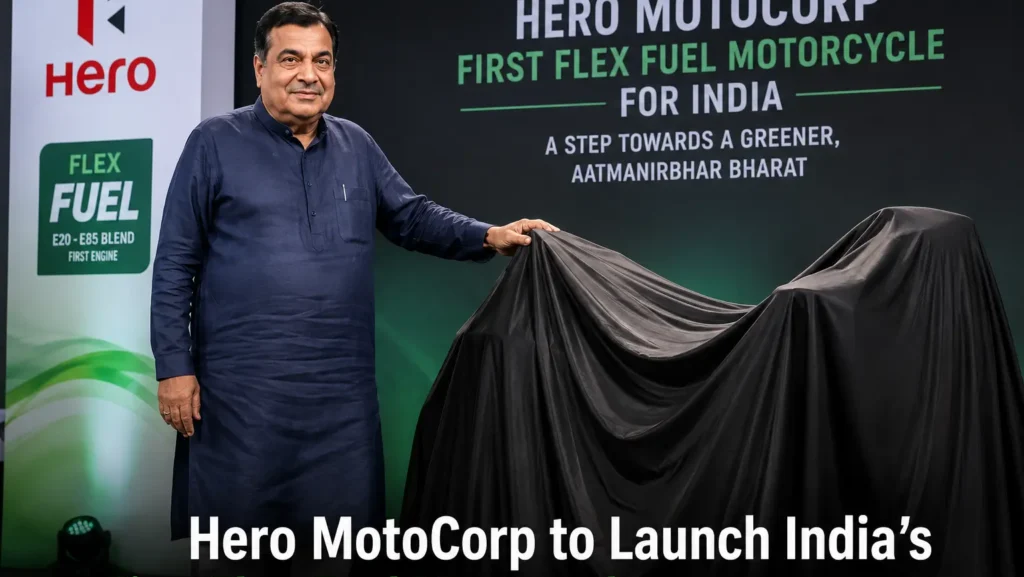
The Indian two-wheeler landscape is on the cusp of a significant ecological and engineering paradigm shift. While the industry has been heavily focused on battery electric vehicles (EVs) over the last few years, alternative fuel technologies are quietly emerging as a practical, parallel pathway toward reducing carbon emissions. Leading this charge from the front, India’s largest two-wheeler manufacturer, Hero MotoCorp, is all set to officially launch its very first flex-fuel powered motorcycle in the Indian market on June 3.
This launch marks a crucial milestone for the Indian automotive sector, making Hero MotoCorp one of the first legacy manufacturers to commercially introduce a mass-market flex-fuel motorcycle. The move aligns seamlessly with the Indian government’s stringent mandates to promote ethanol-blended fuels, aiming to curb crude oil imports and drastically lower vehicular exhaust emissions.
Understanding Flex-Fuel Mechanism
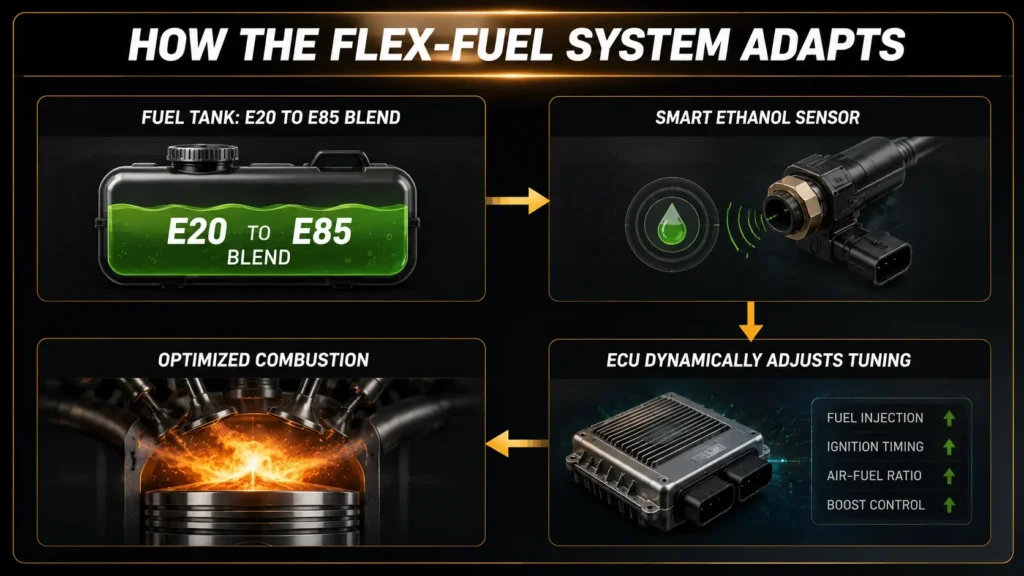
To grasp the significance of this launch, one must understand what happens under the fuel tank of a flex-fuel vehicle (FFV). Unlike standard internal combustion engines that are optimized to run strictly on pure petrol or low-percentage ethanol blends (like E10 or E20), a flex-fuel engine is heavily re-engineered.
Hero’s upcoming motorcycle will feature a highly advanced Flex-Fuel Engine capable of running on a wide range of ethanol-petrol blends, scaling all the way from E20 (20% ethanol, 80% petrol) right up to E85 (85% ethanol, 15% petrol). To achieve this, Hero’s R&D department has upgraded the engine with specialized, corrosion-resistant fuel lines, redesigned valve seats, modified fuel injectors, and a smart Engine Control Unit (ECU). The ECU utilizes an ethanol sensor to dynamically detect the blend ratio in real-time and automatically adjust the ignition timing and fuel injection mapping for optimum performance.
While Hero MotoCorp has kept the exact model name under wraps ahead of the June 3 event, industry insiders and automotive analysts strongly hint at the utilization of a proven, mass-market commuter platform.
Also Read:Hero Splendor XTEC 2.0 Could Become India’s Biggest 125cc Surprise Of 2026
The most likely candidate to receive this green powertrain is a derivative of Hero’s highly successful 125cc segment (such as the Glamour or Super Splendor framework) or a specialized version of the premium Hero Glamour XTEC. At the Auto Expo, Hero showcased a prototype close to this displacement class developed specifically for flex-fuel compatibility. Utilizing a commuter platform is a highly strategic move; it targets the highest-volume selling segment in India, ensuring that the environmental benefits of ethanol blending reach the masses rather than being limited to a premium niche.
The Economic & Environmental Advantages
The commercialization of a flex-fuel motorcycle brings forward a dual-benefit narrative for both the country’s economy and the end consumer’s wallet.
- Lower Running Costs: Ethanol is domestically produced from sugarcane molasses, agricultural waste, and surplus food grains. Because it is homegrown, it is significantly cheaper than imported fossil fuels. Consumers can expect a notable drop in fuel bills per liter when fueling up with higher ethanol blends.
- Drastic Emission Reduction: Running a motorcycle on E85 dramatically cuts down tailpipe emissions. Carbon Monoxide (CO), Hydrocarbons (HC), and Oxides of Nitrogen (NOx) are heavily reduced compared to conventional petrol, paving the way for cleaner urban air quality.
- Support for the Rural Economy: By shifting fuel dependency toward agricultural output, the flex-fuel ecosystem directly funnels capital back into the Indian farming community and local biorefineries.
Infrastructure Challenges
While the technology is undeniably revolutionary, the real-world success of Hero’s new flex-fuel motorcycle will rely heavily on external factors. The primary hurdle is the availability of high-blend ethanol fuel infrastructure. While the government has rapidly expanded E20 fuel availability across thousands of fuel stations nationwide, the retail availability of E100 or E85 dispensing pumps remains in its infancy and is currently limited to select experimental pockets.
Furthermore, ethanol inherently possesses a lower energy density than pure petrol. This means that while running on higher blends like E85, riders might experience a marginal drop of 5% to 10% in overall fuel efficiency (mileage). However, this drop in mileage is expected to be financially offset by the lower cost per liter of ethanol fuel.
Market Impact
Hero MotoCorp’s June 3 launch is a bold declaration of intent. It proves that the future of mobility in India is not a singular race toward electrification, but a mosaic of multiple clean technologies working in tandem.
By delivering an affordable, reliable, and technologically advanced flex-fuel motorcycle, Hero is placing itself ahead of the curve, beating out key rivals who are still in the testing phases of their respective alternative-fuel portfolios. If the pricing is kept competitive—matching or sitting slightly above its standard petrol counterparts—Hero’s flex-fuel bike could very well write the opening chapter of a brand-new green revolution on Indian roads.