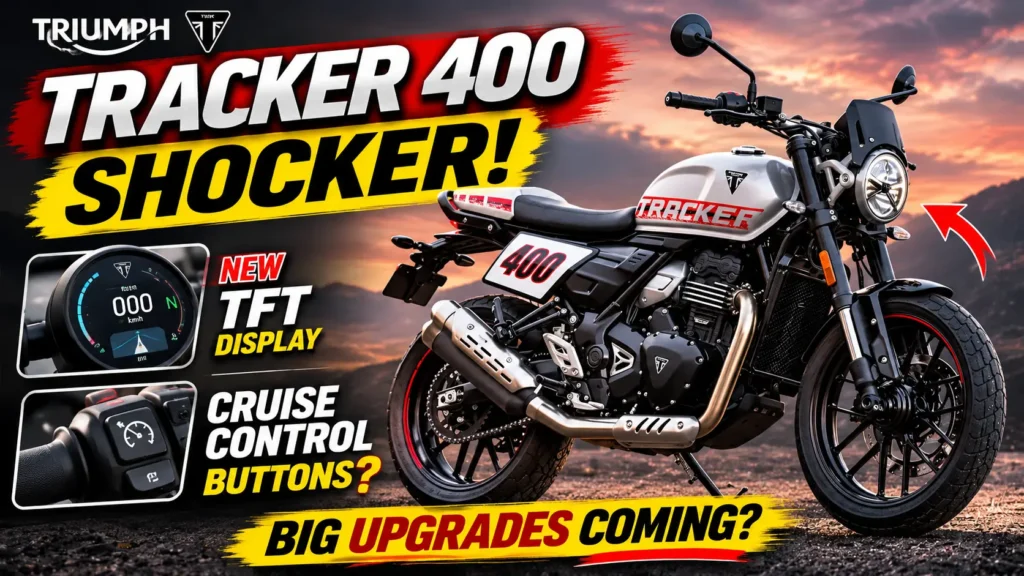
Triumph’s Tracker 400 has barely settled into the Indian market, and the company already appears to be preparing a major technology upgrade. A recently spotted test motorcycle has revealed a new circular TFT display, redesigned handlebar controls and adjustable levers. But the detail generating the most excitement is the possibility of cruise control, a feature that could make this flat-track-inspired roadster considerably more appealing.
The timing is interesting. Triumph introduced the Tracker 400 in India earlier this year with distinctive styling, a lively single-cylinder engine and relatively straightforward electronics. Now, technology first seen on the Bonneville T40 appears to be making its way into other motorcycles in the company’s lineup.
Nothing has been officially announced for the updated Tracker yet. Still, the latest spy shots offer enough clues to suggest that Triumph wants to make its 400 range more competitive without changing what makes each motorcycle special.
1. New 4-Inch TFT Display: The Upgrade Riders Have Been Waiting For
The clearest change on the test motorcycle is a new 4-inch circular colour TFT instrument cluster. It appears similar to the display introduced on the Bonneville T40, replacing the analogue-digital setup currently offered on the Tracker 400.
That matters because the existing dashboard, although perfectly suited to the motorcycle’s retro styling, lacks the visual appeal and functionality offered by some newer rivals. A modern TFT could make the Tracker feel noticeably more premium every time the rider turns on the ignition.
The Bonneville T40’s display supports smartphone connectivity, navigation and connected functions such as call and music controls. If Triumph transfers the same software package to the Tracker, riders could gain access to more useful information without relying heavily on a separate phone mount.
Also Read:- New Royal Enfield Himalayan 750 First Ride: 55BHP Power, 5 Big Upgrades That Could Change Everything!
Full-map navigation would be particularly welcome. For someone using the motorcycle on unfamiliar roads, having route information displayed directly on the instrument cluster could improve convenience.
However, the test images confirm the presence of the new screen, not every software function that will be available on the production motorcycle. Triumph may choose a different feature package depending on the variant or final pricing.
The circular shape is another clever decision. It allows Triumph to introduce modern technology while preserving the classic appearance that makes the Tracker stand out.
2. Cruise Control and Riding Modes: A Much Bigger Technology Leap?
The most intriguing detail is the redesigned switchgear. The test bike features controls resembling those used on the Bonneville T40, including a directional navigation pad and buttons that some reports associate with cruise control.
That has immediately raised expectations that the updated Tracker could receive cruise control and selectable riding modes.
Cruise control would be a meaningful addition for riders who regularly travel on highways. Maintaining a selected cruising speed without continuously holding the throttle can reduce wrist fatigue on longer journeys, especially on open stretches of road.
Selectable riding modes could also improve versatility. Different throttle-response settings would allow Triumph to tailor the motorcycle’s behaviour for varying riding conditions, although the exact modes remain unknown.
There is an important catch. While several reports identify cruise-control-related buttons in the spy images, others say the controls are not sufficiently clear to confirm the feature. Triumph has not officially announced cruise control, riding modes or the complete electronics package for the updated Tracker.
Features such as cornering ABS and advanced traction control have also been discussed because of their presence on the Bonneville T40. Their inclusion on the Tracker remains speculative.
The potential is exciting, but buyers should wait for Triumph’s production specifications before treating these technologies as standard equipment.
3. Adjustable Levers and Better Switchgear Could Improve Everyday Riding
Not every useful upgrade needs to be dramatic. The test motorcycle also appears to feature adjustable brake and clutch levers, something the current Tracker does not offer.
Adjustable levers allow riders to change the distance between the lever and handlebar grip. For people with smaller hands or different riding preferences, that can make the controls more comfortable and easier to operate.
It is the kind of detail that often goes unnoticed in a specification comparison but becomes valuable during daily commuting.
The redesigned left-hand switchgear is another practical improvement. A directional pad should make navigating the TFT menus easier than relying on basic buttons, particularly if the display receives additional connectivity and riding functions.
These changes could also help the Tracker feel more refined alongside premium motorcycles in the segment.
Of course, the final usability will depend on the production controls and software. A feature-rich display is only an advantage when its menus are clear and its buttons are easy to operate.
If Triumph gets that balance right, the updated Tracker could feel substantially more modern without needing an entirely new design.
4. Same 349cc Engine, Same Flat-Track Character?
Despite the technology-focused changes, the latest test motorcycle does not show any obvious mechanical redesign.
The current Indian Tracker 400 uses a 349cc, liquid-cooled, single-cylinder engine producing approximately 40PS at 8,750rpm and 32Nm at 7,500rpm. It is paired with a six-speed gearbox and an assist-and-slip clutch.
The displacement is worth highlighting because the Tracker carries a 400 badge. The Indian model uses a downsized 349cc engine, while the international version has a larger-capacity unit.
For the updated motorcycle, the existing engine configuration is expected to continue. There is no reliable indication of a major power increase or a new transmission.
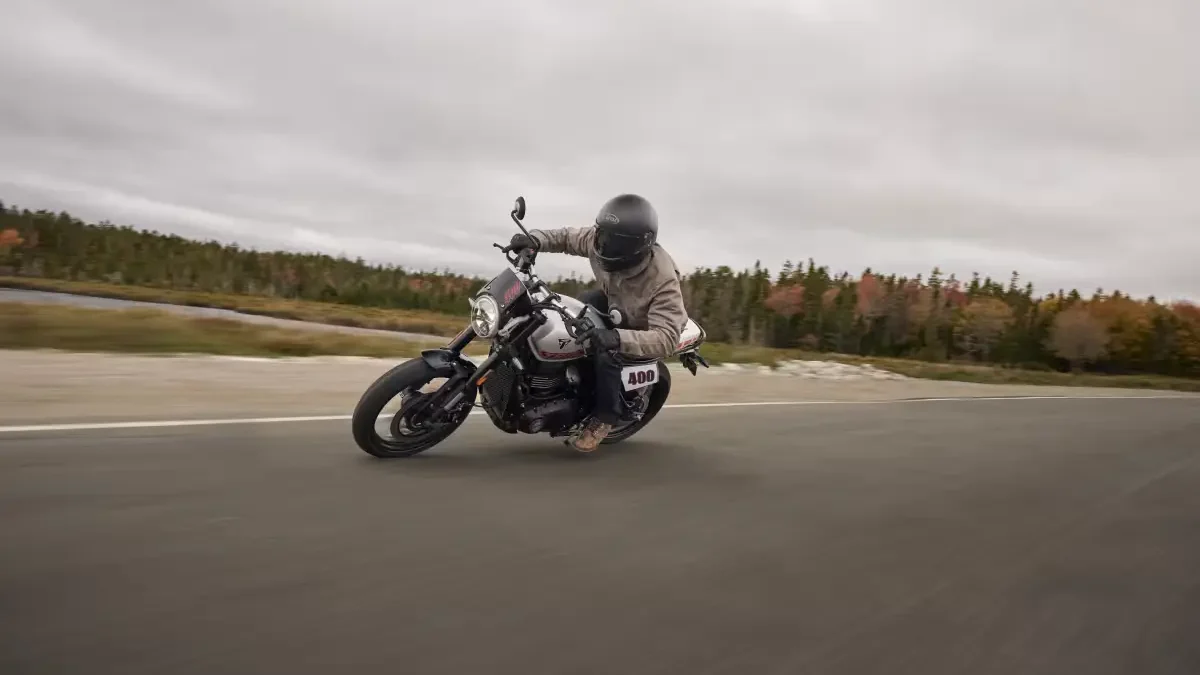
That may actually be the right approach. The Tracker’s personality comes from its sporty riding position, wide handlebar and flat-track-inspired styling rather than an overwhelming specification sheet.
Also Read:- New Royal Enfield GT 750 Revealed: 5 Big Changes That Put the GT 650 in the Spotlight!
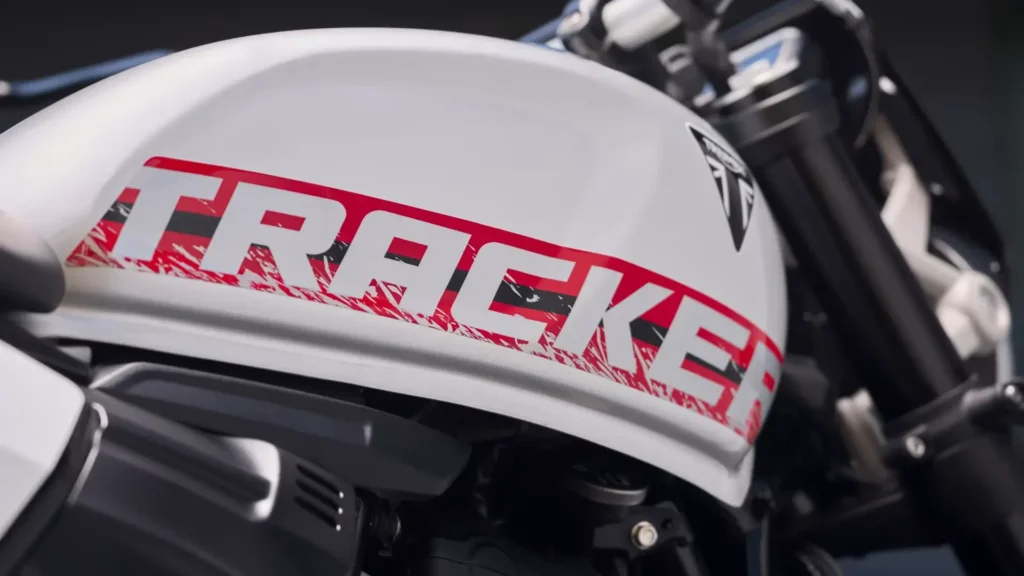
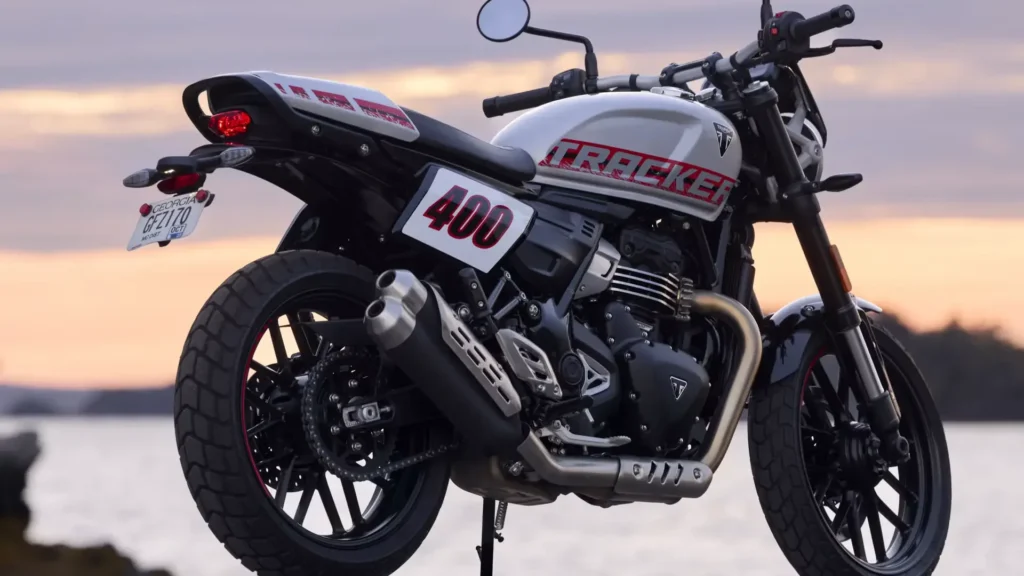
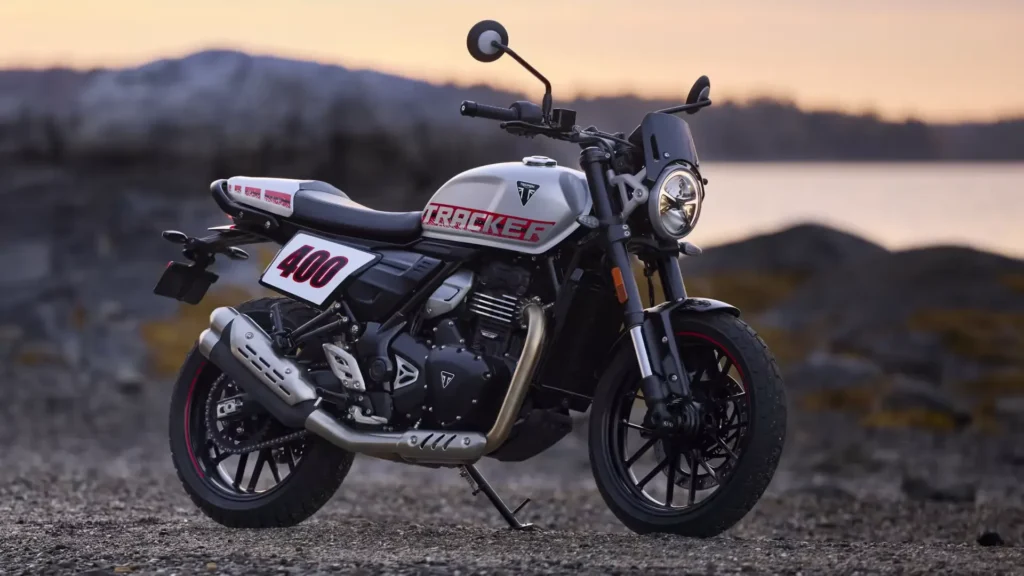
Its distinctive fuel tank, minimal bodywork and compact rear section help separate it from the Speed 400. The test motorcycle appears to retain these design elements.
The current model also uses 17-inch alloy wheels, an upside-down front fork, a rear monoshock and disc brakes at both ends. No major chassis or suspension changes are evident in the latest sightings.
This suggests Triumph is concentrating on making the Tracker smarter and more convenient rather than transforming it into a completely different motorcycle.
For existing owners, that distinction matters. The possible upgrade appears to focus on equipment and usability, not a dramatic change in performance.
5. India Launch and Price: Should You Buy Now or Wait?
The biggest unanswered questions concern the launch date and price.
The existing Triumph Tracker 400 has recently been listed at ₹2,43,069 ex-showroom, Delhi. That is a useful reference point, although dealership offers and pricing may change.
Adding a TFT display, revised controls and potentially more electronic features could increase the price of the updated model. How much more Triumph might charge remains unknown.
There is also no confirmed launch date. Reports have described the spotted motorcycle as a possible 2027 update, but Triumph has not announced when it will reach showrooms.
Another possibility is that the company could introduce the equipment through a higher-spec variant rather than replacing the existing model entirely. Again, no official variant strategy has been confirmed.
For buyers considering the Tracker right now, the decision comes down to priorities. If the motorcycle’s styling, engine and riding experience matter more than electronics, the existing model remains worth considering.
However, riders who specifically want a modern TFT display, connected navigation or possible cruise control may prefer to wait for the official announcement.
There is also a broader competitive angle. Motorcycles such as the Royal Enfield Guerrilla 450 have raised expectations around digital instrumentation and connectivity in this category. A technology update could help Triumph strengthen the Tracker’s appeal among feature-conscious buyers.
A Small Visual Change With Big Potential
The updated Triumph Tracker 400 could become one of the more interesting technology-focused upgrades in the brand’s Indian lineup.
The new circular TFT display is the strongest evidence of change, while the revised switchgear and adjustable levers suggest improvements to everyday usability. Cruise control and riding modes remain exciting possibilities, but their inclusion has not been confirmed.
Importantly, the motorcycle appears set to retain the same 349cc engine and distinctive flat-track styling. That means the update could add convenience without sacrificing the character that makes the Tracker different.
The real test will be the final equipment list and price. If Triumph manages to deliver meaningful technology upgrades without making the motorcycle significantly more expensive, the Tracker 400 could become a much more attractive choice.
Until Triumph reveals the production model, the message from the spy shots is simple: the Tracker 400 may be getting smarter, and its biggest surprise could still be ahead.