For the pragmatic Indian family, buying a 110cc scooter is less about raw emotion and more about cold, hard mathematics. It is a balancing act where three metrics dictate the final handshake: How much does it cost? How far will it go on a litre of petrol? And which version fits my daily needs?
When TVS gave the Jupiter 110 its ground-up tactical overhaul, they didn’t just change the bodywork; they recalibrated this exact value equation. For an authentic journalistic look at the true cost of ownership, let’s break down the critical trifecta: Price, Mileage, and Variants.
The Cost of Entry: Variant-Wise Pricing
TVS has played a highly calculated laddering game with the pricing of the Jupiter 110. Instead of forcing buyers to pay a premium for features they might never use, the scooter is spread across five distinct tiers.
Here is the official ex-showroom (Delhi) price roadmap for the lineup:
Variant Name
Core Feature Profile
Ex-Showroom Price (Delhi)
Jupiter Drum
Steel wheels, analogue console, pure utilitarian base
₹73,550
Jupiter Drum Alloy
Adds sleek alloy wheels, retains analogue layout
₹79,025
SmartXonnect Drum (SXC)
Digital dash, Bluetooth navigation, iGO Hybrid Assist
₹83,175
SmartXonnect Disc (SXC)
Adds a 220mm front disc brake for sharper stopping
₹85,775
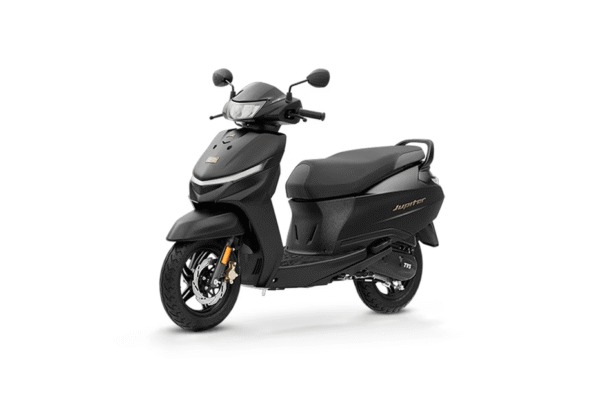
Special Edition
Stardust Black paint scheme, bronze accents, premium styling
₹88,050
⚠️ Journalist’s Note on On-Road Costs: While the entry ticket looks highly competitive at ₹73.5k, remember that regional RTO taxes, comprehensive insurance, mandatory registration, and handling charges will push the actual on-road cost roughly ₹12,000 to ₹16,000 higher depending on your city.The Palette of Practicality: Decoding the TVS Jupiter 110’s Colour Strategy
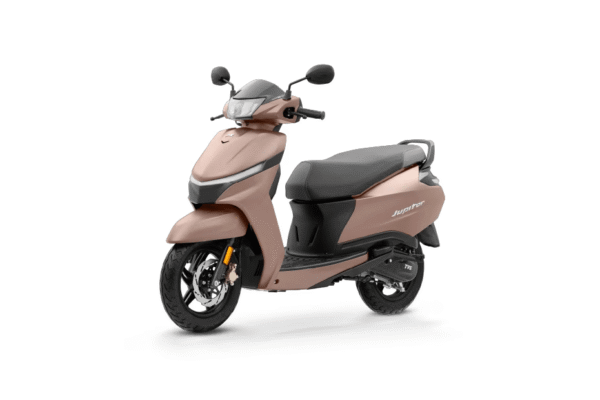
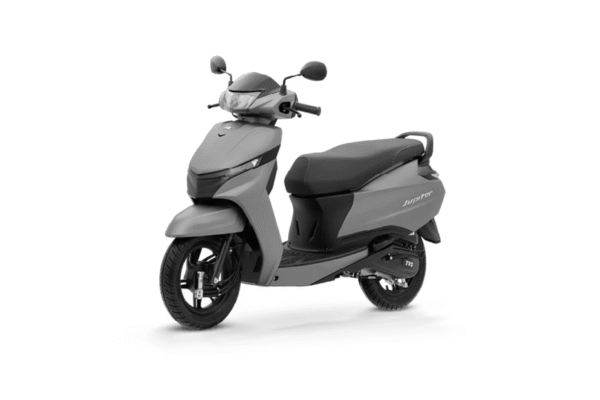
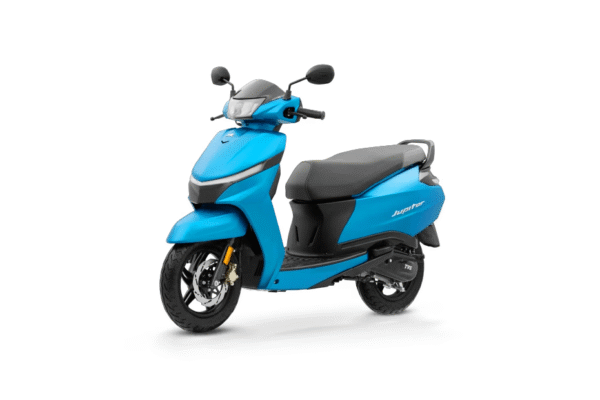
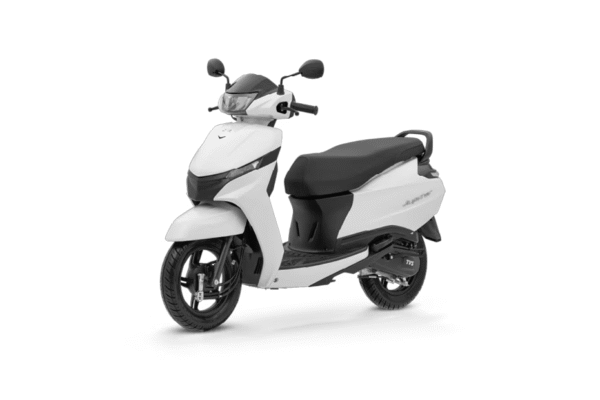
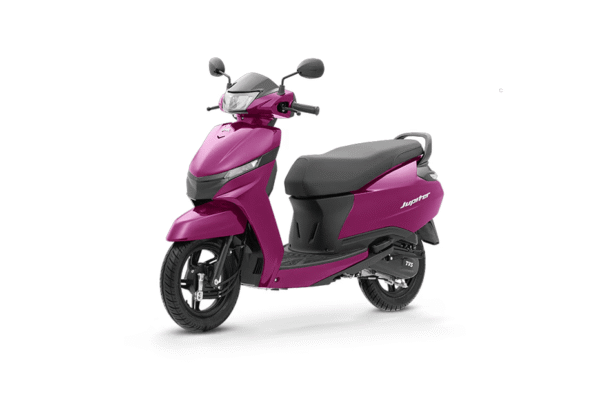
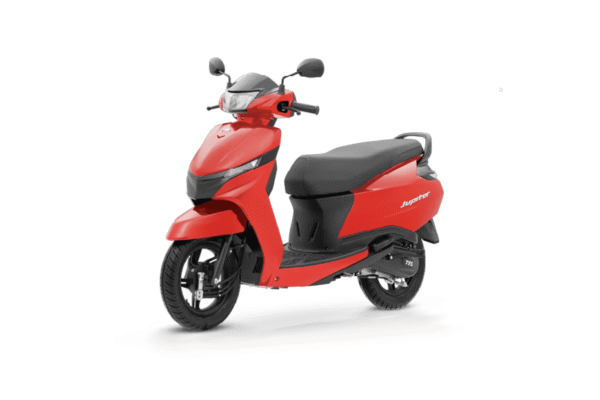
In the world of mass-market commuters, paint isn’t just a cosmetic choice—it is a critical tool for visual differentiation. When TVS completely re-engineered its bestselling Jupiter 110, they didn’t just focus on the clever under-floor fuel tank or the iGO assist hybrid engine. They rolled out a highly strategic, 8-shade color palette specifically mapped to the scooter’s individual variants.
As automotive journalists, we look past the basic brochure sheets to understand why certain finishes exist. TVS has played a clever game here, dividing their lineup into understated workhorses, high-tech flagships, and a sinister dark edition.
Here is our definitive journalistic guide to the TVS Jupiter 110’s color lineup, breaking down every finish and the exact variants they belong to.
TVS Jupiter 110 Colour Matrix
TVS doesn’t offer every color on every trim level. The color options scale strictly alongside your budget and variant choices.
Colour Name
Finish Type
Character Profile
Available On Variants
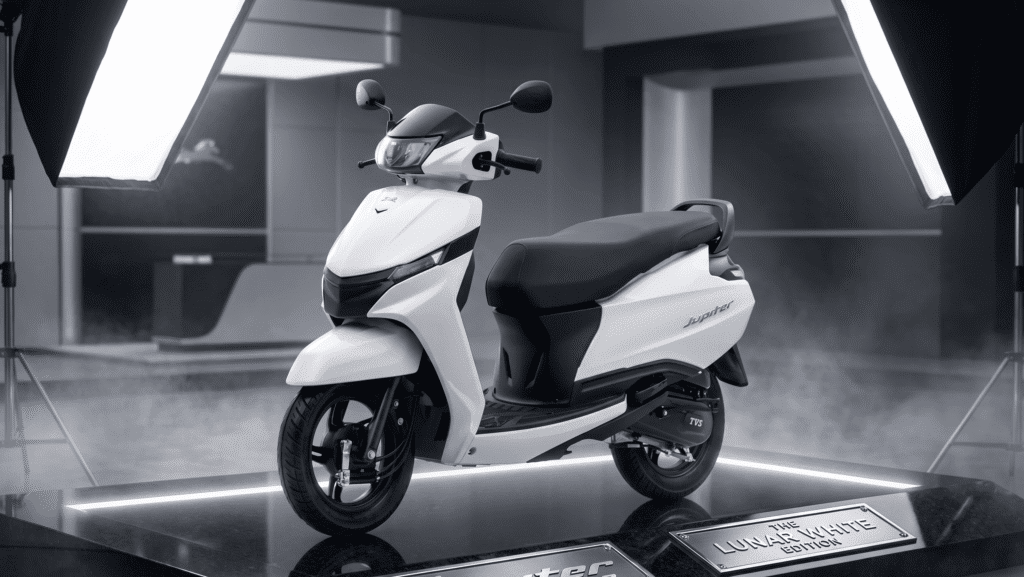
Lunar White Gloss
Glossy Premium
Clean, timeless family look; hides minor dust exceptionally well.
Base Drum, Drum Alloy
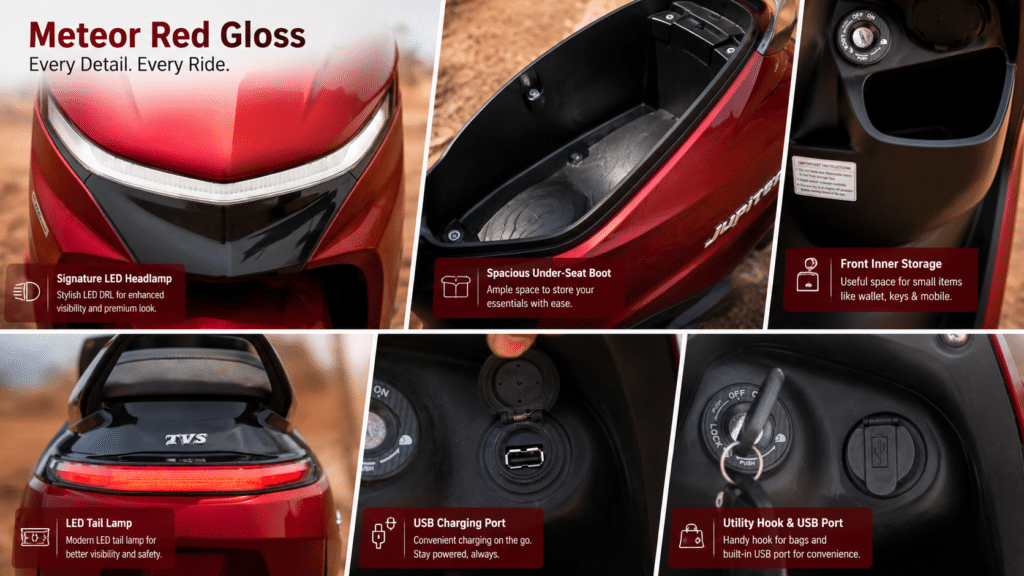
Meteor Red Gloss
Glossy Vibrant
Energetic, highly visible in heavy city traffic; pop-out aesthetic.
Stealth-focused; matched with bronze badges and blacked-out trims.
Special Edition (Top Tier)
Fuel Efficiency: Real-World Mileage vs Claimed Promises
In the 110cc commuter space, mileage isn’t just a specification—it is a religion. The new 113.3cc fuel-injected engine comes with an official ARAI-tested claimed mileage of 53.84 km/l.
However, factory-tested figures rarely mimic the reality of chaotic Indian city traffic. In actual real-world testing conditions, the numbers split into two clear narratives:
City Commuting (Stop-and-Go Traffic): Expect a highly realistic 45 to 48 km/l. This is where the mild-hybrid iGO Assist technology shines. By providing a brief electric torque boost during initial acceleration and cutting off the engine at long red lights via its start-stop system, it stops fuel from being needlessly burned while idling.
Highway or Open Ring-Roads: If you maintain a steady cruising speed between 45–55 km/h in the ‘Eco’ zone display, the Jupiter easily stretches its efficiency to a rewarding 52 to 55 km/l.
With its relocated 5.1-litre fuel tank, a single tank-up will grant you a highly predictable real-world range of approximately 230 to 250 kilometers before you need to scan the horizon for a petrol pump.
The sheer choice of five variants can create a paradox of choice. Let’s streamline the decision-making process based on target buyers:
If your primary requirement is a no-nonsense, rugged machine for localized errands or a secondary household vehicle, the base Drum (₹73,550) handles the job flawlessly. It retains the durable MetalMAXX steel body panels on vulnerable areas. However, we highly recommend upgrading to the Drum Alloy (₹79,025). The extra premium is entirely justified because alloy wheels mean simpler maintenance and instant compatibility with tubeless tires, preventing you from getting stranded during a sudden puncture.
The Sweet Spot: SmartXonnect Drum (SXC)
At ₹83,175, this is where the new-age Jupiter truly comes alive. This variant is the threshold for getting the premium Signature Infinity LED light bar, the fully digital instrument panel with turn-by-turn navigation, and most importantly, the micro-hybrid iGO Assist mechanism. If you enjoy modern tech on a budget, this is your pick.
The Motormitra Choice: SmartXonnect Disc (SXC)
For anyone planning to use the Jupiter as their primary daily commuter on bustling main roads, the Disc variant (₹85,775) is the safest and most logical choice. Traditional drum brakes can lose their bite during heavy rain or under emergency braking conditions. The addition of the 220mm front disc brake drastically cuts down stopping distances and injects a level of lever feedback that drum brakes simply cannot replicate.
TVS has structured the Jupiter 110 ecosystem with surgical precision. By pricing the entry-level variants low, they successfully guard their territory against budget commuters. Simultaneously, by loading the upper-tier SmartXonnect trims with micro-hybrid hardware and tech interfaces, they offer an uncompromised ownership experience that justifies every single rupee spent.