
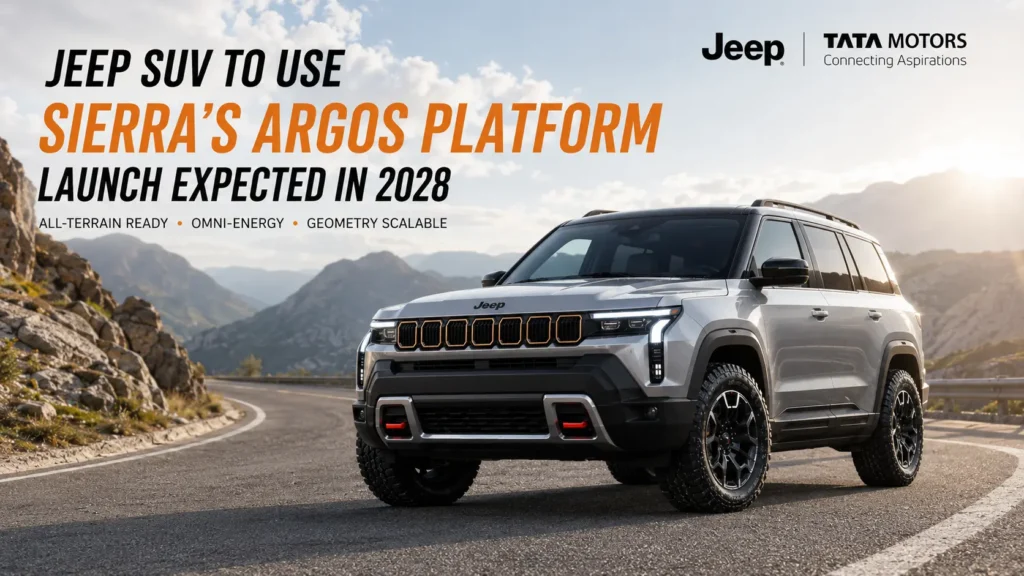
In an industry-defining move that few could have predicted a decade ago, global automotive conglomerate Stellantis is partnering with India’s Tata Motors for its upcoming product pipeline. In a massive vote of confidence for Indian engineering, Stellantis has officially chosen Tata Motors’ brand-new ARGOS platform to underpin its next-gen global Jeep SUV.
This upcoming Made-in-India Jeep SUV, which is slated for a commercial launch in 2028, marks a historic paradigm shift in cross-company platform sharing. Instead of relying on its own European or American architectures, the American off-roading icon will inherit pure Tata DNA under the hood, significantly deepening the industrial synergy between the two legacy brands.
The ARGOS Architecture: Why Jeep Chose It
The ARGOS architecture is the exact same foundational platform that underpins Tata Motors’ highly anticipated flagship, the Tata Sierra. Developed as a highly versatile, future-proof blueprint, the platform’s versatility is exactly what caught the eye of Stellantis engineers.
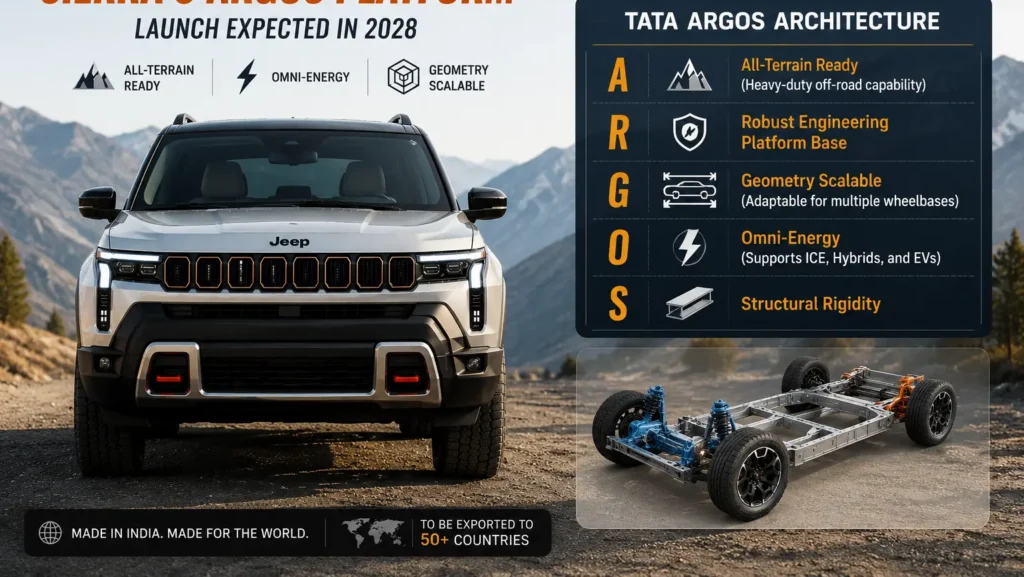
As detailed by the manufacturer, the ARGOS acronym highlights three distinct pillars that make it a formidable platform for a global vehicle:
- All-Terrain Ready: Engineered to tackle extreme trail conditions with optimized break-over, approach, and departure angles.
- Omni-Energy: Exceptionally adaptable, the platform natively supports conventional internal combustion engines (petrol), complex strong-hybrids, and full battery-electric (EV) powertrains.
- Geometry Scalable: The architecture can be stretched or widened seamlessly, allowing it to house various body styles and cabin configurations without compromising structural integrity.
For Jeep, a brand whose global identity is anchored by rugged capability, the most crucial selling point of the ARGOS platform was its native support for All-Wheel Drive (AWD) systems. Jeep treats off-road traction control as a strict, non-negotiable parameter for any car bearing its seven-slot grille, and Tata’s new platform delivered exactly what was required.
The alliance isn’t just about sharing blueprints; it is a full-scale manufacturing strategy. The upcoming ARGOS-based Jeep SUV is expected to be completely developed and manufactured locally within India.
Once the production lines achieve optimal efficiency, India will serve as the exclusive global hub for this model. Stellantis plans to export the SUV to more than 50 countries worldwide, establishing Indian automotive manufacturing as a benchmark for international markets. This strategic integration heavily reduces production overheads for Stellantis while giving Tata’s component suppliers an unprecedented scale of global business.
Aesthetic Alignment: Classic Jeep Cues on Tata Bones
The upcoming SUV beautifully merges classic American utility with modern urban design language. Despite sharing a flat floor, suspension mountings, and electronic modules with the Tata Sierra, the vehicle is visually a purebred Jeep.

The front fascia proudly retains the legendary boxy silhouette, featuring a sleek, updated interpretation of the iconic 7-slot front grille flanked by sharp, modern LED headlamp signatures. Chunky black body cladding, squared-off wheel arches housing off-road spec tires, and prominent front tow hooks confirm that its off-road pedigree remains entirely intact despite its domestic platform roots.
Market Impact
The Stellantis-Tata partnership for the 2028 Jeep SUV is an industry shockwave. Historically, Indian manufacturers looked toward Western conglomerates for platform technology. By flipping this dynamic on its head, Tata Motors has proven that its domestic research, development, and engineering capabilities are now officially world-class.
For Jeep, this move provides an affordable, highly scalable, and structurally rigid platform to battle aggressive competition from local heavyweights like Mahindra and luxury premium crossovers alike. By leveraging a platform that is already optimized for Indian cost structures and global export standards, Jeep might finally unlock the mass-market volume code that has eluded it in emerging markets. The year 2028 cannot come soon enough.